Sacré-Cœur: From the Roman Shadow Blooms the Fleur-de-Lis
The History of Catholic France through the Eyes of a Pilgrim-Part I

Long before the soaring spires of Notre-Dame graced the skyline, the city of Paris was a Roman outpost known as Lutetia Parisiorum —a place of incense-filled temples dedicated to the Roman Gods Jupiter and Mars. But in the mid-third century, a small band of missionaries, led by a man named Denis, carried a message that the Roman Empire found dangerous: a single God who championed the poor and promised eternal life.
On the slopes of the hill now called Montmartre, the ‘Mountain of Martyrs,’ the clash of these religions reached a bloody crescendo. By beheading these Christians, the Roman executioners believed that they would vanquish this new cult forever. Instead, they watered the soil of Gaul with the blood of martyrs, planting the seeds of what would become the most enduring Catholic identity in the world.
Last year, our parish offered a pilgrimage to Western France to celebrate the 10th anniversary of our pastor’s ordination. Now an American citizen, our Canon Commins wished to lead us back to the landscapes of his youth—the region that nurtured his vocation and shaped him. Guided by a wonderful and skillful tour operator (Sacred Heart Tours), we traversed centuries of heritage, from the dawn of French Christianity to the modern era. This series of articles tells the story of the ‘Eldest Daughter of the Church,’ seen through the lens of the holy sites we visited that define our shared Catholic faith.
Our story begins atop Montmartre, a limestone and gypsum butte that rises dramatically above the flat Parisian landscape. Once famous for its natural springs, the Romans dedicated this hill to their gods—yet those same waters served a higher purpose for the early Christians, providing the essential source for baptism by immersion. Today, this ancient ground is crowned by the Basilica of Sacré-Cœur. More than just a landmark, this hill stands as a silent witness to the centuries, embodying within its white stone the very soul and much of the story of Catholic France.
St. Denis (3rd Century)
In the 250s AD, Saint Denis (later the first Bishop of Paris) arrived to convert the Gallo-Romans as part of the northernmost campaign of seven groups sent by the pope (the “Seven Apostles to the Gauls”) to convert this region of the Roman Empire from its paganism.

The cost of planting these seeds of faith was high, as the Roman governors eventually met the missionaries’ zeal with the sword. Denis and his companions were beheaded on the slopes of the mount about half way to the summit. Legend tells of Denis carrying his head to his burial site, becoming the foundational miracle for local Christians. A small chapel was built, dedicated to him and his companions the priest Rusticus and the deacon Eleutherius, who were also martyred with him. The number seven is deeply symbolic in Catholicism, representing completion and the Holy Spirit, among other things. Thus the works of seven bands of men suggested that the Christianization of France was a “perfect” and divinely ordained act.
Saint Genevieve’s Intervention (5th Century)
The importance of Montmartre might have faded if not for St. Genevieve, the patron saint of Paris. Around 475 AD, Genevieve became distressed by the dilapidated state of the hilltop chapel and persuaded the people of Paris to build a more substantial stone church. She also made it more accessible by improving the pilgrimage path (the Processional Way) from the center of the city up to the summit. Because of her efforts, the “Mount of Mars” was permanently renamed Mons Martyrum (Mount of Martyrs), which eventually became the French word Montmartre.

The Merovingian “City of the Dead” (6th – 8th Century)
A church was constructed on the summit dedicated to Saint Peter (Saint-Pierre) by the 7th century, a small parish church serving the local villagers, farmers, and vineyard workers. The deposits of gypsum found within the Mount also proved a valuable resource that could be mined. During the succeeding Frankish era, there was great demand among Christians to be buried near these early martyrs. Many crypts were added, making it a massive Christian cemetery. The abundance of hollowed out areas from the gypsum mining made this a much easier endeavor to repurpose the abandoned mines. The lower Martyrs burial areas and the upper St. Peter chapel both became recognized as shrines.
The Viking Raids and Defensive Retreat (9th-12th Century)

In the 800s, Paris was repeatedly besieged by Vikings. Because of its commanding geography, the heights of Montmartre were used as a lookout point to spot Viking longships coming down the River Seine. During this period, the constant raids made the outskirts of the city dangerous. Many of the small shrines and cemetery structures on the hill fell into ruin as the population retreated behind the walls of the city center for safety.
The Vikings would often be paid tribute to leave but eventually France’s forces began to resist them. In the early 900s, King Charles the Simple made a deal with the Viking chieftain Rollo, granting land around the mouth of the Seine that would become known as Normandy (“Land of the “Norsemen”).

In exchange, Rollo had to convert to Christianity, swear fealty to the King and prevent other Viking attacks on Paris. This began the conversion of Christianity among the Norman peoples.
After the region was secured from invasion, a Benedictine abbey was constructed in 1133 by the royal sponsors King Louis VI (the Fat) and Queen Adélaïde de Maurienne. When the Abbey was built, the builders recycled four Roman marble columns—likely from the original Temple of Mars—into the structure of Saint-Pierre. Under royal protection and patronage, Montmartre became a major center of Benedictine monastic life and a place where new spiritual fruit was born, most notably producing great musical chants and highly ornate vestments for royal coronations.
As an important burial site, it was a major center for suffrages (prayers for the dead). Because so many French royals and nobles were patrons of the Abbey, the nuns spent much of their day chanting the daily liturgy for the souls of their donors.

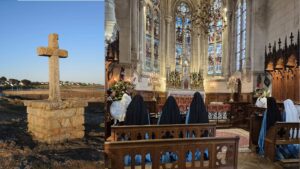
As an aristocratic abbey, many of the nuns were there for political or family reasons rather than mystical ones. Thus there was a greater emphasis on the arts than the some abbeys known more for spirituality. Upon being widowed, the Queen took the veil and became a nun and unofficially given Venerable title, and is perhaps recognized as one of the most devout of all the abbeys occupants. She died after overseeing the construction of the new Church of Saint-Pierre built for them in 1147, one of the oldest churches in Paris still standing today (seen above).
The Birth of the Jesuits (16th Century)
In 1534, while the Benedictine nuns were still the “landladies” of the hill, a pivotal moment in global Catholic history occurred in a quiet, underground chapel on the slopes of Montmartre. This event would launch the Catholic Counter-Reformation and create the Jesuit Order.
On August 15 (the Feast of the Assumption), a middle-aged Spanish soldier-turned-student named Ignatius of Loyola led six companions to the, the small, semi-subterranean chapel marking the spot where Saint Denis was believed to have been beheaded. In that small, candlelit space, the seven men took solemn vows of poverty, chastity, and obedience. Most importantly, they vowed to travel to Jerusalem to convert the “infidels,” or, if that was impossible, to put themselves at the absolute disposal of the Pope and become martyrs if needed. In a poetic echo of history, there were exactly seven original Jesuits—mirroring the “Seven Apostles of the Gauls” who had arrived in France 1,300 years.
This moment is considered the founding of the Society of Jesus. They would go on to founding universities and missions from South America to Japan. This single event produced a trio of important saints: St. Ignatius of Loyola, St. Francis Xavier, and St. Peter Faber.

The crypt would later be destroyed by revolutionaries eager to erase any physical traces of the “superstitious” cult of martyrs. In the mid-1800s, the priest and historian Father Étienne Caffre led an effort to reclaim the site and rebuilt a chapel in 1887 on the ruins of the foundation. It is managed by a private religious association (the Société de Saint-Denis), and only open to the public on specific days.
The Golden Age and the Revolution (17th -18th Century)
The Abbey continue to prosper, turning Montmartre into a refined, spiritual citadel. However, it also made the hill a target. Because it was so wealthy and so closely tied to the Kings of France, the Abbey would eventually be one of the first things the French Revolutionaries sought to destroy in 1790.
At the turn of the Revolution, the Benedictine nuns, who had held the hill for over 600 years, were forced to flee. However, the 71 year old Abbess who was blind and deaf was captured, accused of “conspiring with the enemies of the Republic” and guillotined in 1794. The abbey buildings were stripped and demolished with the ancient Church of St. Pierre being spared and converted to secular building reflecting the new atheistic revolutionary enlightenment.
In the early 1800s, under Republic control, excessive gypsum mining and winemaking continued, scarring the Mount’s beauty. The world famous gypsum would become known by its familiar name, “Plaster of Paris.” The village at the summit began to decline and became a refuge for the poor and radical people.

In 1871, the ‘Eldest Daughter of the Church’ was brought to her knees. Following a humiliating defeat in the Franco-Prussian War, Germany eclipsed France as Europe’s dominant power—a shift many Catholics interpreted as divine chastisement for the nation’s post-Revolutionary secularism. This sense of loss was compounded by the Semaine Sanglante, the ‘Bloody Week’ of the Paris Commune, which saw its first sparks of violence on the slopes of Montmartre. When a radical mob executed two French generals on this very hill, it left a profound moral wound on the city’s soul. At that time, Montmartre was not a place of prayer, but a site of smoldering cannons and barricades, echoing with the sounds of civil strife rather than church bells.
The side altar in the Chapel of the Armies was designed to stand directly in the gap of this trauma. The sculpture depicts a soldier in the mobile guard uniform, being received into the arms of the Virgin Mary. By placing the Infant Jesus in the scene, the artist reminds the viewer that even in the cold isolation of the battlefield, no soldier dies alone.
France’s “National Vow”
This imagery was a radical departure from traditional war monuments that celebrated victory and conquest; instead, it offered a broken nation a visual language for its grief. It suggested that the true strength of France lay not in its military might, which had failed, but in a spiritual resilience that could find hope even in defeat.
In the wake of this chaos, two Catholic laymen, Alexandre Legentil and Hubert Rohault de Fleury, swore a “National Vow.” They argued that France’s misfortunes were the result of a spiritual crisis that could be redeemed. They proposed building a church dedicated to the Sacred Heart of Jesus to ask for God’s forgiveness and protection.

This imagery was a radical departure from traditional war monuments that celebrated victory and conquest; instead, it offered a broken nation a visual language for its grief. It suggested that the true strength of France lay not in its military might, which had failed, but in a spiritual resilience that could find hope even in defeat.
In the wake of this chaos, two Catholic laymen, Alexandre Legentil and Hubert Rohault de Fleury, swore a “National Vow.” They argued that France’s misfortunes were the result of a spiritual crisis that could be redeemed. They proposed building a church dedicated to the Sacred Heart of Jesus to ask for God’s forgiveness and protection.
The National Vow & Basilica Construction (19th Century)
In 1873, the National Assembly of France, then dominated by conservatives, passed a law declaring the construction of the Basilica a matter of “Public Utility.” The traditional Gothic style (like Notre-Dame) was rejected in a favor of a Romano-Byzantine design. With its multiple domes and rounded arches, it was intended to reference churches of the East or the Mediterranean, signaling a broader Catholic identity rather than a nationalistic French identity. The architectural brilliance of the Basilica lies in its choice of material: the Château-Landon stone, a rare travertine quarried from the southern Seine-et-Marne region, a three to four day trip for a team of horses.
This stone was selected specifically for its high concentration of calcite, which reacts with rainwater, providing a self-cleaning effect. This allows the monument to stay a bone-white symbol of purity, standing in stark, defiant contrast to the City of Paris below. While the capital’s streets were historically stained grey with industrial soot and the ‘moral decay’ of its revolutionary history, the Basilica remains pristine, refusing to let the grime of the world beneath it dim its glow.
Thus, as the more the storms of the world beat against it, the more brilliantly white the sanctuary becomes—a perfect architectural metaphor for the soul of France’s purification through the National Vow.
In 1875, the first stone was laid and the massive underground foundations built within the unstable mines below were completed in 1881 and surface building began. The project was funded by millions of small donations from citizens across France. People “bought” individual stones, and their names are often carved into the walls of the crypt.
Construction was controversial and the roughly 2/3 leftist governmental majority generally opposed it. However, it weathered numerous votes to kill the project based on technicalities or other providential circumstances.

St. Margaret Mary Alacoque
The Basilica would be dedicated based on the theology of the Sacred Heart of Jesus promoted by St. Margaret Mary Alacoque in the late 1600s and beginning to take deep root in French spirituality at that time.

St. Margaret Mary Alacoque serves as the spiritual bridge between the ancient martyrs of Montmartre and the modern Basilica. In her 17th-century visions, Jesus promised that her mission would be championed by a ‘faithful servant and perfect friend’—the Jesuit priest Saint Claude de la Colombière. This partnership between a cloistered nun and a world-traveling Jesuit ignited a global devotion.
Most significantly for France, Margaret Mary recorded a startling request in 1689: a divine appeal for King Louis XIV to consecrate the nation and build a ‘temple’ in honor of the Sacred Heart. However, the king never fulfilled the request, and the promise sat dormant through centuries of revolution and war. It was only after the national trauma of the 1870s that the people of France finally answered this call, raising the white domes of Sacré-Cœur as a ‘belated gift’ to the saint. Today, her presence reminds us of a promise kept across three centuries, linking a humble nun’s vision to a nation’s public prayer.
St. Thérèse of Lisieux
In 1887, a certain Thérèse of Lisieux would visit the Basilica as a young girl and be deeply moved by this “National Vow.” At age 14, Thérèse visited Sacré-Cœur with her father and sister while on their way to Rome to ask the Pope for permission to enter the Carmelites. She later donated her own gold bracelet to be melted down to help create the massive, ornate monstrance used for the Perpetual Adoration noted later in this article.


While the building was structurally finished in 1914, the outbreak of World War I delayed its formal consecration until 1919.
As part of the National Vow, one of the principal acts of reparation would be the establishment of Perpetual Adoration, a remarkable tradition that has remained uninterrupted since it began in 1885. Even during the heavy bombing of Paris in World War II, volunteers stayed inside to ensure that the prayer never stopped. On the night of April 20-21, 1944, Allied bombs fell on the neighborhood of Montmartre, shattering the stained glass windows and hitting the rear of the Basilica. Despite the explosions and the danger of the roof collapsing, the people praying at the altar refused to leave. They simply moved closer to the pillars and continued their vigil until the sun came up.
The Golden Monstrance at the center of this adoration is a masterpiece of goldsmithing. It is nearly one meter tall and made of precious metals donated by the people of France.

The Great Mosaic Dome
Completed in 1923, the main sanctuary dome features one of the world’s largest mosaics, the Christ in Majesty is the largest mosaic in France, covering roughly 5,112 square feet. It serves as a visual climax to the ascent, where the rugged penance of the exterior steps gives way to the golden, eternal embrace of the apse, bringing the ‘National Vow’ into a timeless, heavenly light.
The mosaic was created using Smalti, a special glass tile that are angled slightly so that they catch the light from below, making the figure of Christ appear to “glow” differently at different times of the day.
On the Left representing the Universal Church you see the Virgin Mary, Saint Michael (the protector of France), and Pope Leo XIII offering a globe of the world to Christ. Behind them are representatives of the five continents in traditional dress. On the Right representing the Nation of France, Saint Joan of Arc kneels, offering her sword to Jesus. Beside her is a figure representing France personified, offering her royal crown as a sign of national surrender to God. The additional attendant saints include the patrons Denis, Genevieve and Louis IX. A curious detail often pointed out by guides is a solitary figure on the far right who is looking away from Jesus, leaning against a pillar. Some interpret this as the “Tourist” or the “Skeptic”—a reminder that even in the presence of the divine, some choose not to look.

The Innen Chapel
The Innen Chapelle de Sainte-Marie Kapelle is named from a curious fusion of French and German. In French, it is the Chapelle d’Axe (the Axis Chapel), located at the apex of the church’s sanctuary, the most sacred point after the main altar. It sits directly above the deepest support pillars that hold the Basilica to the bedrock. Following the Franco-Prussian War, many German-speaking Catholics made “penitential pilgrimages” to this specific altar to pray for peace between the two nations.


Also known as the Lady Chapel, here the ‘Eldest Daughter’ honors her Mother. Here, the mosaic details depict Mary as Mother and Queen of France. This chapel serves as the hill’s theological anchor; if the Sacred Heart is the pilgrim’s destination, Mary is portrayed as the steady guide who has watched over France since its conversion.
The Penitential Path
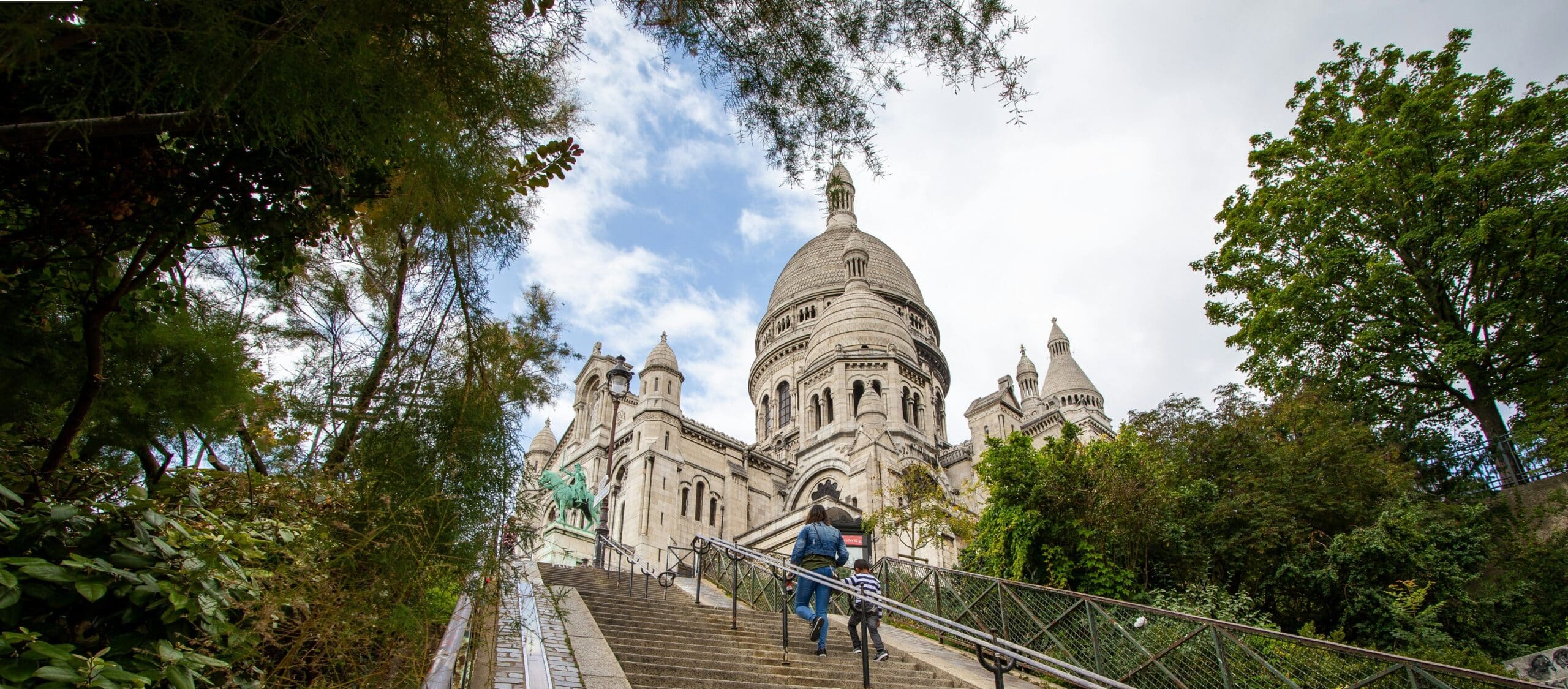
The stairs are laid out in a symmetrical, neo-Renaissance pattern that forces the visitor’s eye upward toward the central dome of the Sacré-Cœur, forming a sort of grand pedestal.
The Rue Foyatier, the primary staircase, mimics the “ascent to the mountain” found in biblical narratives. There are roughly 222 steps in the central climb, though the winding paths offer a gentler alternative for those who cannot handle the direct ascent. While there is no documented reason for that number of steps, in Catholic numerology, 222 is sometimes linked to Acts 2:22, which speaks of the “mighty deeds, wonders, and signs” performed by Jesus Christ—a fitting theme for a site dedicated to the Sacred Heart.

For pilgrims, the act of climbing the stairs is considered a “physical prayer” or an act of penance. The stairs are made of the same durable stone as the Basilica’s foundations to withstand the constant friction of millions of feet and the harsh weather at the summit.

At the front of the observation deck above the main flight of steps are fountains serving more than just decoration– they were part of a massive civil engineering project designed to stabilize the hollowed out mines. Notice the massive “scallop shell” carvings inside the arches. In Christian art, the shell is a symbol of pilgrimage and rebirth, perfectly fitting for a path that leads up to a site of penance. However, some design cues inspired by the ancient Roman grottoes dedicated to water nymphs were incorporated to reference the hill’s pagan history.

The Two Patrons
At the main entrance , the mounted statues represent the country’s two great patrons, Louis the XIV and Joan of Arc.
They are positioned high on the portico to represent the two pillars of French identity: the Monarchy and the Peasantry, united in faith. Saint Louis IX on the left is not shown with a scepter of power, but rather holding the recovered Crown of Thorns. He is depicted in 13th-century armor, appearing as a crusader-king who has returned to protect the city.

On the right, the “Maid of Orleans” St. Joan of Arc represents the common people and the miraculous survival of France. Unlike Louis, Joan holds a sword but it is held in a way that suggests she is pointing toward heaven, rather than attacking. The oxidation of the copper has turned them a pale green, an intentional choice by the architect to adds depth and “life” to the largely monotone façade. Louis represents the aristocracy and Joan the poor, signaling that inside the church, all social classes of France are equal.
Jesus and Mary
When you tour the sanctuary and side altars, you are struck by two striking metallic statues of Our Lady and Jesus. In the dim light of the chapel, the silver reflects the hundreds of votive candles, making the statue appear to glow. The architects chose these unique silver finishes to ensure that the statues remained visible in the massive, dark nave. Unlike the exterior stone that weathers, the silver is meant to represent the incorruptible and eternal. Because of the Perpetual Adoration, the interior is meticulously cleaned and silver is polished regularly to ensure a heavenly effect.


St. Rita
While St. Louis and Joan of Arc outside represent the glory of France, St. Rita represents the struggles of the individuals who visit. Thousands of visitors come to Montmartre not just for the view, but because they are facing impossible life situations. The Basilica provides a dedicated space for them to seek her intercession. St. Rita’s own life story made her a powerful symbol for addressing sexual morality and domestic struggles. She spent eighteen years married to a violent, unfaithful, and ill-tempered man. Through her patience and prayer, her husband eventually converted and repented before his death. Because of this, the Church recognized her as a patron of women in impossible or abusive relationships, and by extension, to those trapped in the trade of prostitution in Paris, offering a path of redemption. Such notorious places of debauchery include the famed Moulin Rouge district located at the foot of the Mount.

St. Louis IX
A side chapel is dedicated to St. Louis IX, who is intentionally de-emphasized as there is no prominent statue of him here. Louis IX’s greatest legacy to Paris was the recovery of the Crown of Thorns from Constantinople. Putting a giant statue of a King inside a “National” church would have been seen as a provocative political statement as France was deeply divided between Republicans (who wanted no King) and Monarchists. By keeping St. Louis in a carving on a smaller in scale, the Church avoided referencing him as a greater political symbol for the Monarchists.

The white marble relief carving on the altar depicts the famous 1239 procession where King Louis IX brought the recovered Crown of Thorns, to eventually be housed in Paris, first at Sainte Chapelle and later Notre Dame of Paris. Here, the roles are remarkably reversed: The King is the Giver: He brings the spiritual treasure. The Church is the Receiver: It guards the treasure. This fits the “National Penance” theme of Sacré-Cœur: the secular power (the King) humbles himself before the divine power (the Crown of Thorns). If you look closely you can see that he is barefoot, reflecting the penitential nature of the act.
Today, Sacré-Cœur is the second most visited religious site in Paris (after Notre-Dame), serving as a beacon of both French piety and the city’s tumultuous history. The contrast between the “Bohemian” Montmartre aside it and below (the bars, the cabarets, and the artists) and the “Pious” Basilica above created a tension that defines the unique character of the hill to this day.


Resources and Further Reading
Official & Historical Sites
- The Basilica of the Sacré-Cœur de Montmartre (Official Website): The primary source for the history of the perpetual adoration and the architectural timeline of the “National Vow.”
- The Musée de Montmartre: Located just minutes from the Basilica, this museum tells of the more secular aspects of local history including notable artists, the Paris Commune, the ancient gardens and vineyards, and the Cabaret culture that defined Parisian nightlife.
- The Institute of Christ the King Sovereign Priest (Official Site): Explore the charism and international apostolates of the Institute.
Architectural & Spiritual Deep-Dives
- “The Sacré-Cœur of Montmartre: Spiritual and Political History” by Raymond Jonas: (amazon link) A definitive work on why the Basilica was built, exploring the tension between the “Salt” of the Paris Commune and the “Silk” of the Catholic recovery.
- Notre-Dame de Paris Cathedral and Saint-Chapelle: To understand the journey of the Crown of Thorns mentioned in the Saint Louis Chapel, explore the history of these “sister” landmarks of the French Catholic faith.