Salt and Silk: A Tale of Two Abbeys
The History of Catholic France through the Eyes of a Pilgrim-Part II

“It was the best of times. It was the worst of times…”
Charles Dickens penned those words to capture the convulsive heart of the French Revolution—a time when the head of the ‘Eldest Daughter of the Church’ was nearly severed by the guillotine. Yet, for the modern pilgrim, these words are more than a literary echo; they are the two bookends of the French Catholic soul.
When my parish, St. Joseph Shrine (Institute of Christ the King), embarked on a pilgrimage to France in the summer of 2025, we traveled with our French priest to his homeland in search of that soul. I expected to return with a portfolio of photographs and a storehouse of memories. More importantly I sought a deepening of my faith by being enriched with a greater appreciation of Her history and why France earned her royal title as “the Eldest Daughter.” My hope was to learn more of that faith that survived the storm and flourished in the vale– and to bring those lessons home, to inspire those who could not walk those hallowed grounds with us.
The Pilgrimage Begins
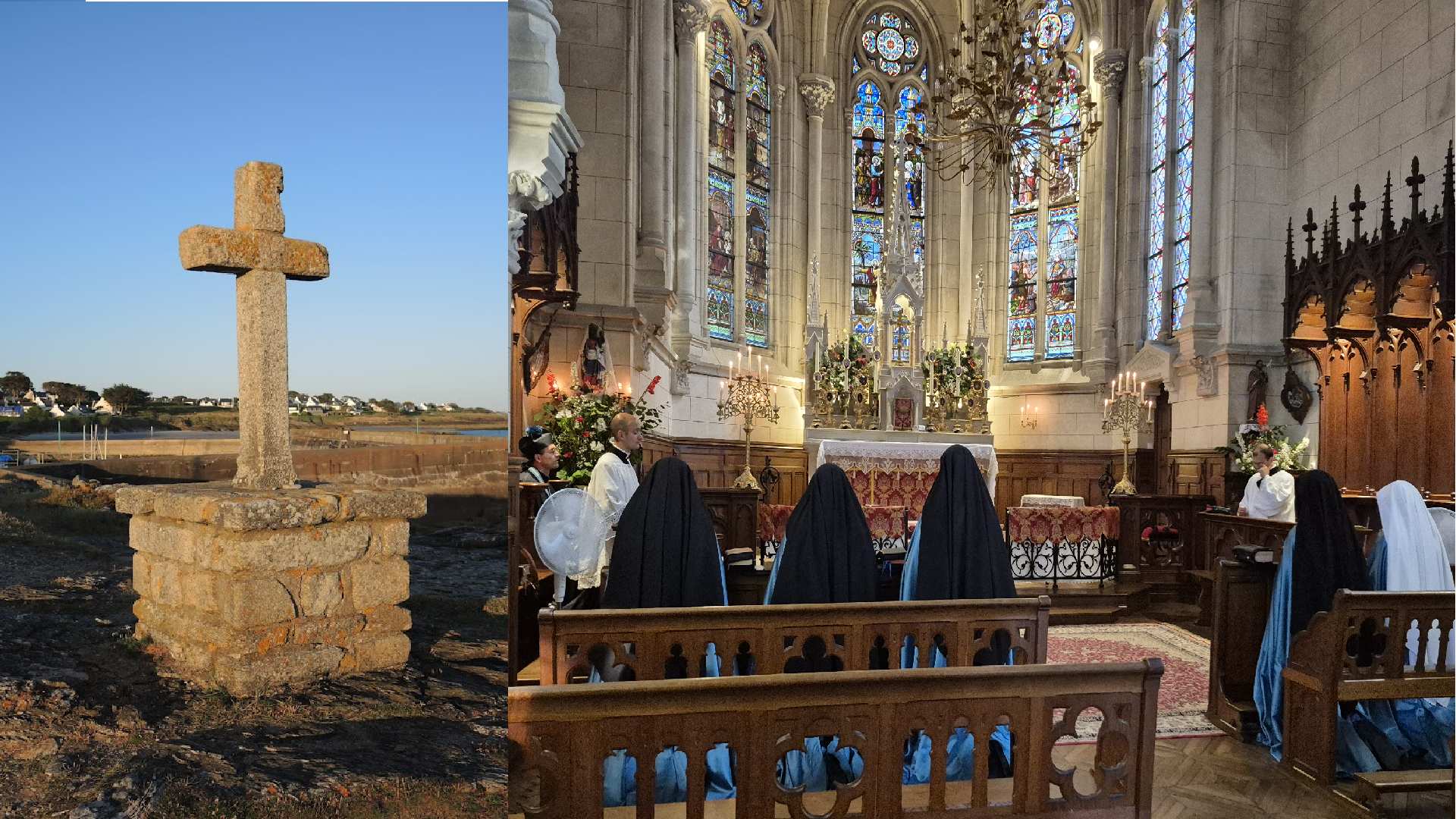
Our pilgrimage to western and northern France began and ended with two stays at two very different abbeys. We began our pilgrimage at the edge of the Atlantic and ended it in a hidden forest near Paris, discovering that the story of Catholic France can be likened to a Tale of the Two Abbeys where we stayed. We spent our first night at St. Gildas-de-Rhuys, a granite sentinel perched on the wind-whipped cliffs of Brittany. This was an image of France’s Frontier of Salt—a site built of rugged stone to survive both the elements and the threat of Viking invasion. Sleeping within those ancient Romanesque stones and walking the weathered stone shores, one could feel the grit of a faith that survived by sheer endurance. Here, the story is one of rugged hospitality, where the Sisters have turned a great medieval bastion into a welcoming retreat center.

The course of travel for our nine day pilgrimage along the west coast eventually pulled us away from the salt spray of the Atlantic and into the deep, wooded silence of the countryside northeast of Paris. We spent our final nights at the Abbey of the Sister Adorers at Ver-sur-Launette (formerly The Abbey of Notre-Dame du Lys), also named St. Sulpice-du-Désert for its patron (a map at the front would advise us of its other past formal name of the estate: Domaine de Saint Sulpice la Ramee). I would liken this to France’s Frontier of Silk—a place where the faith didn’t just survive; it put back on its royal robes. While one place survived the Vikings; the other survived the Revolution. Together, these contrasting sanctuaries are living symbols of the enduring and evolving spirit of modern day Catholic France.


These two resting places scheduled by the Sacred Heart Tours ended up providentially framing the earliest and final chapters of the French Monastic story. The contrast was startling. The Abbey of St. Gildas-de-Rhuys in Brittany reflected the ancient, rugged root of the “Eldest Daughter,” while the Sister Adorers at Lys represented the sophisticated, royal flowering and the restoration of the authentic traditional Catholic faith. By staying at both, we realized that the story of Catholic France is not found in one or the other, but in the tension and contrast between them. As we would learn exploring the history of both sites, one showed us how the faith survived; the other shows us how the faith reigned.
One survived the Vikings; the other survived the Revolution. Together, they tell the story of two places that have seen the best of times and the worst of times.
The Frontier of Salt
The story of these two frontiers begins at our first place of rest: the Abbey of Saint Gildas-de-Rhuys. Named for its founder, Saint Gildas the Wise, the site was born of exile rather than ambition. A Roman-Briton fleeing the wreckage of a collapsing Britain, Gildas did not seek a palace, but an untamed edge of the world. It was a lawless ‘no-man’s-land’ populated by British refugees and remnants of a fallen Empire, a place that had to survive without the patronage of a crown. In approximately 536 A.D., he established his sanctuary upon the jagged cliffs of the Rhuys peninsula—a site already steeped in the ‘Salt’ of ancient conflict.


Long before the monks arrived, this ground had served as a Roman outpost built to surveil the sea against the seafaring Veneti Celts. Indeed, the waters of the nearby bay once churned with one of the greatest naval battles of Julius Caesar’s Gallic Wars. Upon these pagan Gallo-Roman ruins, Gildas found his home. Here, his rule would be defined by a rugged asceticism—a struggle of man against his own nature that was perfectly mirrored by the harsh, windswept frontier he claimed for God.
Gildas wasn’t just a monk; he was a scholar with a fire-and-brimstone edge to him. He would become famous for writing the historical treatise De Excidio et Conquestu Britanniae (“On the Ruin and Conquest of Britain”), foreshadowing the same fate that would later follow northern France. He wrote a scathing critique of the kings and clergy of his time, blaming their immorality for the collapse of Britain to the Anglo-Saxons, later echoed in the history of France. For this, he would later become the patron saint of historians.
In 570, Gildas knew he was dying. True to his character as an exile, requested that his body be placed in a boat and set adrift in the bay, letting God decide his resting place. Three months later, on the feast of Pentecost, a group of monks walking the shore found the boat wedged between the rocks near the abbey. His body reportedly was incorrupt, emitting a “sweet fragrance” (the “Odor of Sanctity”).
The monks of Gildas would continue to practice a gritty Celtic Monasticism that was hermit-focused, nomadic, and fiercely independent. However, as the more stable and communal Benedictines spread their charisms westward from the Italy, the monks would eventually adopt the less salty (the more refined and disciplined) Rule of Saint Benedict in 818 A.D.
The story of St. Gildas was not only be known for the founding prophet but also the intellectual rebel Abelard. Abelard was a 12th-century Parisian intellectual who found this same ruggedness “barbaric.” The very walls that Gildas built to keep the world out, Abelard felt were a prison keeping him in. As an abbot in exile, he called the monks “wild and lawless” and actually feared they could kill him. One account suggests they tried to poison and strangle him. Eventually he would flee the monks to reside outside of France near where the Abbey of the Lys would later be built. As a man of silk rather than salt, he would have felt much more at home at our second stop at Lys.
When Salt Meets Steel
Centuries later, the monks of Rhuys would spot “dragon ships” on the horizon. The Vikings—the “Northmen” who would eventually give their name to Normandy—had discovered that the abbeys along the Breton coast were easy targets. The first Viking raids on the oceanic coastline began as small seasonal “hit and run” attacks. During the early raids (roughly 830–850 A.D.), some of the vulnerable wood structures were burned to the ground. The monks would persevere, returning after the ships left and rebuild. They began to realize that the wood of their buildings was too vulnerable and began to fortify their outpost by building with stone. But the Vikings attacks persisted and finally in 919 A.D., the Vikings managed to overrun the fortified stone walls, sacking and desecrating the monastery. The monks fled hundreds of miles inland to Bourges, with their precious relics, including his remains. For the next 100 years, the Abbey of St. Gildas-de-Rhuys existed only as a memory and a collection of bones exiled in a foreign city as the Vikings conquered and settled the coastal region of Brittany. The Vikings would eventually be repelled by local resistance and the monks would return in 1008 AD to the ruins.
Three Saints and the Turning of the Tide
The Frontier of Salt would be recrystallized by three men who would later be saints: Felix, Rioc and Goustan. The structural vision fell to St. Felix, the iron-willed abbot who transformed the Viking ruins into a granite bastion, trading the flammable wood of the past for a fortress-like permanence. He was aided by St. Rioc, who proved that the exile had not severed the abbey’s ancient roots in a hermit ethic. Finally, the daily labor was fueled by St. Goustan, a simple illiterate man who supposedly memorized the Psalms despite being unable to read, fittingly becoming the patron saint of the sailors and fishermen who still call this coast home.
All three can be found buried in the sanctuary of the main church, resting as living stones beneath the very bedrock they labored to restore, forming the spiritual bedrock of the abbey. This is when they built the massive Romanesque stone church that anchors the current abbey. The 11th-century rebuild wasn’t just a restoration; it was a grand statement made of sturdy stone to ensure that the tragedy of 919 A.D. would never happen again. The thick walls and small simple windows gave the church a fortress-like identity to resist any future invasions. They weren’t just building a church; they were building a message to the sea: “We are back, and we are not leaving again!”
Their tireless cycle prayer would transform the abbey from a mere defensive stronghold to a powerhouse of prayer for all of Brittany.

At about the time the story of the first age of this fortress was closing, a new one was beginning in the fertile heart of France. Our story now moves inland as we did, moving from the salt-stained stone of the survivor to the royal silk of the crown…
The Frontier of Silk–the Best of Times
As we began the final leg of our pilgrimage, we pulled into the deep, emerald shadows of the forest of Dammarie-les-Lys northeast of Paris. We would trade the soothing pulse of waves of the nearby Atlantic for the centuries old, wooded silence of Lys.


If our first night at St. Gildas felt like being quartered in a fortress, our arrival at the lodging in Lys felt like entering a sanctuary. The hard weathered granite had given way to the softer limestone and plaster of the Abbey buildings. As the bus engine cut out and the distant birdsong of the valley took over, we realized we had moved from the Church’s battered armor to its regal adornment.
The story of these hallowed grounds begins in the mid-13th century with Queen Blanche of Castile, the mother of the Saint-King, Louis IX. She didn’t seek a remote cliffside for protection; she sought a sacred valley for prayer. She established the Abbey for Cistercian nuns (the “White Nuns”) in 1244. Unlike the heavy, defensive Romanesque arches of St. Gildas, Lys was a masterpiece of High Gothic design. The walls were no longer thick bunkers; they were comparative veneers of stone. St. Gildas was built to keep the darkness out, but Lys was built to let the Light of God in. The Queen’s abbey with its intricately carved arches and flying buttresses was built for beauty rather than strength, It wasn’t built to fight off Vikings; it was built to reflect the peak of Gothic elegance and the close bond between the Crown and the Cloister. The beauty and delicacy of its mission was reflected in its name: Le Lys (“The Lily”), then becoming Notre-Dame du Lys (Our Lady of the Lily). The lily was a direct nod to the fleur-de-lis, the long-standing emblem of French royalty, symbolizing purity, faith, and sovereignty.
Part of the Abbey’s mission was to become powerhouse of prayer for the safety of the Crown while her son was away on the Crusades. For the first few centuries, the abbey was occupied by Cistercian Nuns representing the peak of medieval monasticism. They lived a life of “Ora et Labora” (Prayer and Work) in total silence, using hand gestures for communication! Because of Queen Blanche’s patronage, the abbesses were almost always women of high nobility. By the 17th century, it would eventually become a small priory for the monks of the Order of Saint Bridget (Brigittains). The term La Ramée in the name [translated as the leafy boughs] replaced the Lily, likely referring to the dense foliage of the forest to emphasize the idea of hiding from the world.
But the same royal favor that had built its soaring Gothic arches would eventually lead to its ruin. As the revolutionary fires began to smolder in Paris, the Abbey’s proximity to the Crown turned it from a sanctuary into a target. The ‘best of times’ had ended. The ‘Silk’ was about to be torn, and the ‘worst of times’ was preparing to march through its gates.
The Frontier of Silk–The Worst of Times
When the revolutionary storms spread from Paris to the countryside in 1789, it did not merely rattle the windows of the Abbey; it shattered the foundation. Because Lys was a ‘Royal’ house, the Revolution saw it as a limb of the monarchy that had to be severed. In a fever of iconoclasm, the bells that had marked the hours of prayer for five centuries were melted into cannonballs, the church treasures looted and the carved stones and intricately designed lead flashings were sold off as common building material. Once a castle of prayer, the abbey became a crude stone quarry of ruins as the Revolutionary government declared the abbey “National Property”. By the time the dust settled, the ‘Silk’ was gone—scattered to the winds of the Republic—leaving behind a martyred landscape of ruin in the woods, For over 200 years, the “occupant” of the Abbey of the Lys was silence.
The Resilient and Medicinal Salt
While the Abbey of the Lys lay in a two-century slumber, the ruggedness of St. Gildas-de-Rhuys persevered. The Revolution had tried to kill the “Salt” here as well—stripping the monks of their land and turning the abbey into a state-owned shell—but the sheer physical mass of the place resisted total destruction. Unlike the royal, secluded Lys, St. Gildas was seen as more populist than royal and it survived based on its worldly utility. When the monks were expelled, the local sailors and fishermen—the spiritual descendants of St. Goustan—could use the buildings of this prestigious and strategic seaside location. The Salt would not entirely dissolve in the sea of revolution.
As the storms of revolution subsided, practices of piety again began to flourish and replace their secular squatters. The Salt was being recrystallized while the Silk remained scattered in the winds of northern France.
Since the early 19th century (post-Revolution), the abbey has been the motherhouse for the Sisters of Charity of St. Louis, who took over abbey and redeveloped much of the existing buildings. For over 150 years, the abbey was a devout place of Gregorian chant and the Latin Mass, but with a more rugged spirituality than Lys due to the local impoverishment and the physical demands. They trained hundreds of sisters to go out from this coastal stronghold into the rugged heart of Brittany, bringing the light of the Gospel to the salt-of-the-earth souls of the rural interior. While their motherhouse stood against the Atlantic spray, their mission was to carry that same granite-hard faith to every village and schoolroom in need of restoration. Their mission would eventually turn inward as they would host a boarding school and orphanage on their grounds. They would also build a clinic and offer thalassotherapy, a form of medicine using sea salt minerals to treat various conditions. A Frontier of Salt indeed!


Leaving behind the weathered rock of the Breton coast, we now find ourselves returning decades earlier to the forest of Dammarie-les-Lys. We find Lys at its lowest ebb—unlike the enduring seaside fortress of stone, it is a ‘desert’ of ruins. It is here, in the wake of the Revolution’s fury, that the unlikely story of Lucien Bonaparte emerges to pick up the scattered threads of a royal past.
The Rebel Prince of Salt and Silk
Lucien Bonaparte, the rebellious and intellectually brilliant younger brother of Napoleon, would purchase the estate of the Abbey of the Lys in 1798. He was the “black sheep” of the Bonaparte family, of royal blood stripped of the silk of his noble status to become a man of salt. He perfectly embodied the contradiction: he was a fierce Republican who nonetheless felt the pull of the royal heritage of his country. The land that would someday be dedicated to the Royal Heart of Jesus was once the private refuge of a man who helped dismantle the very monarchy the Sister Adorers spiritually represent to this day
He was an amateur archeologist who cherished the Gothic ruins of the abbey, preserving the “Silk” of its history while the rest of France was tearing its medieval heritage apart. He redeveloped the grounds, framing the ruins as a “memento mori.” He kept the royal memory of Queen Blanche alive even while being a staunch supporter of the revolutionary Enlightenment.
His stewardship ensured that the Abbey of the Lys remained a place of contemplative beauty, where the echoes of Cistercian chant could still be felt amidst the shifting political winds of the nineteenth century.
His more famous brother Napoleon would write of him:
“Lucien is misconducting himself at Rome… and is more Roman than the Pope himself.”

While his brother Napoleon was busy building an empire of steel and stone, Lucien was at the Lys, tenderly preserving the ‘Silk’ of the grounds within his own private gardens. He became the first guardian of the ruins, ensuring that the light of Queen Blanche’s vision wasn’t entirely extinguished by the revolutionary gale.
The Gathered Silk Threads are Woven
In 1892, the scattered threads of silk were picked up by the benefactress Mademoiselle Drelon, a woman who transformed the abbey’s story from one of secular dormancy into spiritual resurrection. Using her private wealth to buy back this sacred landscape, she commissioned the building of the chapel between 1897 and 1899. This timing was providential; she completed this just years before the 1905 Law of Separation of Church, which triggered a new wave of secular confiscations and religious expulsions. While Queen Blanche gave the Abbey its life and the Revolution gave it its death, the “Silk” of the Lys had finally found its resurrection.
Following its initial restoration, the site became a focal point for the Diocesan Clergy and small groups of religious.
It was primarily a place of retreat. The atmosphere was defined by the Traditional Latin Mass and the “Sulpician” spirituality—a very French, high-clerical style that emphasized the dignity of the priesthood. However, Vatican II would fray the rich threads of silk spun here, and the royal aesthetic would be pushed aside for the new Novus Ordo Mass of the Church. The Abbey of the Lys would transition from the grandeur of royal silk to the sturdy weave of individual wealth, before finally unraveling under the modest threads of public funding. As the funding thinned, so too did the presence of the clergy, leaving the Lys once again on the brink of silence in the shadow of Vatican II.
St. Gildas Today
The changes of Vatican II hit France with the force of an Atlantic gale, and dramatic change would follow. Because the sisters of St. Gildas were an active rather than cloistered order, their traditional habits were replaced by secular-style clothing with simple veils. The interior of the ancient abbey was cleared of much of its ornate appointments and statuary to focus on embracing the simpler tones of Vatican II. As the Sisters realized they could no longer staff schools as their vocations dropped, they turned the abbey inward towards a mission of Hospitality.


Today, the Sisters of St. Gildas have transitioned the abbey into a “Centre Spirituel,” a thriving hub for lay pilgrims, artists, and retreatants. It is no longer a silent “fortress” against Vikings but a lighthouse for the modern world as they host “Arts and Faith” weeks, ecological and spiritual-themed retreats for people searching for meaning in a secular age… as well as devout pilgrims like us!
The Sister Adorers Establish a Far, Far Better Place
The ‘Silk’ of the Lys had been worn thin by secularization and a loss of liturgical identity, leaving the chapel and other abbey buildings Mlle. Drelon built to face a slow, cold decline. But the ‘Golden Thread’ was not yet broken.
In a movement that mirrors the return of the Benedictines to the Salt of St. Gildas centuries before, the Sister Adorers of the Royal Heart of Jesus arrived to reclaim the ruins in 2022. They did not come with the royal coffers of Queen Blanche or the bourgeois inheritance of Mlle. Drelon; they came with the perpetual sacrifice of their lives. Where the Sulpician style has been replaced with different charism of their order, they restored the ‘Royal Heart’—the high-clerical dignity and the Traditional Latin Mass that the stones of the Lys had been carved to house. The abbey was thus reborn in a total inversion of its origins: moving from a place of perpetual silence to a choir of beautifully sung liturgy, and from a 13th-century monument to royal power to a 21st-century vessel of divine providence.


The Sister Adorers are known for their focus on beauty and solemnity as a path to God. Their use of the Traditional Latin Mass, their intricate blue-and-white habits, and their devotion to the “Royal” liturgy mirror the high Gothic culture of Blanche and St. Louis. They have transformed this “Frontier of the Ruin” back into a “Palace of Prayer.”
We would get a chance to witness this as we were invited to join the Sisters in the St. Sulpice chapel for evening sung vespers. Based on the precision and ethereal clarity of their voices, one would have to be reminded this was prayer–not performance.
The French Lily: From Whither to Bloom
Our pilgrimage was a study in the resilience of the French Catholic spirit. To fully appreciate Catholic France, one must experience both the coarse salt and smooth silk of its history. At St. Gildas, we found the Salt—a faith carved into granite that refused to be washed away by the sea or the centuries. At the Lys, we found the Silk—a royal beauty once torn apart by the Revolution but now restored to its glory. One was built to survive the world; the other was built to transcend it.
At St. Gildas-de-Rhuys, you see the faith as a hospice—a rugged, salt-stained shelter that has survived the Vikings and now welcomes the modern drifter. At Lys, you see the faith as a sanctuary—a quiet, blue-clad vigil that refuses to let the fire of the 13th century go out. One abbey guards the coast of the world; the other guards the coast of Heaven. Historically, at Gildas the enemy was the Vikings from a foreign land. For Lys, the enemy came from within, from within the very heart of France.
Our principal historical figures of these two sites mirrored those contrasts: Gildas was an outsider fleeing a collapsing Britain. He chose the Rhuys peninsula precisely because it was remote and difficult. His rule was about asceticism—the struggle of the man against his own nature in a wild oceanfront setting. Queen Blanche, however, had a vision for a place of contemplation among the peace and seclusion provided by the stability of this lush, sheltered forest valley that would be patronized by the Crown.
While St. Gildas had a wild and unrefined masculine past, Lys was one of feminine royal dignity and order. Whereas St. Gildas was like a fortress in the pagan untamed wilderness, Lys appeared to have tamed the wilderness with its devout and secluded practice of the faith. If France is the “Eldest Daughter,” then St. Gildas is her rough childhood in the fields, and Lys at Ver-sur-Launette is her wedding day in the palace.
If the 11th century was the era of the ‘Great Restorers,’ the 12th century brought the Great Collision. Peter Abelard, the quintessential ‘Silk’ intellectual of Paris, was made Abbot of St. Gildas in a move of political exile. Abelard brought the logic of the schools to a peninsula that only understood the logic of the storm. He saw the monks as barbarians; they saw him as an intruder. In the end, the granite of the Rhuys broke the spirit of this Parisian scholar, proving that the Eldest Daughter requires a heart of salt, not just a mind of silk.
To understand the French Abbeys, one must see both the Fortress and the Flower. At St. Gildas-de-Rhuys, we see the Church as a survivor, once clinging to the cliffs of Brittany against the salt and the Vikings and now enduring a changing and more modern and secular world. At Lys in Ver-sur-Launette, we find the delicate mirror opposite of Rhuys’ rugged stone: a faith that was martyred by the Revolution, only to be miraculously reborn through the devotion of women like Mlle. Drelon and the Sister Adorers of the Royal Heart of Jesus.
Today, St. Gildas is the hand reached out to the weary traveler, the artist, and the modern seeker, a home for all with retreats offered for many faiths. Lys, however, is the hand folded in prayer, receiving those who have already found their purpose as reflected in the traditions practiced by the Sister Adorers. At Gildas, the “Eldest Daughter” tries to speak the language of the “salt of the earth”, to the modern, secular Frenchman. At Lys, the ancient traditional language of the Church, the silky beautiful ecclesiastical Latin is spoken and sung in the daily prayer life of the Church. At Lys, the charisms of its retreats reflect the authentic historic values appealing only to the most traditional of Catholics. Gildas survives through adaptation whereas the way of Lys is one of survival through restoration.


The final line of Charles Dickens’s A Tale of Two Cities is spoken as the protagonist goes to the guillotine to sacrifice his life for another:
“It is a far, far better thing that I do, than I have ever done; it is a far, far better rest that I go to than I have ever known.”
Our pilgrimage highlighted a dual legacy: the bloody witness of those martyred during the French Revolution and the enduring, unbloody oblation of the Sister Adorers, whose religious vocations represent a timeless commitment to the sanctuary’s restoration The Sisters hidden life of prayer is a daily fulfillment of the Dickens’ hero’s final promise. One might even boldly claim that by offering their hidden, “unbloody sacrifice” of perpetual adoration at Lys, they are effectively “paying the debt” that allows the Salt of St. Gildas to continue its life as a parish and a retreat center.
Whether standing against the Atlantic gales or the revolutionary fire, the message remains the same: it is a far, far better thing to be a stone in the Frontier of Salt or a thread in the Frontier of Silk, provided one is ultimately resting in the royal heart of Jesus.
Because of all these heroes of the faith, we hope for a far, far better thing for the soul of France.
Enjoyed this article? Read Part I: Sacré-Cœur: From the Roman Shadow Blooms the Fleur-de-Lis
Resources and Further Reading
The Living Tradition
- The Institute of Christ the King Sovereign Priest (Official Site): Explore the charism and international apostolates of the Institute.
- Sister Adorers of the Royal Heart of Jesus: Learn more about the sisters’ life of prayer and their retreats offered at the Abbey of the Lys.
The Frontier of Salt
- The Abbey of St. Gildas-de-Rhuys : Inventory and overview of historical sites in the Morhiban region.
- Abbaey de Rhuys : Official website for the Abbey.
- Rhuys Abbey : Official Vannes Ministry of Tourism website for the Centre Culturel et Spirituel retreat center.
- Sisters of Charity of St. Louis: The history and mission of the congregation that restored the ruins of St. Gildas in the 19th century.
The Frontier of Silk
- Notice sur Saint-Sulpice-la-Ramée (Gallica/BnF): A primary historical review from the Comité archéologique de Senlis, detailing the transition of the Loisy estate from a medieval hermitage to a 19th-century Neo-Gothic restoration.
Chapelle Saint-Sulpice de Loisy (Eglises de l’Oise): A French heritage archive of historical church properties under private ownership. - Blanche of Castile and the Cistercian Reform: A deep dive into the “Eldest Daughter” of the Church’s royal history and the founding of the Lys.
Editorial Note: This article is a synthesis of tour guide insights, historical records, and personal observations gathered during a pilgrimage with the Institute of Christ the King Sovereign Priest. The historical context was compiled with the assistance of Gemini and the official archives listed above.