The Feminine Heart of Catholic France: St. Anne d’Auray, Chartres, and St. Thérèse of Lisieux
The History of Catholic France through the Eyes of a Pilgrim-Part III
France is often called the ‘Eldest Daughter of the Church,’ but to look at her cathedrals is to see a deeper family tree.
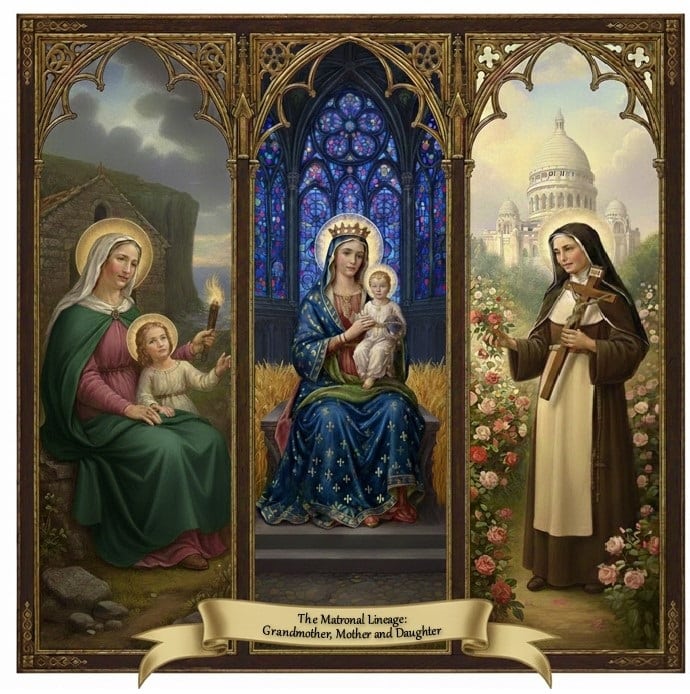
Beyond the stone spires of the kings lies a lineage of love: The Grandmother, the Mother, and the Daughter of France, reflected by the three places in the title. From the salt-swept granite of Brittany to the sky-blue glass of the plains and the rose-gold mosaics of Normandy, we find the feminine heart of the faith—a story of heritage, incarnation, and the ‘Little Way’ that leads us to Jesus.
In the summer of 2025, to mark the 10th anniversary of his ordination, my pastor Canon Commins (Institute of Christ the King Sovereign Priest) led a pilgrimage through the historic landscapes of his French homeland. Facilitated by Sacred Heart Tours, we traversed through centuries of Catholic heritage, aimed at uncovering the living soul of the ‘Eldest Daughter of the Church.’
This series of articles is the fruit of that expedition. It is my hope that these pages offer more than just a glimpse of the remarkable sites we visited. I invite you to join me in uncovering the living faith of France—the vibrant, pulsing soul that breathed life into these holy places and the stones and statues that tell the story of our Catholic ancestry.
In the previous articles of our explorations, we looked at the broad sweep of history from the heights of Sacré-Cœur and examined the historical and spiritual contrasts at the two abbeys at Rhyus and Lys that we stayed at.
As our bus wound its way from the first stops along rugged coast of Brittany toward the fertile plains and valleys of Normandy, the “feminine heart” of Catholic France began to reveal itself. After visiting of number of great basilicas and cathedrals, I realized that the story of this land wasn’t just written in royal decrees or monastic rules; it was held together by a generational passing of the torch of faith that defines France.
Of the many churches, basilicas, and cathedrals we visited, three stood out as representing a distinct maternal lineage of the faith: the Minor Basilica of Sainte-Anne-d’Auray, Our Lady of Chartres Cathedral, and the Minor Basilica of St. Thérèse of Lisieux. Together, I propose that they embody the Grandmother, the Mother, and the Daughter image of the Catholic faith in France (and perhaps the Universal Church as well)! It is a story told through the lives of these women and the churches that honor them, standing as three distinct pillars of this matronal lineage.
Table of Contents
- 1. The Roots: The Minor Basilica of Sainte-Anne-d’Auray
- 2. The Foundation: Our Lady of Chartres Cathedral
- 3. The Glory: The Minor Basilica of St. Thérèse of Lisieux
- 4. An unexpected bonus stop–the hidden secret of Lisieux
Our journey into the “feminine heart” of France would begin near the root of its ancestral family tree with St. Anne.
The Matriarch of Stone: St. Anne d’Auray
As we pushed north along the western coast of Brittany on our pilgrimage, most suitably our first church stop was a Basilica dedicated to St. Anne, the grandmother of Jesus, erected in the village of her namesake near Vannes. Although not the oldest church we visited, it was fitting that this Basilica became our first stop in a series of churches dedicated to Our Lady.
Built in the late 19th century to replace a much older chapel, the Basilica is, by French standards, quite young. Yet its local granite and Renaissance Revival architecture lends it a grey, resilient, and ancient character. It possesses a weight that belies its relative youthfulness, connecting the modern pilgrim to a foundation of faith reaching back to the 6th century.
It is the third most popular pilgrimage site in France, after Lourdes and Lisieux. It is a place of profound intercession where the Breton people—and now pilgrims from across the globe—come to speak to the “Mamm-Gozh” (the Old Mother) as their own spiritual grandmother.
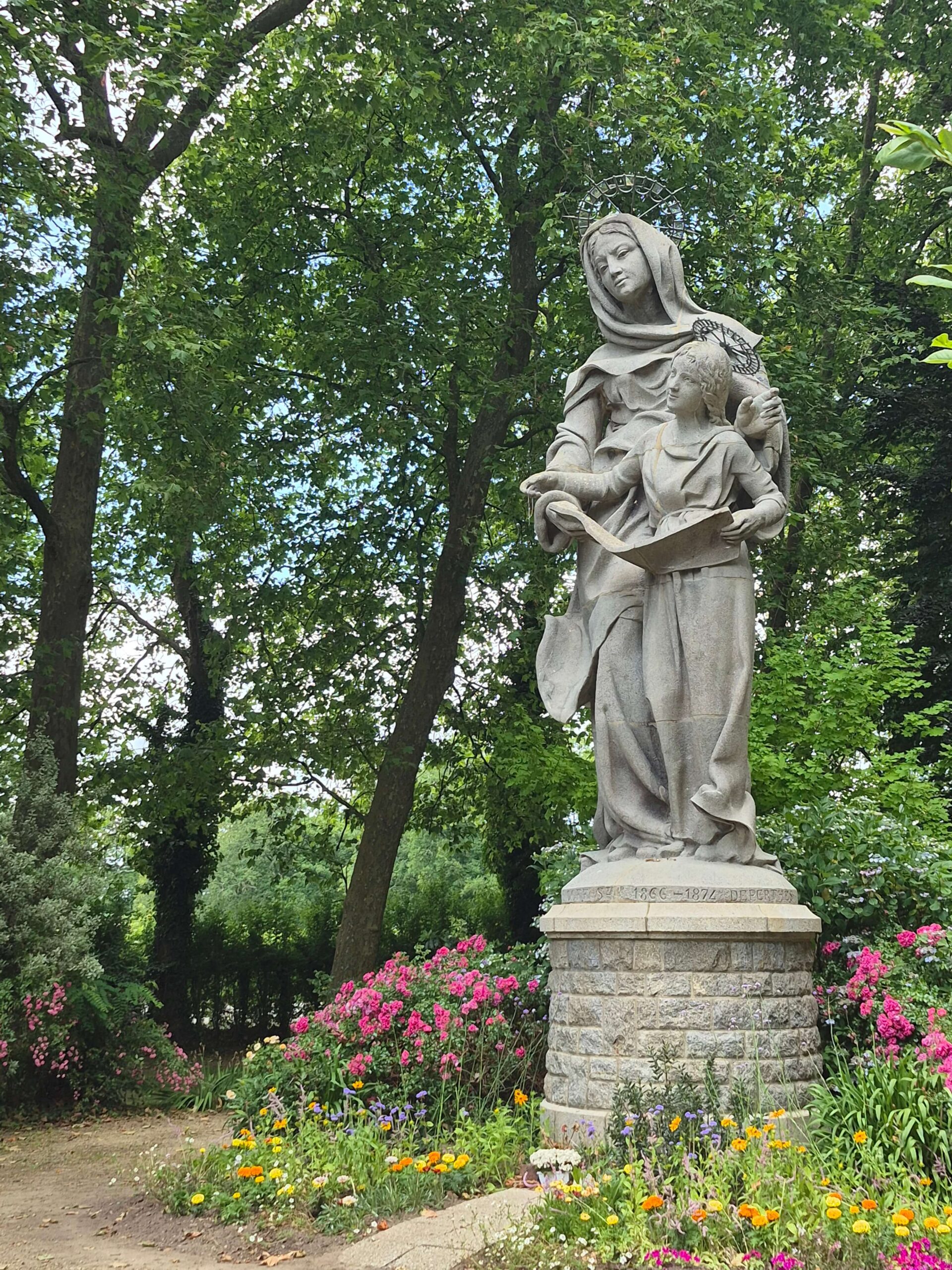
Stepping onto these grounds means entering a centuries old lineage of faith. Here, the grandmother of Christ is not a distant historical figure but a living matriarch—one who has guided a nation through revolutions, wars, and the shifting tides of history. It also the place of the annual tradition of the “Great Pardon,” a distinctively Breton event of atonement and pageantry complete with traditional costumes, banners, and ancient hymns. This occurs on the Vigil and her Feast Day of July 26, the best time to visit this church if you don’t mind the large crowds.
St. Anne is also of personal interest to me as the patron saint of my home diocese of Detroit! The first church in Detroit was St. Anne de Detroit, founded in 1701 by the first French Catholic settlers who brought the torch of faith to the New World. I also previously wrote of St. Anne as one of my daughters picked that name for confirmation as a way of honoring her (ahem) grandmother.
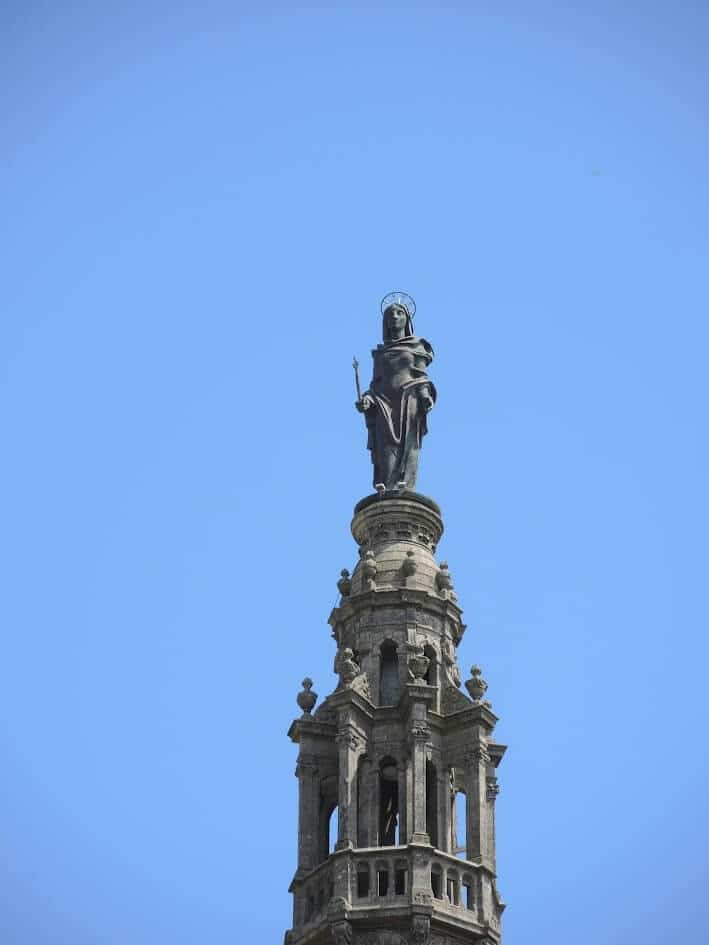
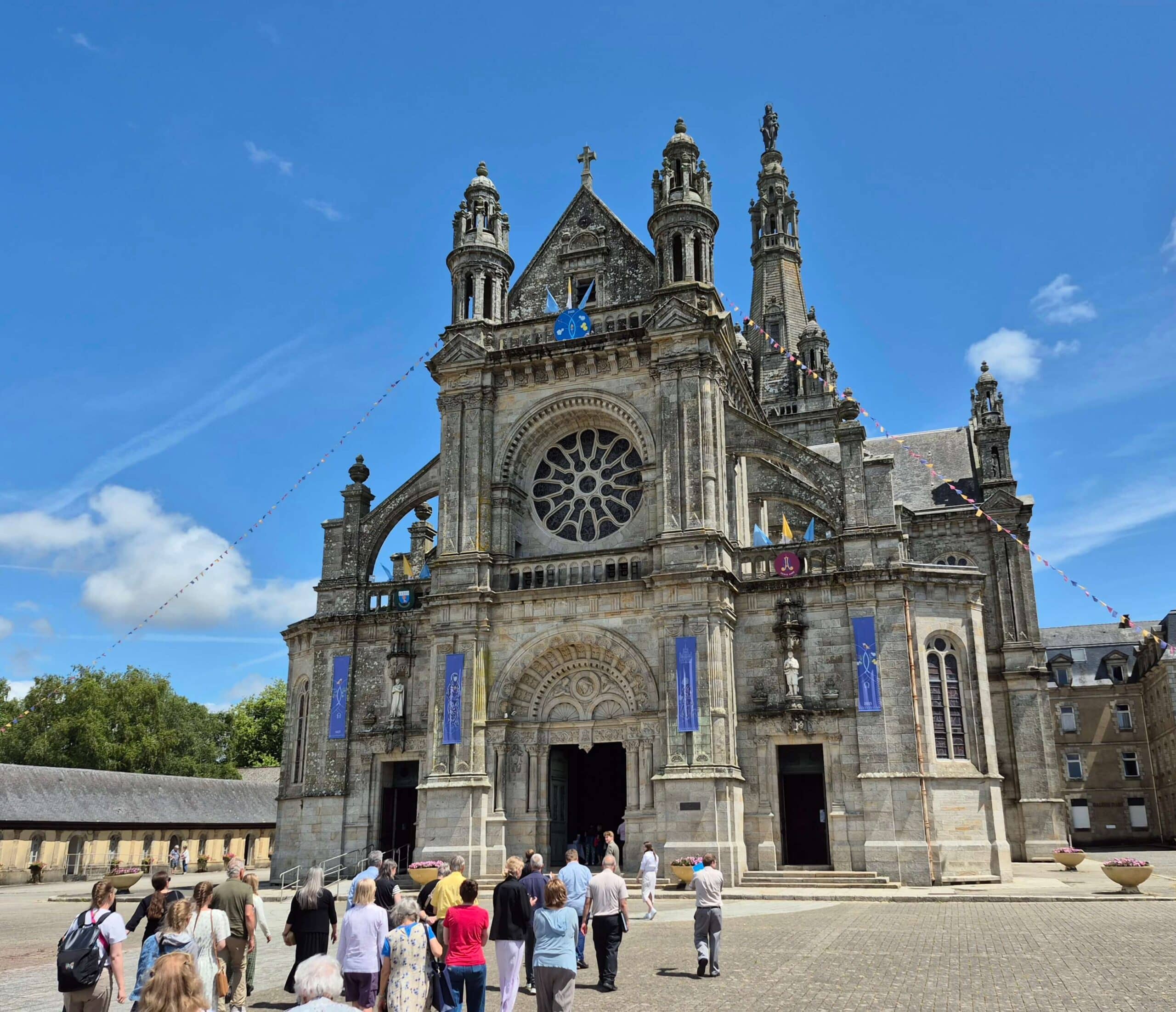
The sanctuary’s importance was cemented in the 1620s when St. Anne appeared to a humble local farmer, leading him to rediscover a long-buried statue of the saint in his field.
The Apparition: The Farmer and the Torch
The history of this sanctuary begins not with a royal decree, but in the muddy silence of a nearby field in 1625. The story begins with Yves Nicolazic, a simple, pious farmer who spoke no French—only his native Breton.
For two years, Yvon was haunted and guided by a mysterious light; a flickering torch held by an invisible hand that led him through the darkness of his fields. Finally, St. Anne appeared to him, speaking his own language: “I am Anne, the mother of Mary. Tell your priest that in the field once known as Bocenno, there stood a chapel dedicated to me. I wish for it to be rebuilt.” To prove her identity, she led Yvon to a specific patch of earth where, after digging, he unearthed an ancient, charred wooden statue of the saint. It was a 6th-century relic of a forgotten past—a memory of the Grandmother that had been buried in the soil, waiting for the right moment to be brought back into the light.
Little is known of this early chapel of St. Anne. Some historians believe that the town, originally dedicated to the Celtic goddess Ana, became Christianized by early missionaries around the 6th century, the same era that brought St. Gildas to these shores. Christianization, meaning the inculturation of pagan practices, is the mysterious intersection of coincidence, opportunism and Divine Providence. In this sense, the Church “baptizes” rather than erases pagan tradition. Our later travels would take us elsewhere in Brittany and Normandy, where the flavor of pagan customs of the converts has been subtly introduced into local Catholic tradition and architecture.
This simple field eventually grew into the granite Basilica we see today, becoming a place where the “feminine heart” meets the most desperate needs of her grandchildren. But even more so, her love for us points us to her Mother and her grandson, Jesus.
Anchored in Hope: The Navy of the Nave
As you walk in to the sanctuary, one of the most remarkable and unexpected sights is “Anne’s navy,” the ex-voto ships. The ships of the nave are the ex-voto offerings, the physical ‘vows fulfilled’ and thank-yous for her intercessory prayers against the gales of the sea. They are the tangible receipts of answered prayers.
Seeing a meticulously rigged model vessel featured where one might expect to find a saint statue can be a bit jarring for a novice pilgrim like me. I learned that mariners would come to light a candle and pray before a voyage, asking for a grandmotherly protection over the dangerous work of her grandsons. Because of the shrine’s proximity to the ocean, the ‘Grandmother of France’ became the patroness of those who faced the nautical perils of the Atlantic.
To stand beside them is to feel that motherly care in the sanctuary: a place where the chaotic, masculine violence of the ocean is finally brought to rest under a Grandmother’s watchful eye.
A keen-eyed visitor would see plaques on the wall of the nave from two naval ships commanders, dated 1886 and 1890. These men of worldly power felt it necessary to publicly credit St. Anne for their safety or success in places as far away as the middle and South Atlantic.
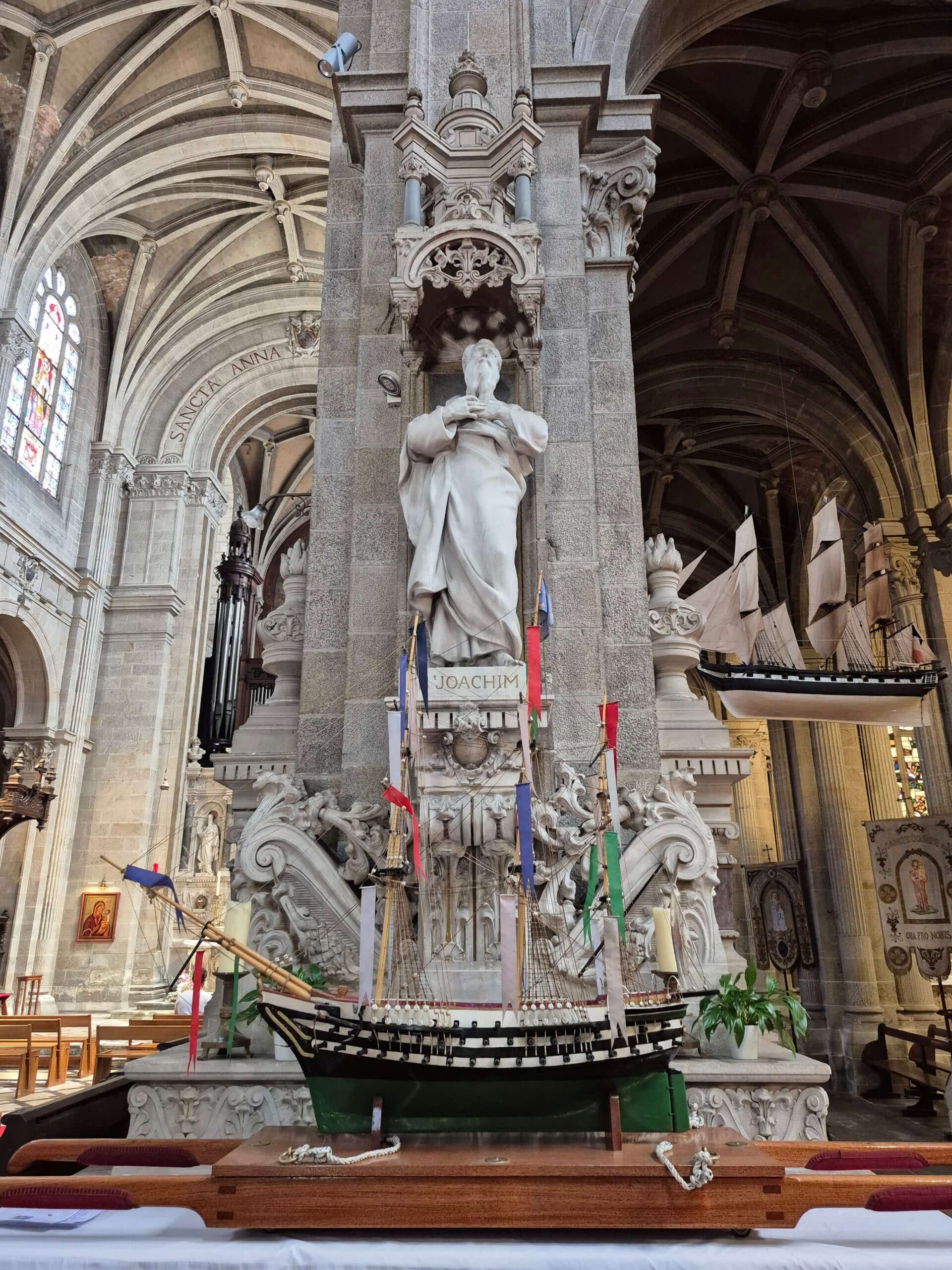
St. Joachim. Directly behind in mid-air floats another ship.
From Anchors to Altars
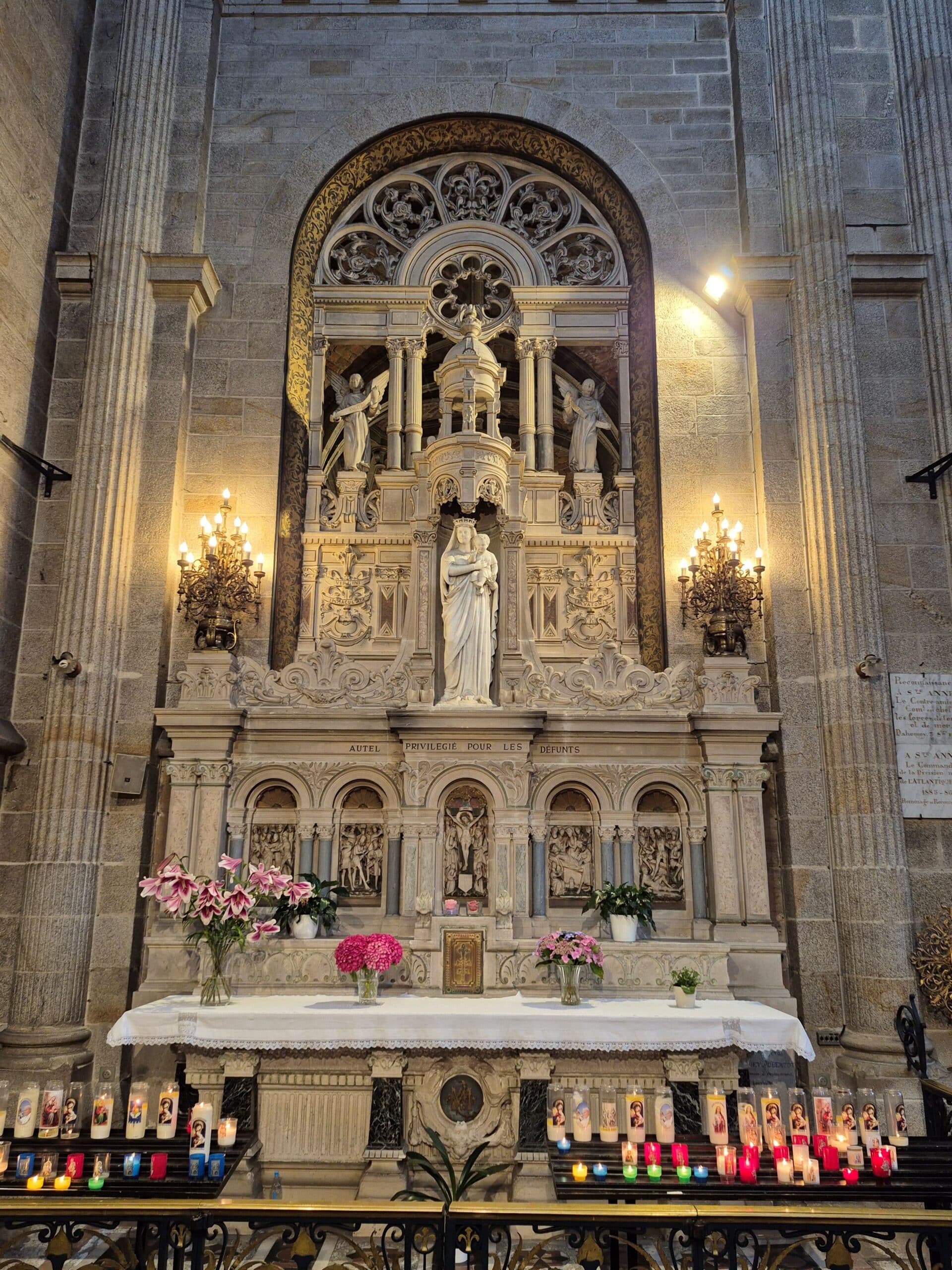
In a quiet side altar dedicated to the Virgin, we see the middle link of our matronal lineage. Here, the daughter of Anne is venerated for fulfilling her own role as the Mother of God. The side altar dedicated to Mary reminds us that St. Anne’s greatest legacy was her daughter. As I explored in my previous piece on St. Anne’s spiritual motherhood, her unique role was the ‘Ladymaker,’ the one who formed the heart of the Virgin Mary herself to prepare the way for the Incarnation. You can also find prayers to her as the patroness of fertility.
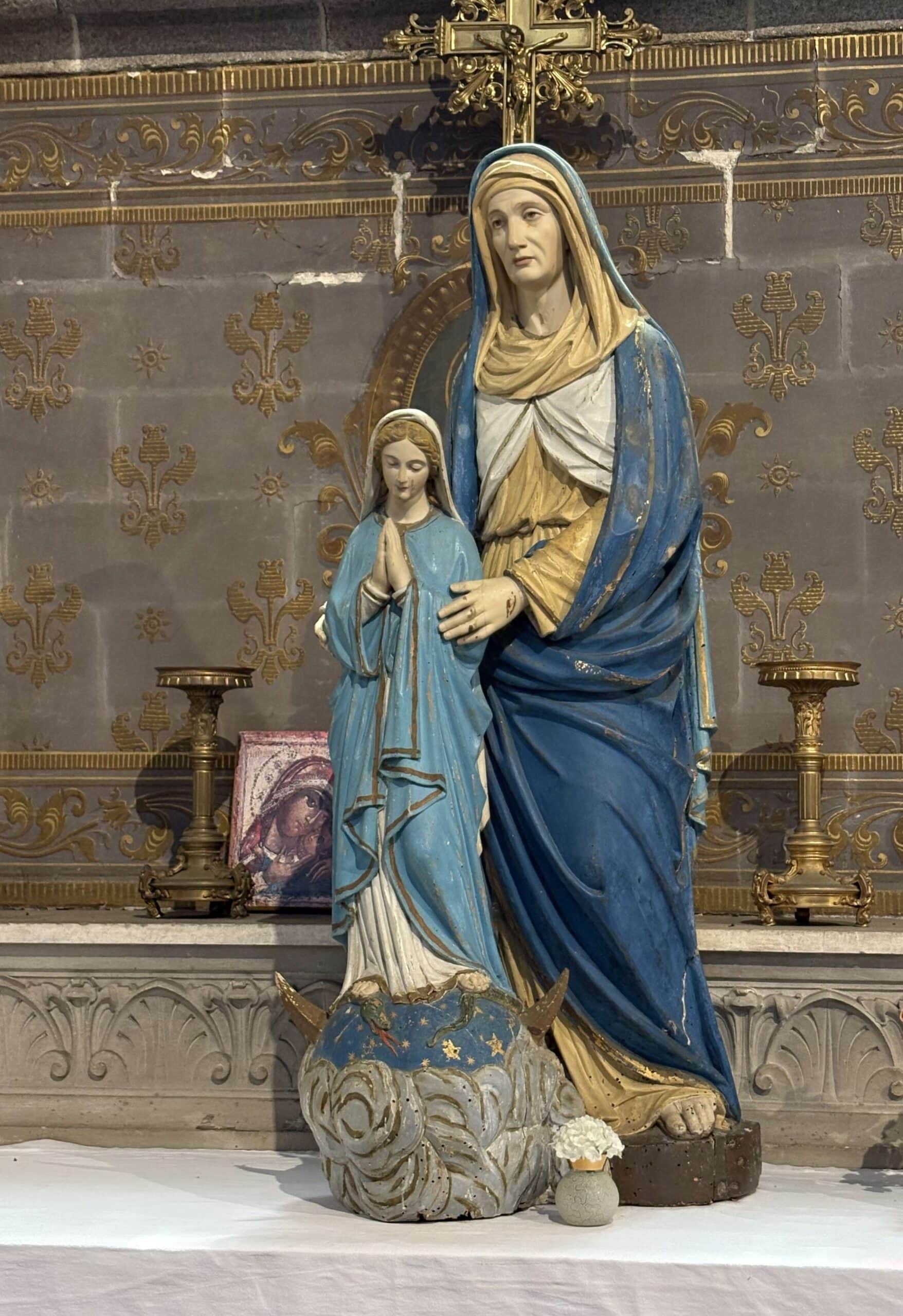
As the pilgrim proceeds through the sanctuary, they are eventually led to the featured altar of Saint Anne. Here, in glimmering gold, Anne appears with Mary at an age when the child would have been dedicated to the Temple. It is a visual representation of the ‘passing of the torch,’ as Anne prepares her daughter to become the Living Tabernacle for the infant Lord. Carved into the base of this altar are the words ‘Autel privilégié pour les défunts,’ identifying this as a Privileged Altar for the Deceased—a sacred place where the lineage of prayer reaches beyond the veil to seek a plenary indulgence for the souls of loved ones.
I would learn later that there is a rugged, earthly side to St. Anne belying her grandmotherly image: she is the ancient patroness of miners. In the medieval mind, this wasn’t just a random assignment but a theological metaphor. If Mary is the “precious gold” that yielded the rare gem of the Incarnation, then St. Anne is the mine from which that treasure was drawn. She is the deep, dark earth that held and protected the treasure until the time was right for it to be brought into the light. To honor Anne is to honor the raw materials of humanity that God chose to refine.
(Cynthia Burley)
This patronage once changed the course of world history in a single, violent instant. In July 1505, a young law student named Martin Luther was traveling home when he was caught in a terrible thunderstorm. As a bolt of lightning struck the ground beside him, knocking him flat, he didn’t cry out to God or Jesus—he invoked the saint of his father’s profession. As his father was in the copper mining business, Luther fearfully shouted: “Help me, St. Anne! And I will become a monk!”
He survived, and true to his word, he entered the Augustinian monastery shortly after. It is a striking historical irony that the man who would eventually spark the Reformation and move the Church away from the veneration of saints began his spiritual journey with a desperate prayer to the “Grandmother of God.”
After spending a quiet moment of prayer at St. Anne’s side altar, the pilgrim naturally feels drawn toward the heart of the Basilica: the High Altar. If the side chapels of Anne and Mary are the quiet rooms of a family home, the High Altar is the throne room of the King. Here, the rugged Breton stone meets the splendor of gold and light, marking the spot where the prayers of these two great lady intercessors finally reach their destination. To kneel here before the tabernacle is to see the torch give its brilliant flame to the Sacred Heart of Jesus.
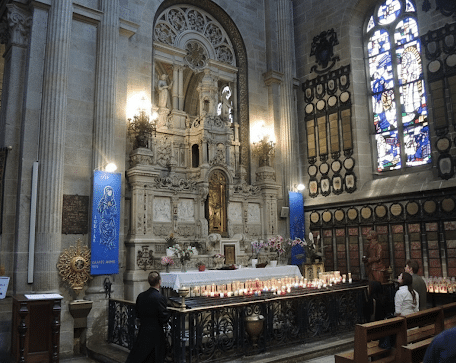
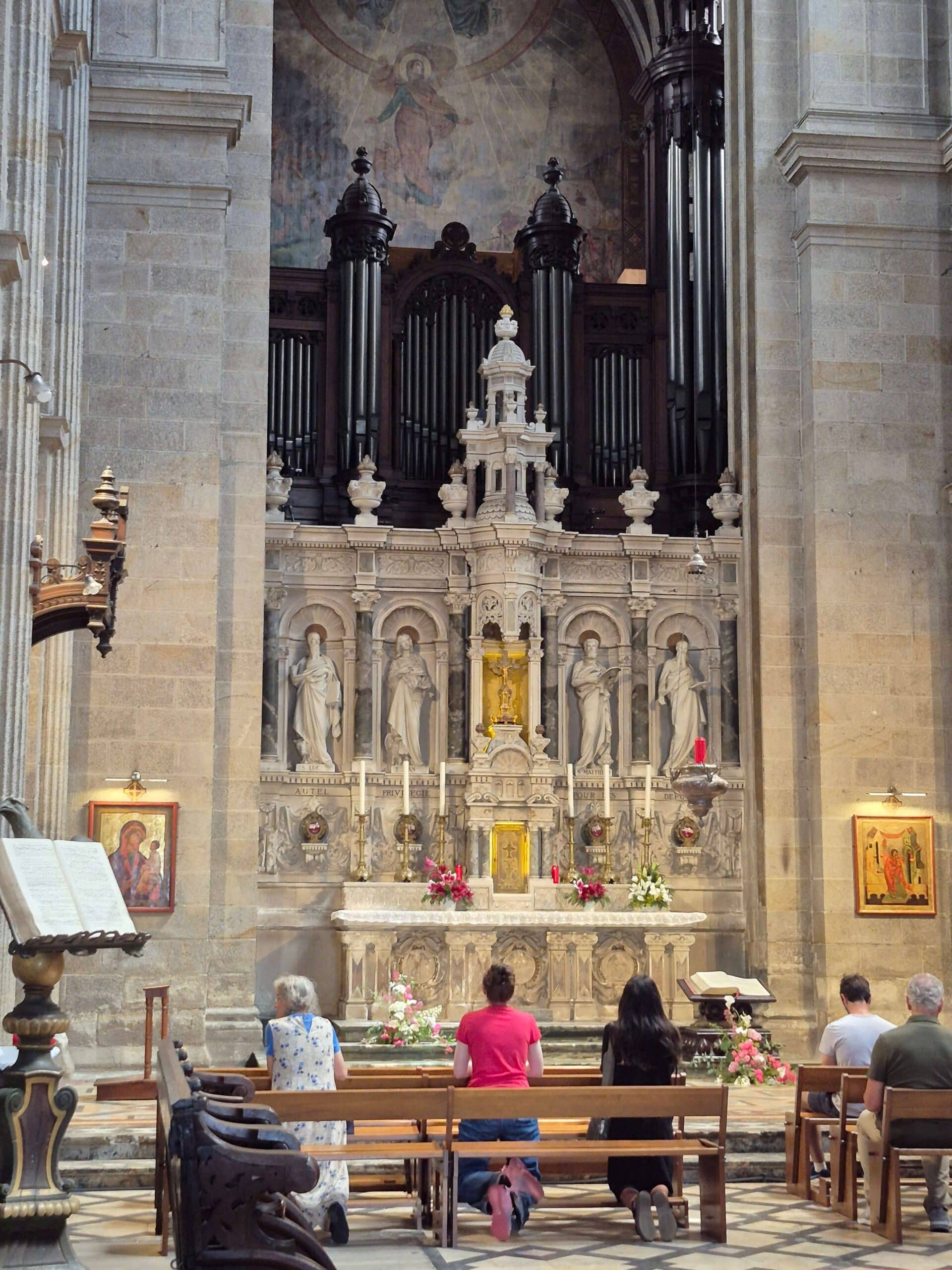
St. Anne’s Grandmotherly aspect extends even further. Tradition and the visions of Ven. Anne Catherine Emmerich tell us that Mary was a child of her parents’ old age, born after a long and agonizing period of barrenness, a tribulation of the heart that many pilgrims today still bring to these altars. It is said that Mary’s sister, Maria of Cleophas, bore the sons who would become the Apostles Jude, Simon the Zealot, and James the Less, making Anne a Great Grandmother of three of the Apostles! The would results in the remarkably unusual circumstance of our Lord being a Great Uncle to the three men who were about His own age.
Lessons of the Courtyard: Lament and Labor
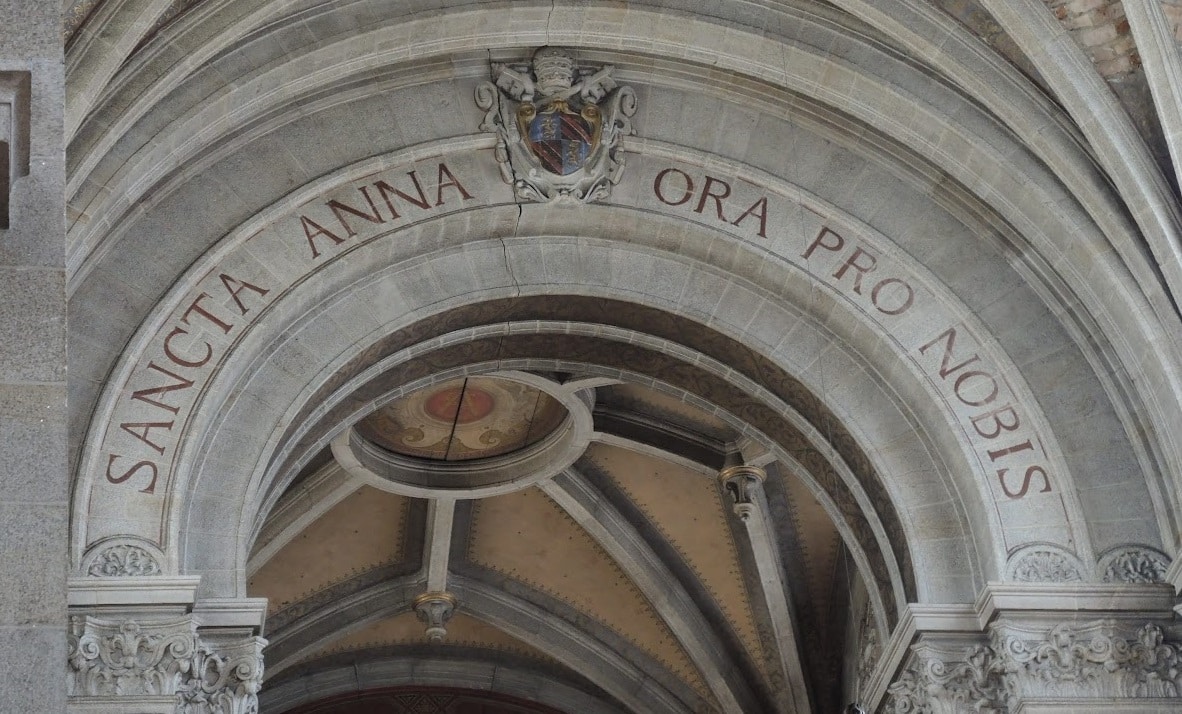
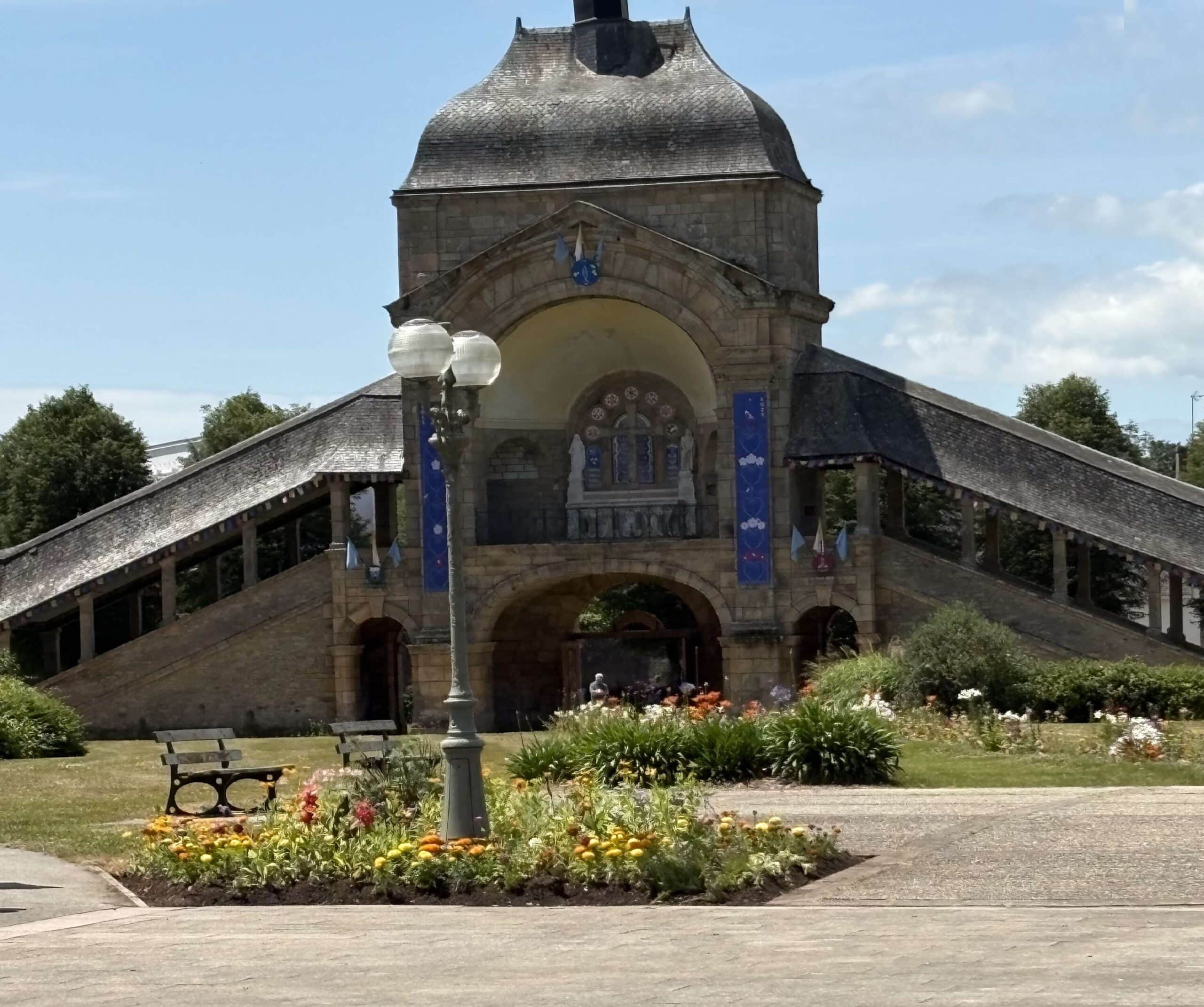
“Sancta Anna, Ora Pro Nobis.” As the pilgrim prepares to leave the sanctuary, this carved stone arch offers a parting reminder of a grandmother who never stops watching the horizon for her children to return home. Yet, before the pilgrim continues on, one is compelled to linger at the two imposing features of the plaza grounds: The Great War Memorial Crypt and the Scala Sancta.
These are complementary features of descent and ascent. The descent offers a journey down into the cool, silent roots of the matronal lineage of the crypt. The crypt visit is one more moment to pray for the dead and to be reminded of our own mortality. The climb of the Scala Sancta prefigures our hope to someday ascend to the heavenly heights. The Scala Sancta serves in part as a replica of the Holy Stairs in Rome. Reflecting an ancient tradition, some pilgrims will scale the flight of steps on their knees as an act of penance. (Note: Due to time constraints, the author missed the opportunity of the challenge of the Scala Sancta but had successfully completed it in the past on a pilgrimage at a shrine in this home state of Michigan).
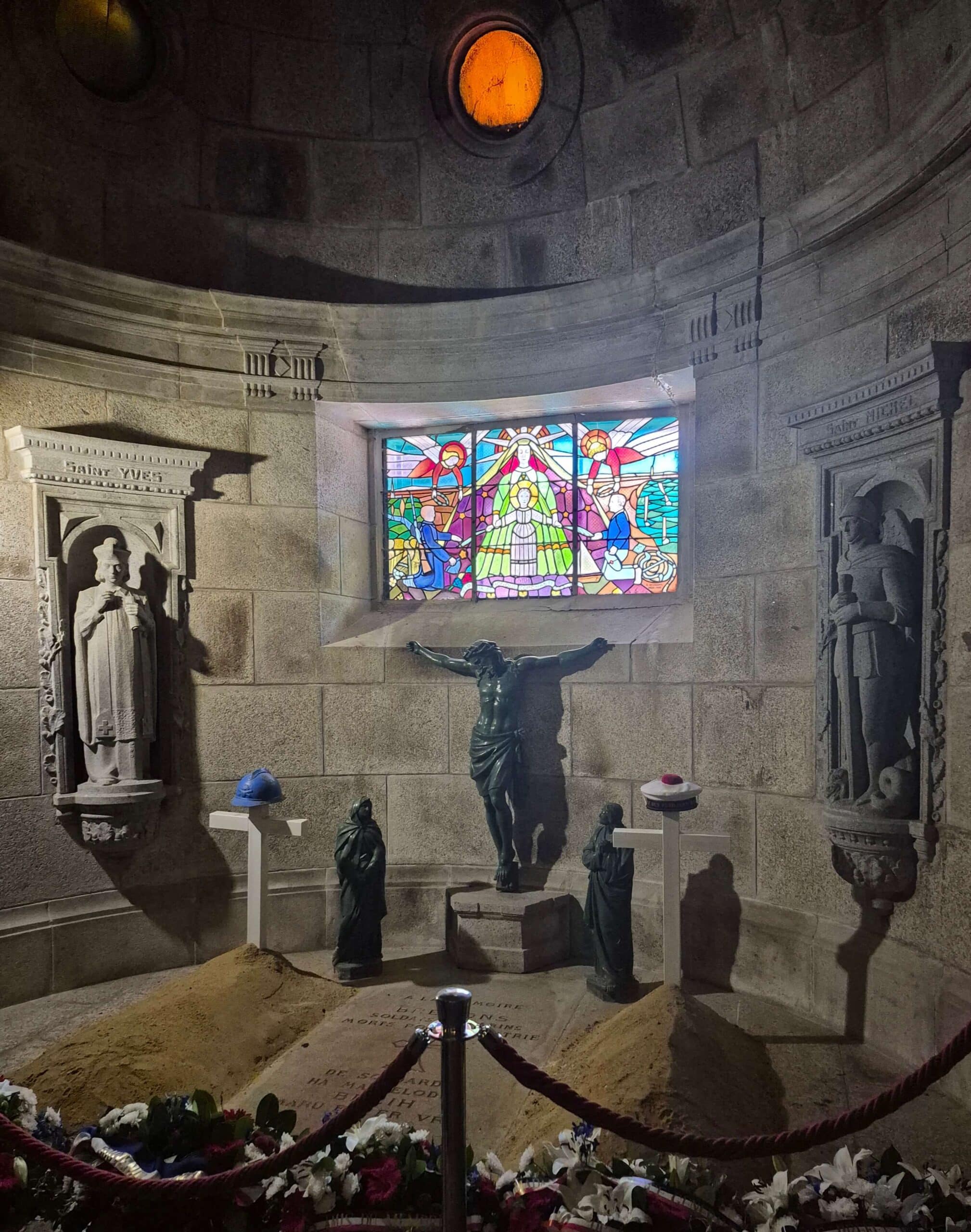
The War Memorial crypt prominently includes statues of St. Yves of Kermartin, patron saint of Brittany (not to be confused with Yves Nicolazic) and St. Michael the Archangel.
These two structures give the final lessons of the heart of the Grandmother: compassion, humility, endurance and hope. With the reminders of these virtues , we now turn our gaze away from the rugged Atlantic coast as our tour bus takes us inland. We leave the “Grandmother’s House”‘ to now seek our “Queen Mother’s House,” trading the grey earthy tones of Brittany for the luminous, royal splendors of Chartres.
From the Grandmother’s Hearth to the Queen’s Court of Chartres
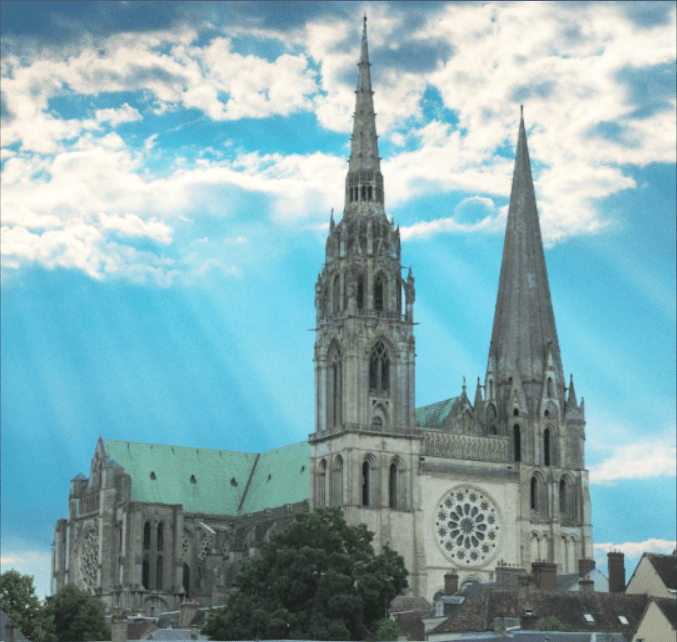
As we approach the City of Chartres, the massive silhouette of the Cathedral begins to rise above the flat, golden fields of the Beauce region, its two mismatched spires piercing the soft ‘Mary-blue’ sky and dominating the landscape for miles. If Sainte Anne d’Auray is the intimate home where the faith was nurtured in its infancy, then Chartres represents its full flowering—a radiant expression of spiritual motherhood proclaimed in the light. We have left the house of the Grandmother to enter the palace of the Daughter Mary, the Queen of Heaven, whose presence is woven into the very glass and stone of this High Gothic masterpiece.
Stepping off the bus, the sheer scale of Chartres strikes you with a supernatural force. The massive entryways, both at the front and sides, are designed to arrest the senses. Whether your eyes are transfixed by the hundreds of intricate stone carvings, the unique wrap of cobalt blue clerestory windows, or the two soaring spires, the effect is almost hyperbolic. This isn’t merely a church building; it is a theological statement about the Blessed Virgin Mary painted with stone and glass, informing the soul that you are about to enter a space where a mere veil separates the earthly and the divine.
The older spire on the right is a masterpiece of Romanesque restraint from the 1140s. The newer one on the left was built 300 years later in the flamboyant Gothic style. The earliest church building, rebuilt several times, dates back to about 350 A.D.
The Timeless Faces of Stone
As you approach the facade, the massive stone fortress is transformed by its depiction of humanity. The entrances are flanked by the famous jamb statues—tall, unnaturally slender figures of Old Testament kings, queens, and prophets who appear to serve as the literal pillars of the building.
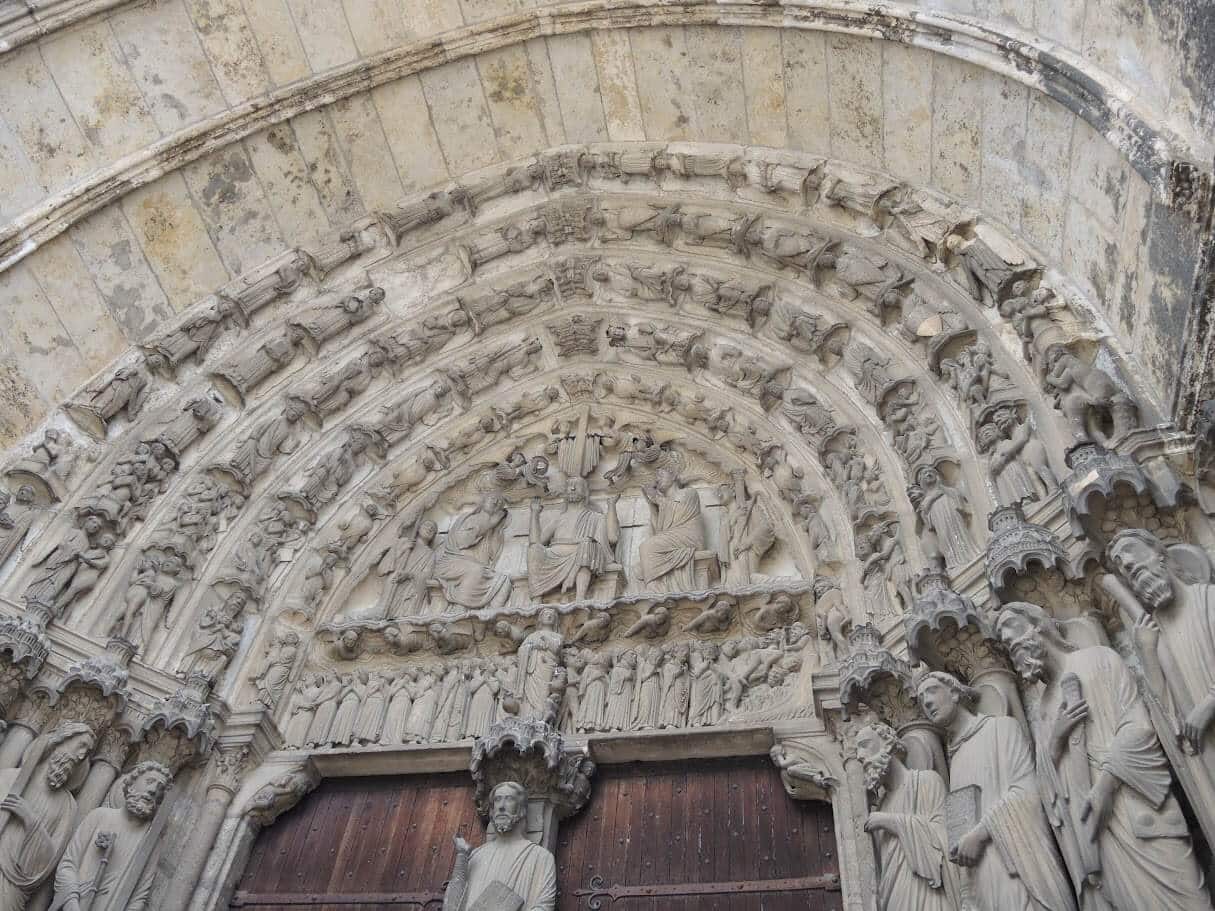
Carved in the 1140s, their elongated forms were never meant to mimic human proportions. Instead, they evoke the idea that these great figures of the faith stand as the very columns upholding the Church. Their faces remain fixed in a state of serene, timeless peace, looking past the modern pilgrim and into eternity. They are symbols first, and humans second. Surrounding them is an ordered cacophony of ornamentation—stone impossibly carved with so much detail. Even more astonishing is to imagine them in their glorious original state, intricately painted in vibrant colors with crisp details not worn by centuries of weathering. These portals are widely considered the highest achievement of 12th-century sculpture, marking the exact moment the world transitioned from the “heavy” Romanesque style to the “graceful” Gothic.
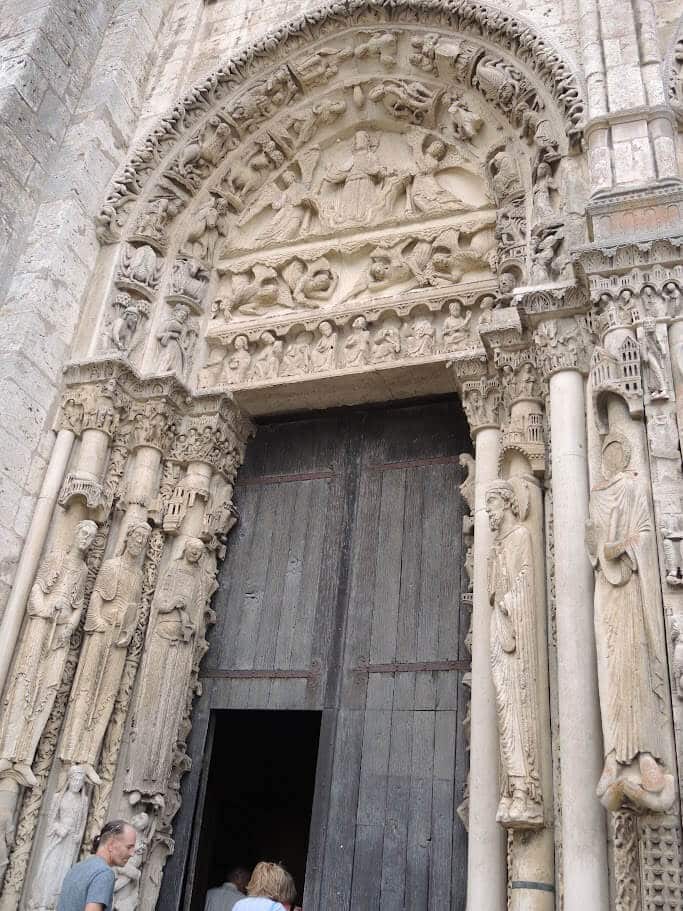
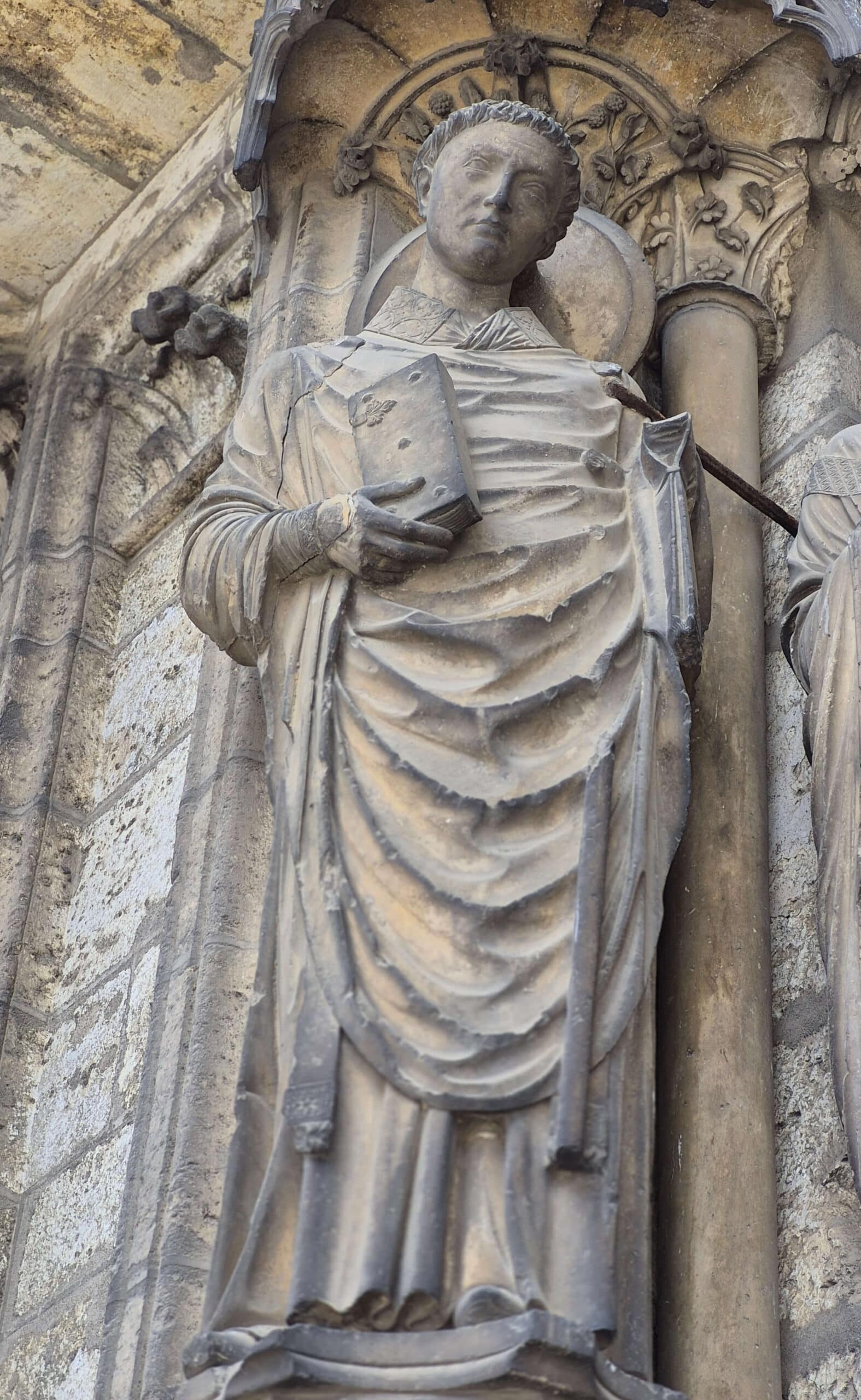
As you move around the exterior to the later portals, the statues begin to “step out” from the columns and become more proportionally accurate and more human. It is a visual record of the Church’s growing realization: that holiness doesn’t require us to be stiff and inhuman. These legendary figures are rendered more like us in hopes that we too can aspire to sainthood.
The Clerestory Windows: Of Feast and Feria
As you step inside, the cavernous interior of the nave is at first glance devoid of any eye-catching features. A pilgrim will notice that most people are looking up at the world famous windows. To be honest, our local tour guide wanted to spend almost all of our entire two hour allotment talking about the windows–so most of us went rogue and bolted to pace ourselves through the sanctuary at our own pace.
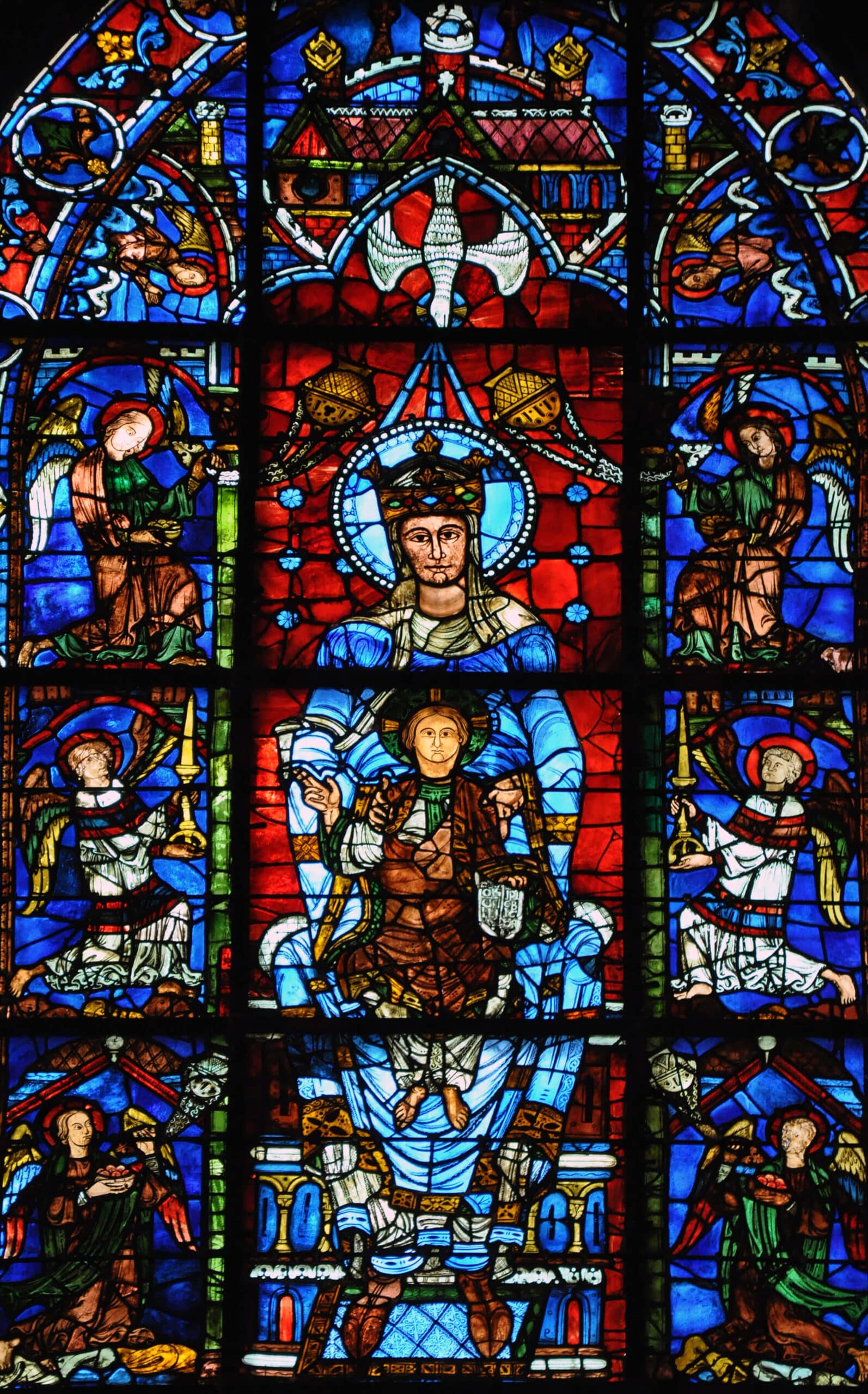
While there is no way to give fair time and treatment to the large number of stunning windows, it would seem an injustice to not at least mention the most famous of the 143 windows, the Notre-Dame de la Belle Verrière (Our Lady of the Beautiful Window), one of only four of the earliest windows from the 12th century.
This window made with the characteristic Russian cobalt blue glass with a luminosity that seems to glow from within, even on a cloudy day. Mary is depicted as the Sedes Sapientiae (The Seat of Wisdom), with the Christ Child on her lap. Eastern influence is seen in her image, perhaps referencing her patronage for the Crusades at that time of the design. Contemporary royal influence is seen in the crown, which includes elements of the imperial crown of King Charles the Bald, thought to be the monarch who gifted the artifact veil of Mary to the church. The panels on either side and at her feet include angels with the top panel including the descending Holy Spirit as represented by a dove. This central panel survived the Great Fire of 1194. It was so beloved by the people of Chartres that they rescued it from the burning ruins and re-set it into a larger 13th-century window. It is the literal heart of the cathedral’s history. The glowing sapphire hue of the “Chartres Blue” remains one of the world’s great wonders of medieval window craftsmanship.
Of particular note, however, is that not every single window includes some notable saint or historical event to be commemorated. The simple ornamentally-patterned (grisaille) windows, of which there are 14 at the clerestory level, have their specific purpose. At typical of every design feature of a Catholic church, they are intentional and not random. These panels don’t have the “celebrity status” of the featured windows but play a vital role. If the more celebrated and colorful windows are the “Feast Days” of the Church, these simpler and more transparent panes are the “Ferial days.” Here, the unseen holiness of God is depicted not through a face or a story, but through a rhythmic interplay of geometric shapes and shifting light, reminding us of the mystery of our invisible God. They remind us that the Divine can also be found in the ‘in-between’ spaces—the ordinary, quiet and more mundane moments of life.
These windows also serve a more practical function where they can be positioned to direct sunlight at certain times of the day. They are often strategically used to counter where a spire might block sunlight and cause a dark spot in the sanctuary. More of these windows tend to be on the north side, where the light is more consistent and less blinding. Conversely the most deeply hued “Feast Day” windows would be placed to filter out the most intense sunlight. In the 18th century, some of the windows at Chartres were actually moved or replaced to better “tune” the lighting in places where canons would be chanting and therefore need better lighting for reading text.
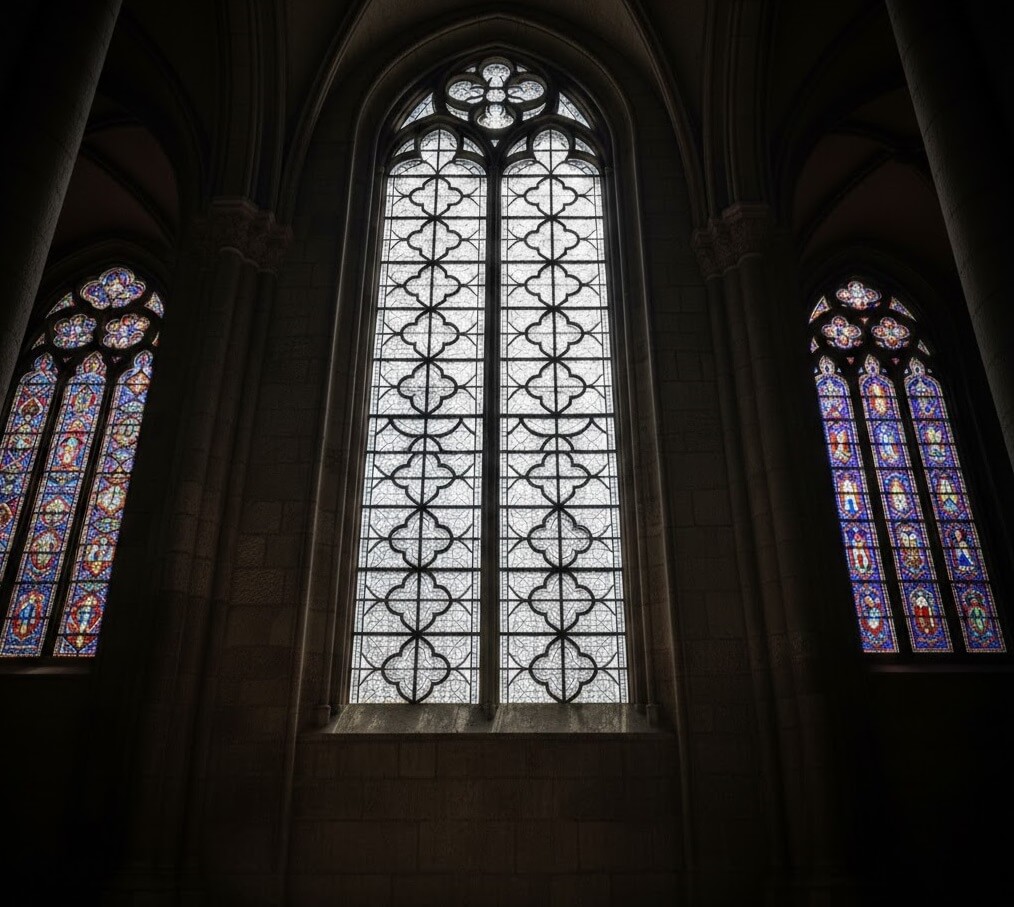
As an amusing side note on the power of the clerestory lighting, my wife and I once sang with my church choir as part of a large choir in a nearby church for a special Mass. Afterwards, I went to find my wife standing among the rest of her section on choir risers at the opposite end of the building. Seeing a familiar silhouette from behind, I reached out and tapped her on the shoulder. As the woman turned around, her movement unleashed a previously blocked beam of sunlight from a high clerestory window, sending a blinding stream of rays directly into my eyes. Dazzled and nearly blinded by the glare, I began chatting away to this stranger as if she were my wife. It took several moments to realize I was presumptuously talking to a woman I had never met!
The next time you are in your own church, take a moment to observe your own sanctuary’s grisaille windows. Find your bearings with respect to the path of the sun. Can you see a “light tuning” scheme at work? Take a moment to reflect on how these simpler windows represent the simple hidden mystery of our God.
Our Lady of the Pillar
As we proceeded through the sanctuary, we went from observing Mary and the celestial court among the high realm of the clerestory to her more earthly and personal space in a side altar space of the nave. Here we find a shrine to Our Lady of the Pillar, the earliest approved apparition of Mary. According to tradition, she appeared to the Apostle James during his missionary travels in Spain. Mary appeared to him standing atop a jasper pillar carried by angels while she was still living in Jerusalem, In this first recorded instance of bilocation, she gave him encouragement to endure his trials, giving him a small wooden statue of her likeness as a sign and reminder. This miracle revealed her motherly care and intercessory powers, sparking the beginning of the devotion of Mary across Europe.
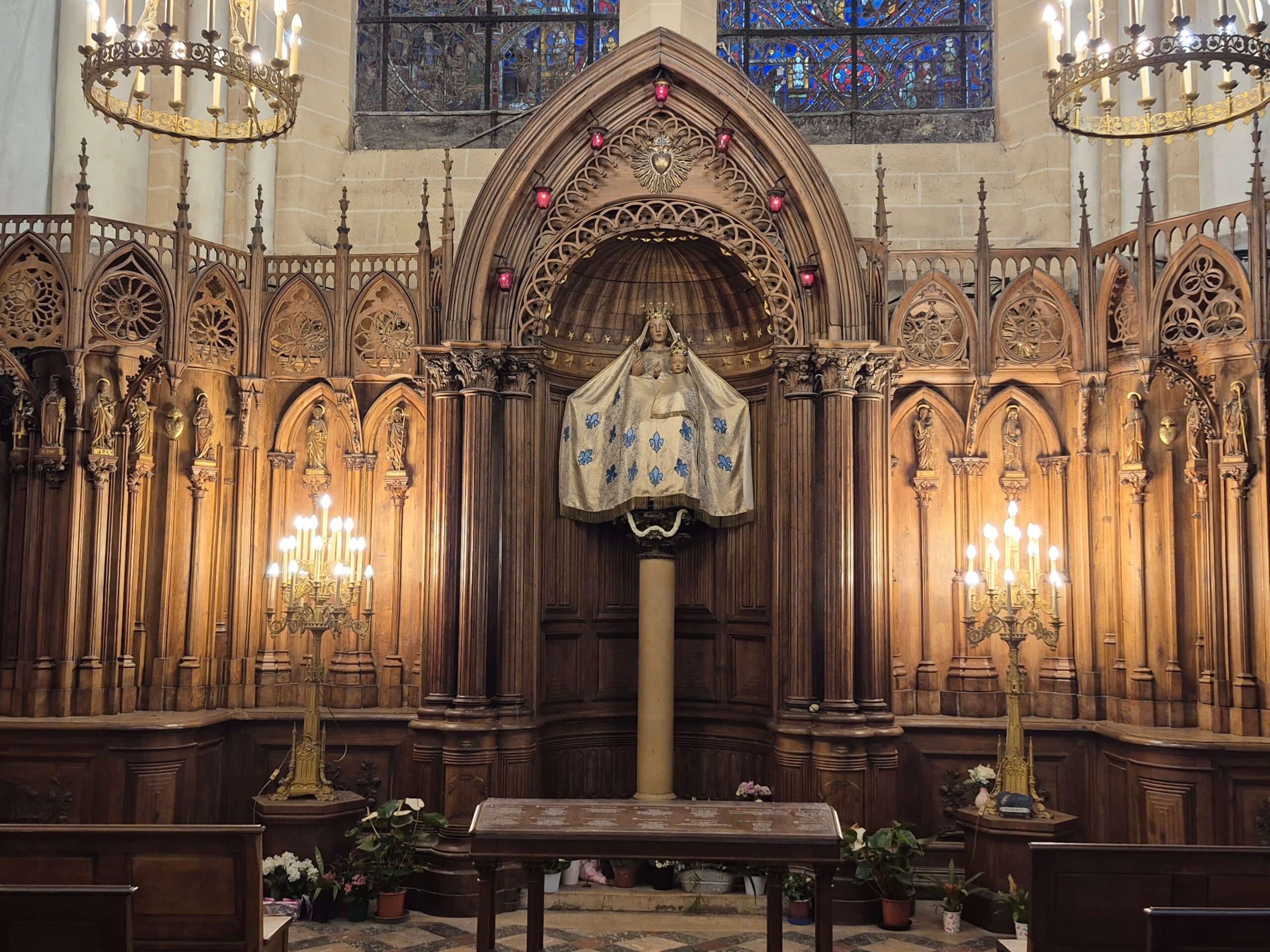
She eventually became one of France’s so-called ‘Black Madonnas,’ a result of centuries of discoloration of soot from the countless candles burned in her honor. She was restored to her original fair appearance following a cleaning in 2013.
She was originally located near the main altar but because of the frequent stream of visitors coming to pray and honor her, the canons decided to move her away from the choir where people would be less distracting during their prayer of the hours. According to the cathedral guide, it was reported that pilgrims would even sleep there! She was also separately venerated in the dark silence of the crypt below as Notre-Dame-de-Sous-Terre (Our Lady of the Under-Earth), near an ancient well said to have healing properties. This duality allowed Chartres to serve the pilgrim both in the bright light of this oratory and in the mysterious depths of the earth.
Stories Told in Stone Lace
Stained glass windows were often used historically in churches to tell the stories of the faith to the many faithful who could not read but could learn and be reminded of the stories. In fact, the English word for a “story” of a building traces back to the stories told by these windows. In the case of Chartres and other massive churches, the clerestory windows are generally too high to serve this purpose. Like Notre Dame of Paris and many other great cathedrals and basilicas, the outside of the choir screen around the main high altar was detailed with carvings of wood or stone, recalling important biblical events. At Chartres, however, this functional narrative was elevated to an almost miraculous level of artistry. The screen was designed to offer the clergy a sanctuary of silence for their prayers, shielding them from the bustling activity of visitors in the adjacent ambulatory. Due to their fine artisanal detail, the carvings have become commonly known as ‘Stone Lace.’ Here, the barrier between the public aisle and the sacred choir isn’t just a wall; it is a meticulously carved narrative that invites the viewer to linger at eye-level with the Divine.
As the pilgrim follows the curve of the ambulatory, it can be likened to a “cinematic experience” of medieval times. There are 40 different scenes featuring over 200 statues on this screen, moving from the Annunciation of the birth of Mary to Joachim all the way to her coronation as Queen of Heaven. With the carvings begun in 1514, the earliest sections are Flamboyant Gothic—very curly and dramatic. By the time of completion two centuries later, the later generations of sculptors had been trained and completed it in the cleaner and more orderly Renaissance style, serving not only as timeline of Mary and Our Lord but also the techniques of the high classical period of French art.
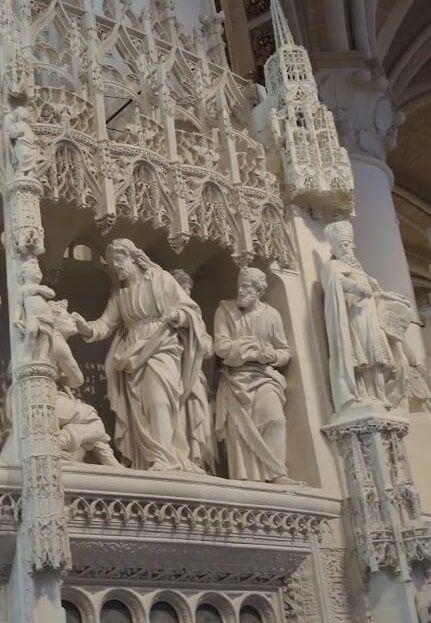
photo credit: Dr. Peter von Buelow
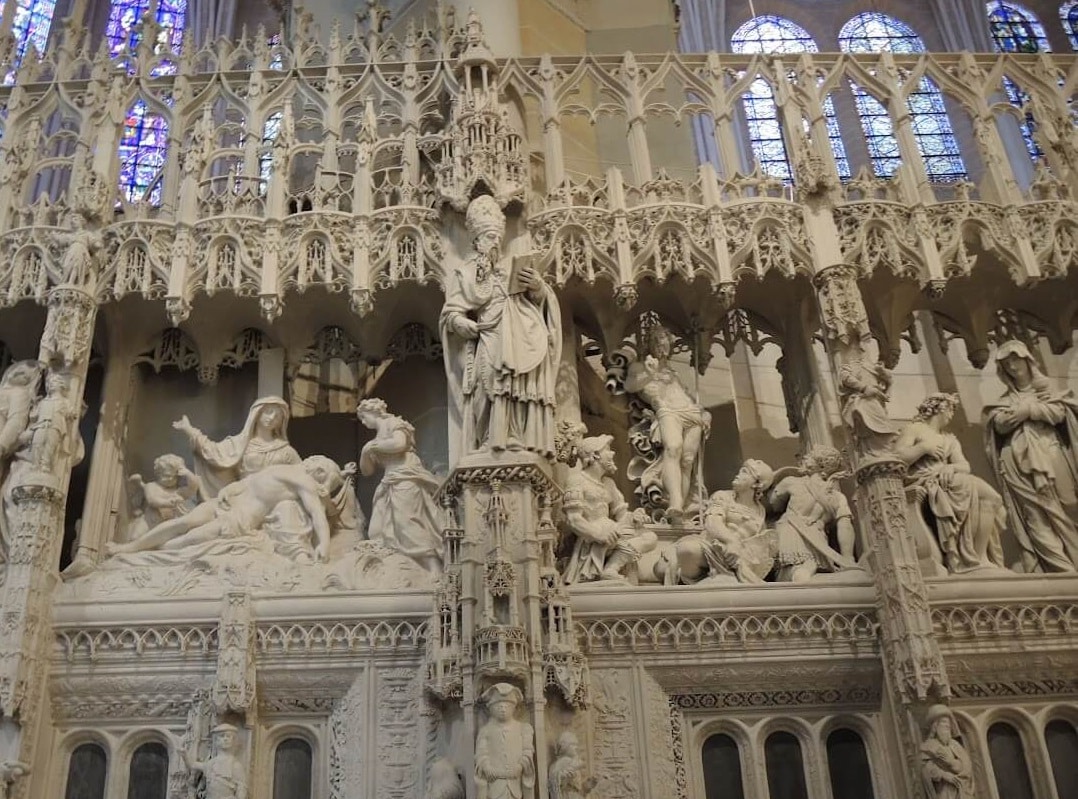
photo credit: Dr. Peter von Buelow
Imagine being a monk or priest chanting the hours every day in choir, hearing the distant rhythmic clinking of the carver’s chisels nearly every day, knowing that you would likely never see its completion in your lifetime. Most of these men, as well as the artists lived, and died knowing they would likely never see the screen’s completion in their lifetime; yet they both must have recognized the glorious merit of the effort. They were part of a long-form act of devotion, one that would eventually become a source of awe for pilgrims like us.
As a pilgrim completes their walk around the screen, culminating with the coronation, one might need to be reminded to double back to near the apex of the sanctuary to the place this great cathedral was built, the relic of the Veil of Mary. Personally, I was so transfixed by these stories told in stone that I walked right by the featured attraction without realizing it!
The Sancta Camisa
For over a millennium, the primary draw for pilgrims to Chartres has not been the other features, astonishingly beautiful as they are, but a simple piece of cream-colored silk. Known as the Sancta Camisa, it is traditionally believed to be veil worn by the Virgin Mary during the Annunciation. Gifted to the cathedral in 876 by King Charles the Bald, the grandson of Charlemagne, it elevated Chartres into one of the most important spiritual hubs in Christendom, sparking a fervor of Marian piety.
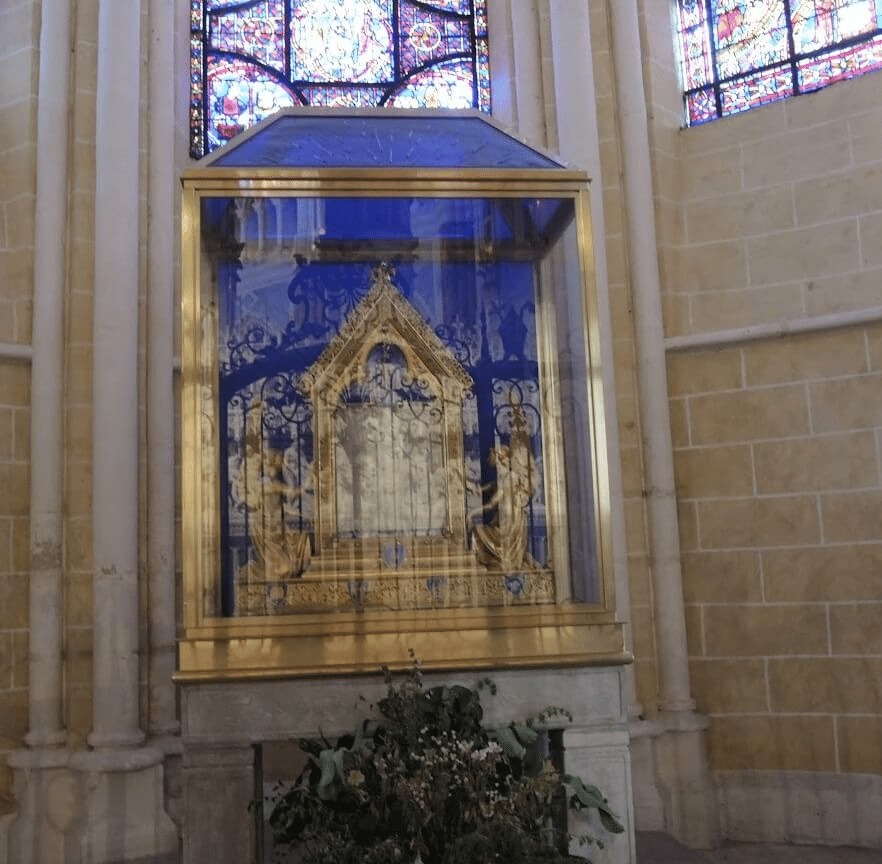
The Veil’s history is a testament to the “Providential Survival” of Catholic France herself as we have seen throughout this pilgrimage. In 1194, a catastrophic fire tore through the cathedral. The townspeople wept unconsolably, believing the Veil and the soul of their city had been lost. However, three days later, the priests emerged from the iron doors of the crypt, where they had fled with the relic. The Veil was untouched by the flames. This miracle so galvanized the people of Chartres that they rebuilt the main shell of the cathedral in an amazing span of just 25 years, creating the Gothic masterpiece we see today. Nevertheless, some scholars have questioned the veil’s authenticity. In the 1920s, scientific analysis of the fabric revealed it to be a fine, non-mulberry silk consistent with 1st-century Middle Eastern weaving, eliminating the likelihood of a forgery or a replica. While faith does not require scientific proof, there is a profound weight in realizing that this fragile garment has survived Viking raids, the French Revolution, and world wars.
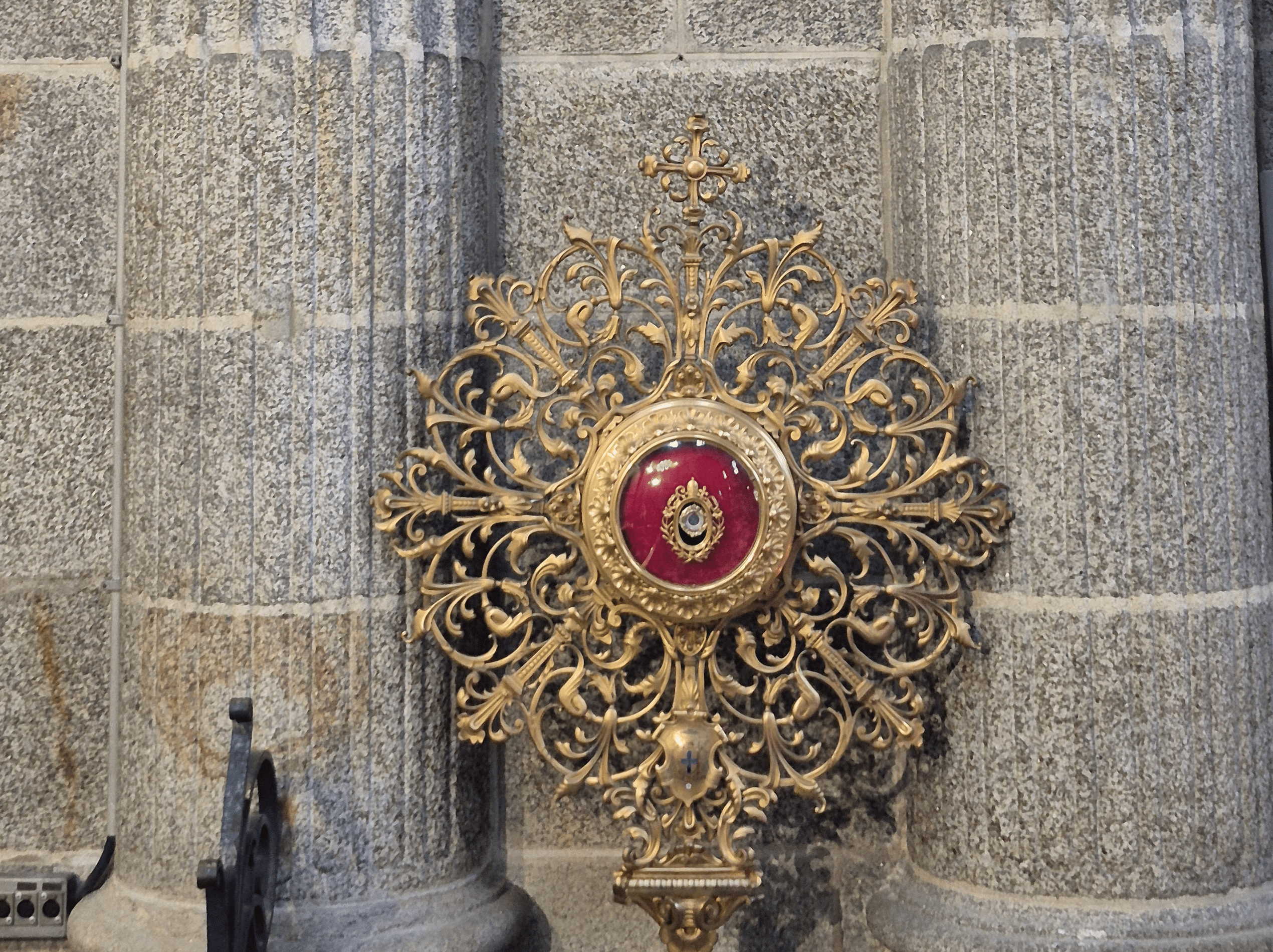
Standing before the golden reliquary, one realizes that the massive weight of the stone vaults above exist solely to protect this small, delicate piece of fabric. It is a powerful metaphor for the Christian life: the grandest structures of our lives and institutions are ultimately meant to house the simple, humble reality of the Incarnation.
The True Queen of France
If the pilgrim follows the hierarchy of glorious features, moving from the relic to the High Altar is the final step of this interior traverse. If the Sancta Camisa is the hidden heart, the High Altar is the public stage—the point where all the vertical lines of the Gothic arches finally meet the earth. The sanctuary of Chartres presents a striking contrast. While the rest of the cathedral is defined by the deep, cool shadows of the centuries old “Chartres Blue” glass, the High Altar is dominated by the brilliant, white marble of the 18th century.
At the center stands the massive Assumption of the Virgin by the sculptor Charles-Antoine Bridan. Carved in 1773, it depicts Mary being swept upward by angels into a cloud of glory. After the earthly feel of Our Lady of the Pillar and the antiquital feel of the choir screen, this altar brings the narrative back to the Supernatural. Thankfully and perhaps miraculously, this glorious sculpture would survive the ransacking that would follow a few years later during the French Revolution. While revolutionaries were smashing statues of kings and saints, some historians posit that “The Assumption” was spared because it could be re-branded as “Lady Liberty.” The intent was to convert the church into secular temple of reason. It has been observed that because the statue depicts a woman breaking free from the earth and rising toward the sky, it could serve as a symbol of the “Liberation of the People.” Whether by divine providence or clever re-branding, the “Queen of France” remained on her pedestal while the other monarchical figures of France were being toppled.
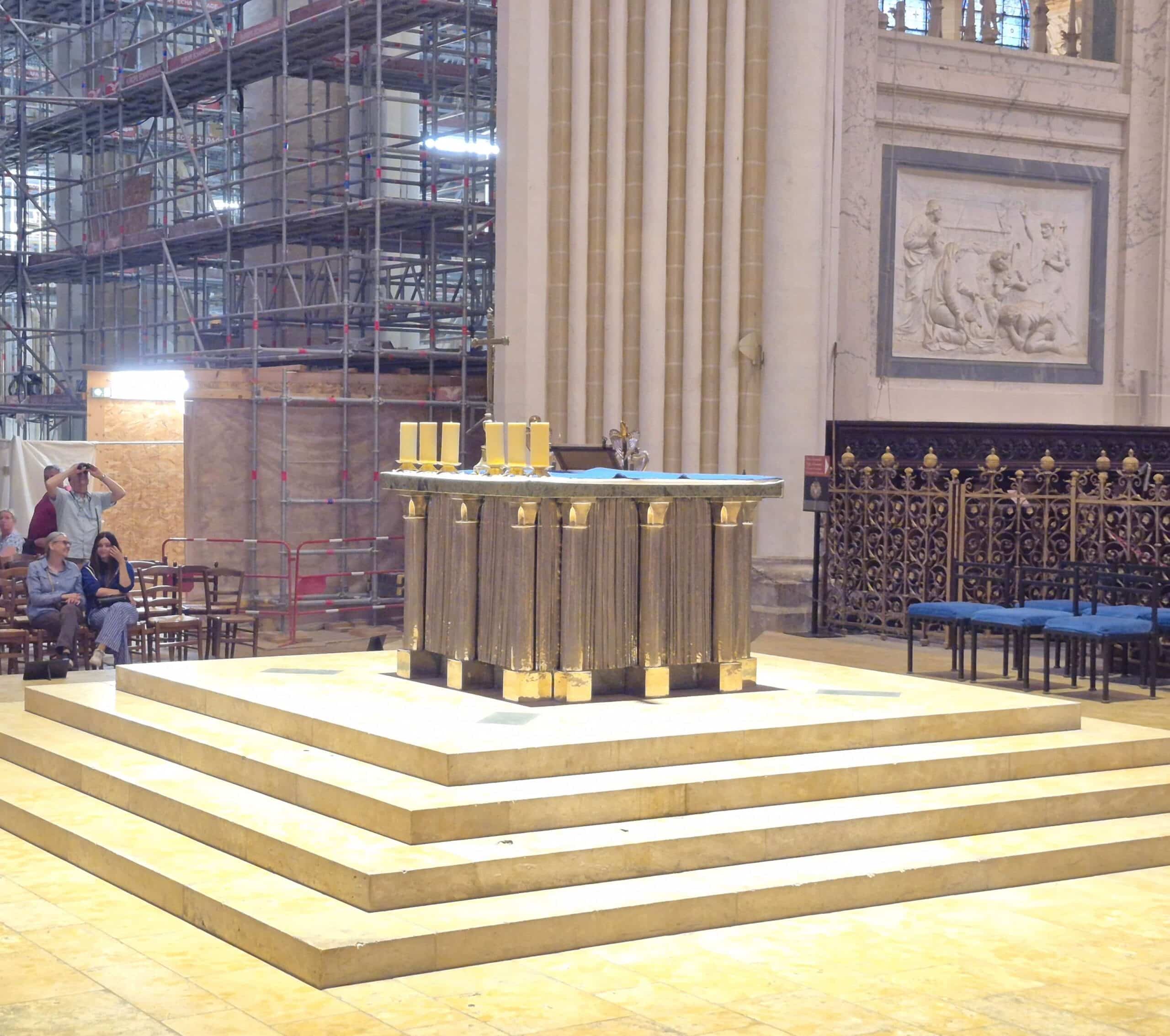
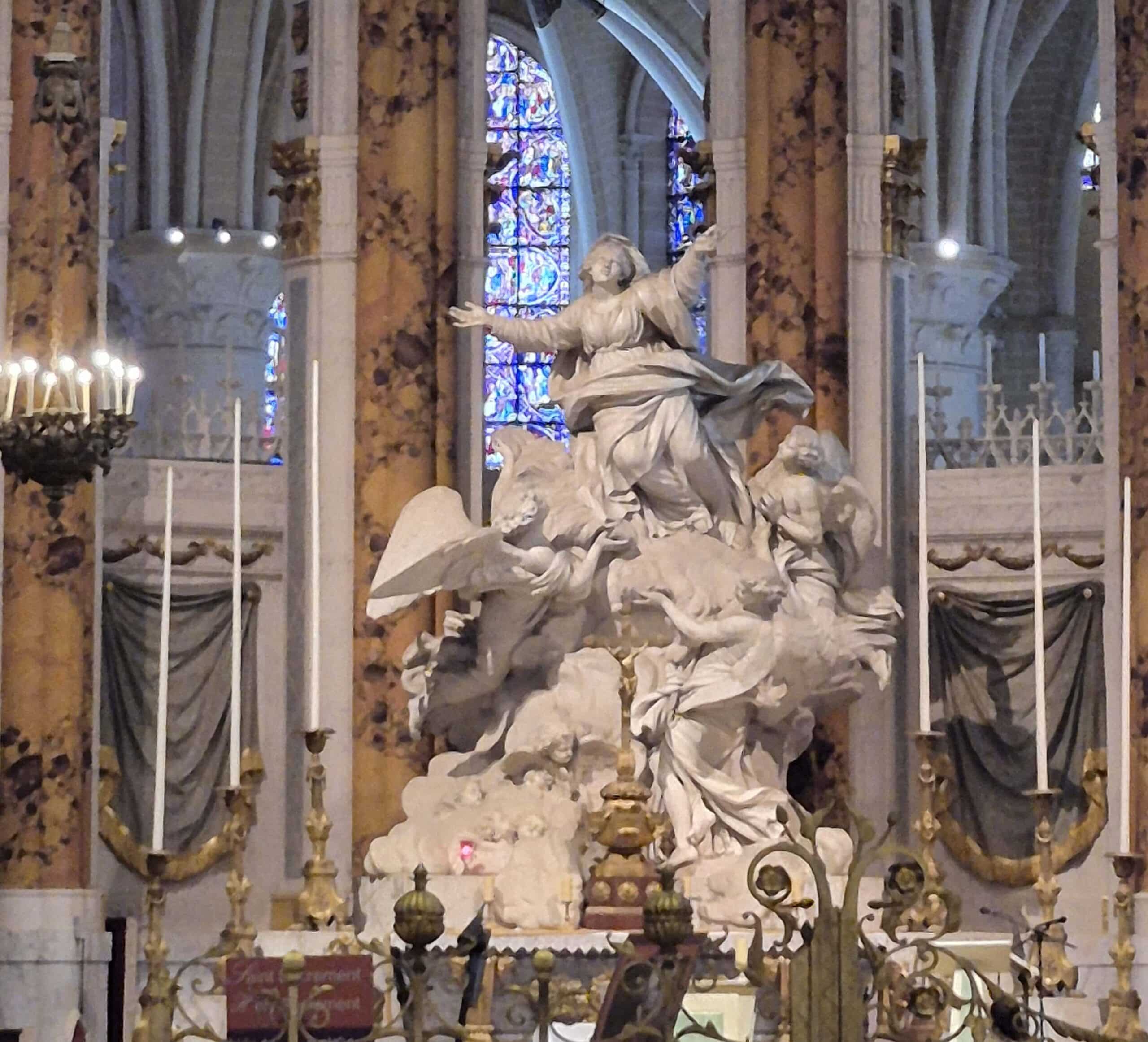
To stand before this altar is to feel the pull of heaven that Ven. Anne Catherine Emmerich so vividly recounted in her visions. Her description provides a startlingly clear script for the drama unfolding in the stone:
I saw the Apostles and disciples once more standing round the Blessed Virgin’s bed and praying. Mary’s face was radiant with smiles as in her youth. Her eyes were raised towards heaven in holy joy. Then …the ceiling of the Blessed Virgin’s room disappeared, the lamp hung in the open air, and I saw through the sky into the heavenly Jerusalem. Two radiant clouds of light sank down, out of which appeared the faces of many angels. Between these clouds a path of light poured down upon Mary, and I saw a shining mountain leading up from her into the heavenly Jerusalem. She stretched out her arms towards it in infinite longing, and I saw her body, all wrapped up, rise so high above her couch that one could see right under it. I saw her soul leave her body like a little figure of infinitely pure light, soaring with outstretched arms up the shining mountain to heaven. The two angel-choirs in the clouds met beneath her soul and separated it from her holy body, which in the moment of separation sank back on the couch with arms crossed on the breast. My gaze followed her soul and saw it enter the heavenly Jerusalem by that shining path and go up to the throne of the most Holy Trinity.
— The Life of the Blessed Virgin Mary, trans. M. Palairet, 1954 (Tan Books)
The Assumption of the Virgin is not just a theological doctrine in France; it remains a matter of national identity. In the early 17th century, King Louis XIII was desperate for an heir after 23 years of childless marriage. He placed the entire kingdom of France under the special protection of the Virgin Mary, specifically under the title of her Assumption. When his son (the King Louis XIV) was born, he declared the August 15, Feast of the Assumption (the author’s birthday) a national holiday. From that point forward, Mary was officially the “Patroness of France.”
Being In-spired Some More
Stepping out of the cool, dim sanctuary into the bright light of the square, we waited in the cobblestone square as the rest of the group slowly trickled out from the heavy oak doors, blinking in the sudden afternoon light. We had a few minutes before the bus would arrive, so we simply stood there, necks craned back, looking at the two great spires, the flying buttresses and some of the other masterful details.
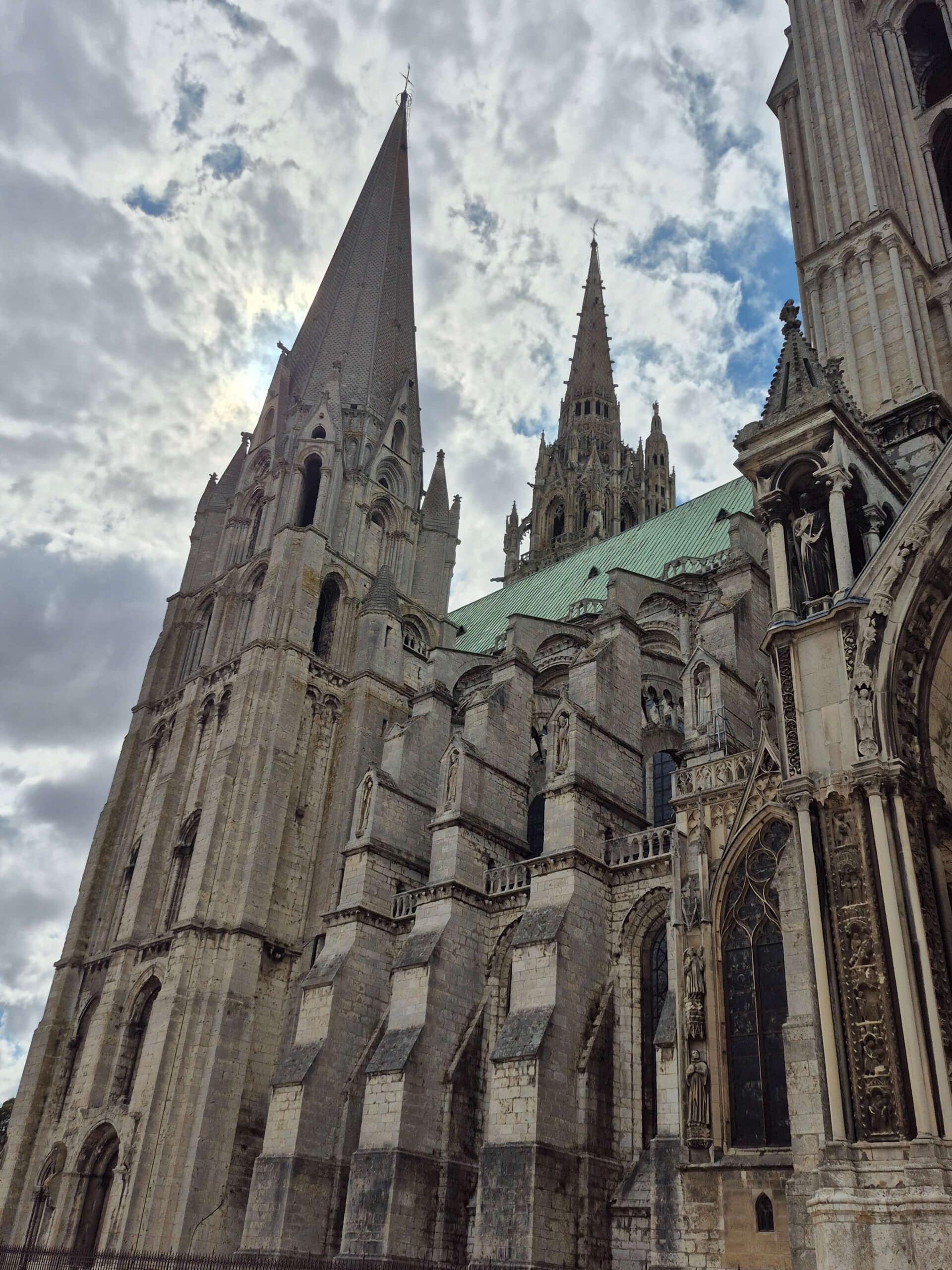
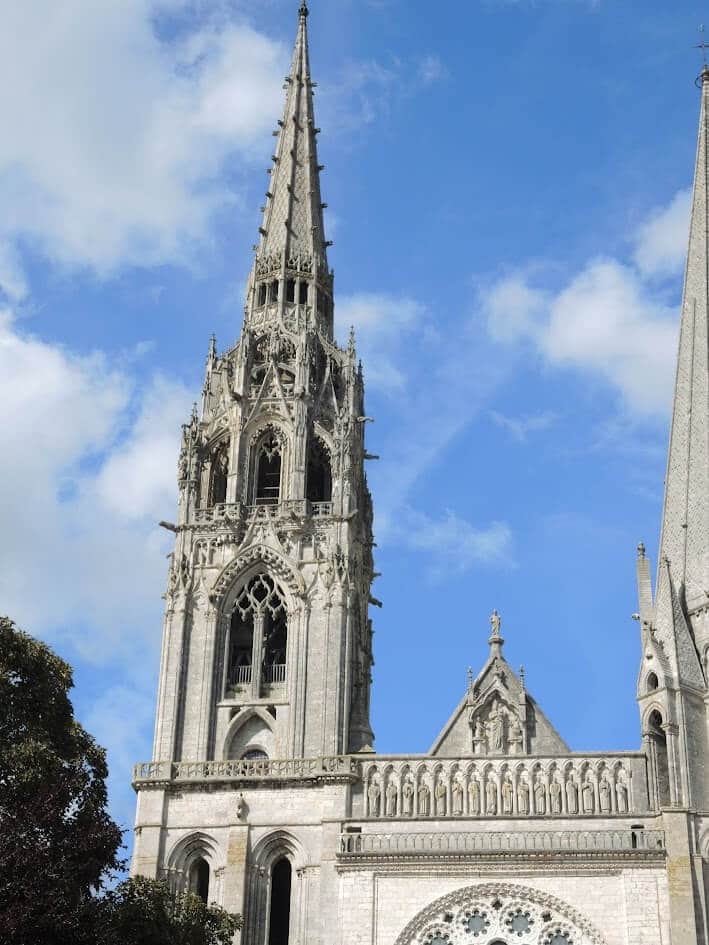
The two towers of Chartres are famous for being “twins” who aren’t identical:
- The South Spire (The Older One): Reaching roughly 344 feet, it is a masterpiece of 12th-century Romanesque simplicity. It is solid, unadorned, and rises with a pyramid-like strength. It represents the “Old World”—the foundational faith that weathered the first great fires.
- The North Spire (The Newer One): Reaching higher at 377 feet, it was built in the early 16th century, contemporaneous with the “Stone Lace” inside in the Flamboyant Gothic style. It is lacy, intricate, and reaches for heaven with a restless, decorative energy.
They provide a stark contrast, one like an austere monk in its simple robes, the other like a cathedral canon in fanciful and flamboyant priestly garments. As a beautiful history of great human effort and divine timing, one spire saw the Crusades depart; the other saw the Renaissance arrive. Both have watched as centuries of pilgrims like us arrive with weariness and leave with lifted hearts.
Having observed the grand splendor of this stone-and-glass monument dedicated to the Mother of France, we were now ready to visit the ‘Daughter of France’ as embodied by Thérèse. If Chartres had been an education in the towering majesty of God’s holiness, Lisieux was about to teach us its intimacy, revealing how the smallest acts and the simplest things can be vast enough to hold that same Infinite Holiness.
From the High Way of Chartes to the Little Way of Lisieux
Understanding why a massive, neo-Byzantine Basilica sits upon a hill overlooking Normandy requires a departure from the grand architecture. Our guide recognized that we must first begin in the soil of the ‘Little Flower’s’ own garden. Consequently, we started at her childhood home, Les Buissonnets, before following her footsteps to the doors of the Carmel Monastery.
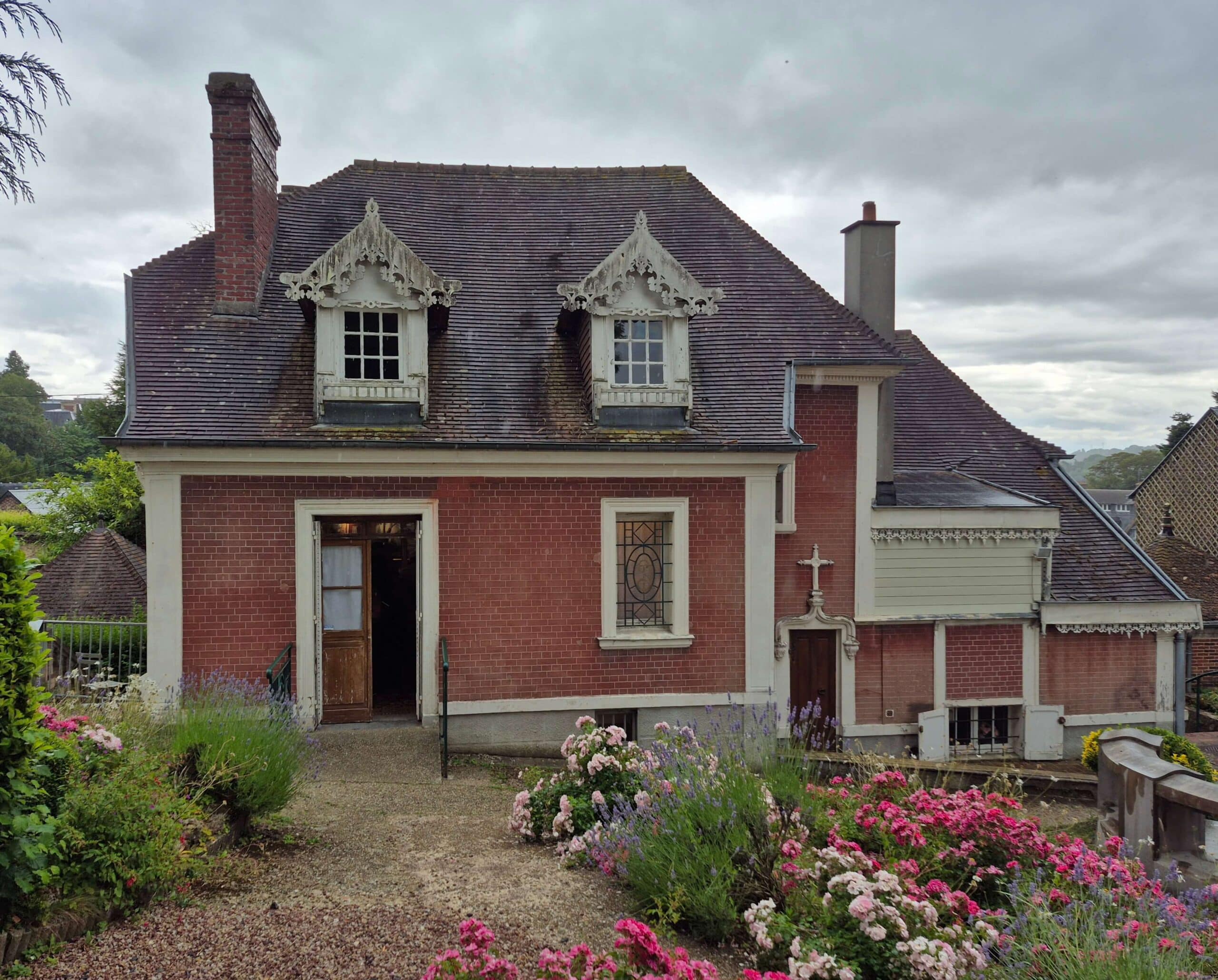
Tucked away in a quiet corner of Lisieux, we visited the red-brick and timber house where Thérèse Martin spent her formative years. To walk these grounds was to enter a world of domestic sanctity. It is a place of tidy gardens and well-worn floorboards—the literal soil where her “Little Way” took root.
She was born in 1873 in Alençon, France and baptized two days later at Notre Dame. Following the death of her mother Zelie, the family moved to the home in Lisieux, where the “Little Way” was born. It was the way of a child learning to trust her father completely after the shattering loss of her mother. This relationship with Louis bloomed into a radical understanding of God as Father—a Father whose love is so immense that we need only remain small and confident in His arms.
At that time, France was becoming exhausted by the constant tension between the modern movements of the Enlightenment and the Revolution with the traditions of monarchy and great high church sophistication. The time was ripe for a message of youthful simplicity. France was still reeling from losing the Franco-Prussian War (1870). They had been humiliated on the battlefield, lost territory, and were enduring a period of intense national penance. The soil of the faith had therefore been prepared for something new.
The Father’s Blessing
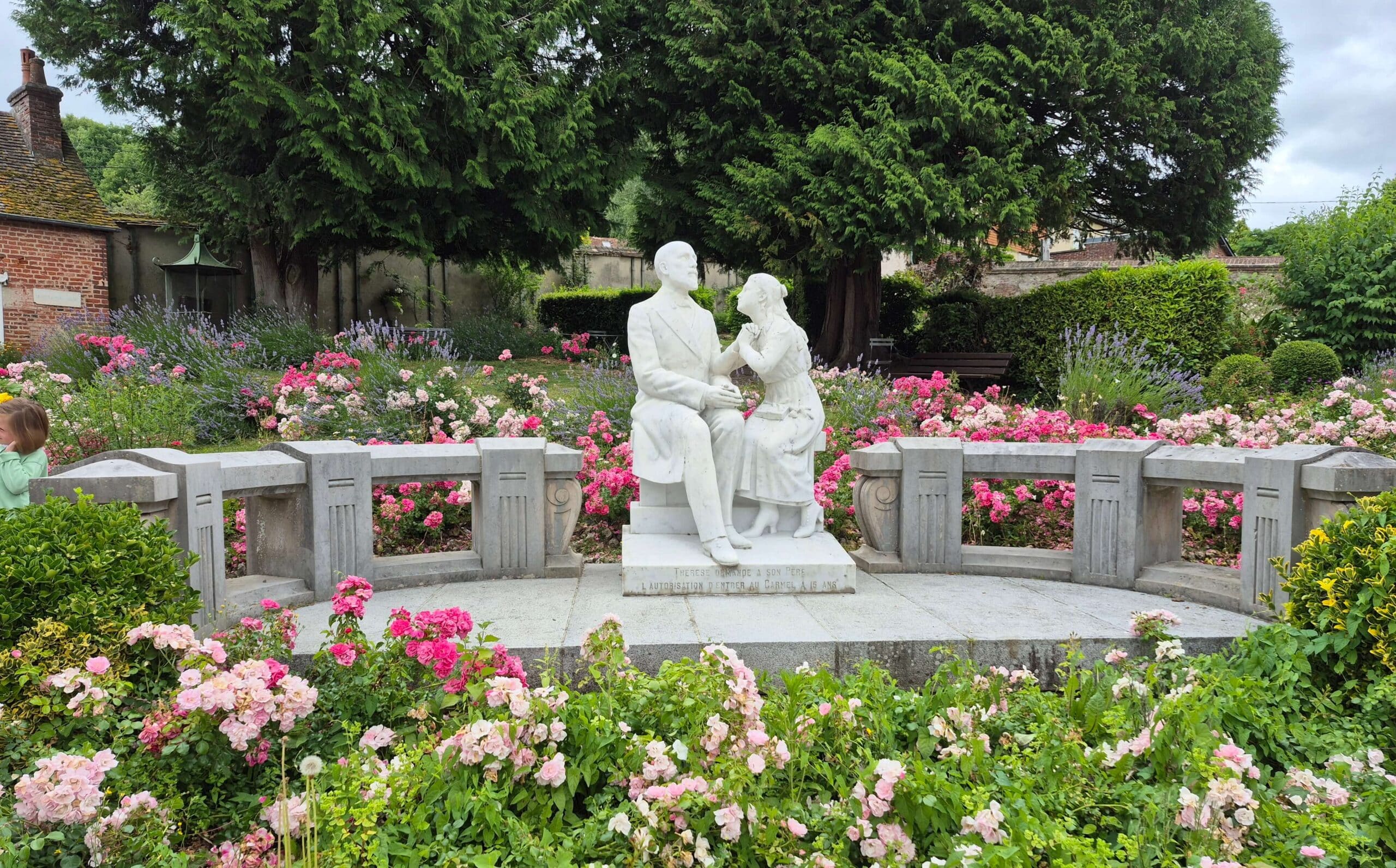
In the backyard garden, a life-sized statue captures the emotional pivot point of her life. It depicts a fourteen-year-old Thérèse sitting with her father, Louis Martin, on the afternoon of Pentecost in 1887. This was the moment she asked his permission to enter the Carmel Monastery at the impossibly young age of fifteen. Louis didn’t just say “yes;” he reached down, plucked a small white flower from the garden wall, and handed it to her. He explained that just as God had brought this little flower to life and preserved it, he would do the same for her in the convent.
Thérèse entered the Carmel at a time when being a nun was almost a counter-revolutionary act. The Third Republic was aggressively secularizing. They were removing crucifixes from schools and expelling religious orders. Her youthful simplicity wasn’t just sweet—it was defiant. She was reclaiming the “French Daughter” identity from the increasingly secularized Republic.
Little Way? Way! Therese’s Entry into Carmel
The Little Flower was thus transplanted from the warmth of the family home and garden to the cool desert austerity of the Carmel cloister. While on a pilgrimage to the house places of Italy such as Loreto, she would ask the Holy Father Pope Leo XIII with childlike audacity to be able to enter Carmel at the age of fifteen. On April 9, 1888, the heavy doors of the cloister swung shut behind young Thérèse Martin, marking her transition to a lifetime vocation in service to the church for her newfound spouse, the Lord Jesus. She made her religious profession on September 8, 1890, on the Feast of the Birth of the Blessed Virgin Mary. When she entered the Carmelite monastery, she took the name St. Therese of the Child Jesus and the Holy Face. In explanation of why she added “Holy Face” to her name, she said, “I desire that, like the Face of Jesus, my face be truly hidden that no one on earth would know me. I thirsted after suffering and I longed to be forgotten.” Pray the “Holy Face Devotional Prayer” here.
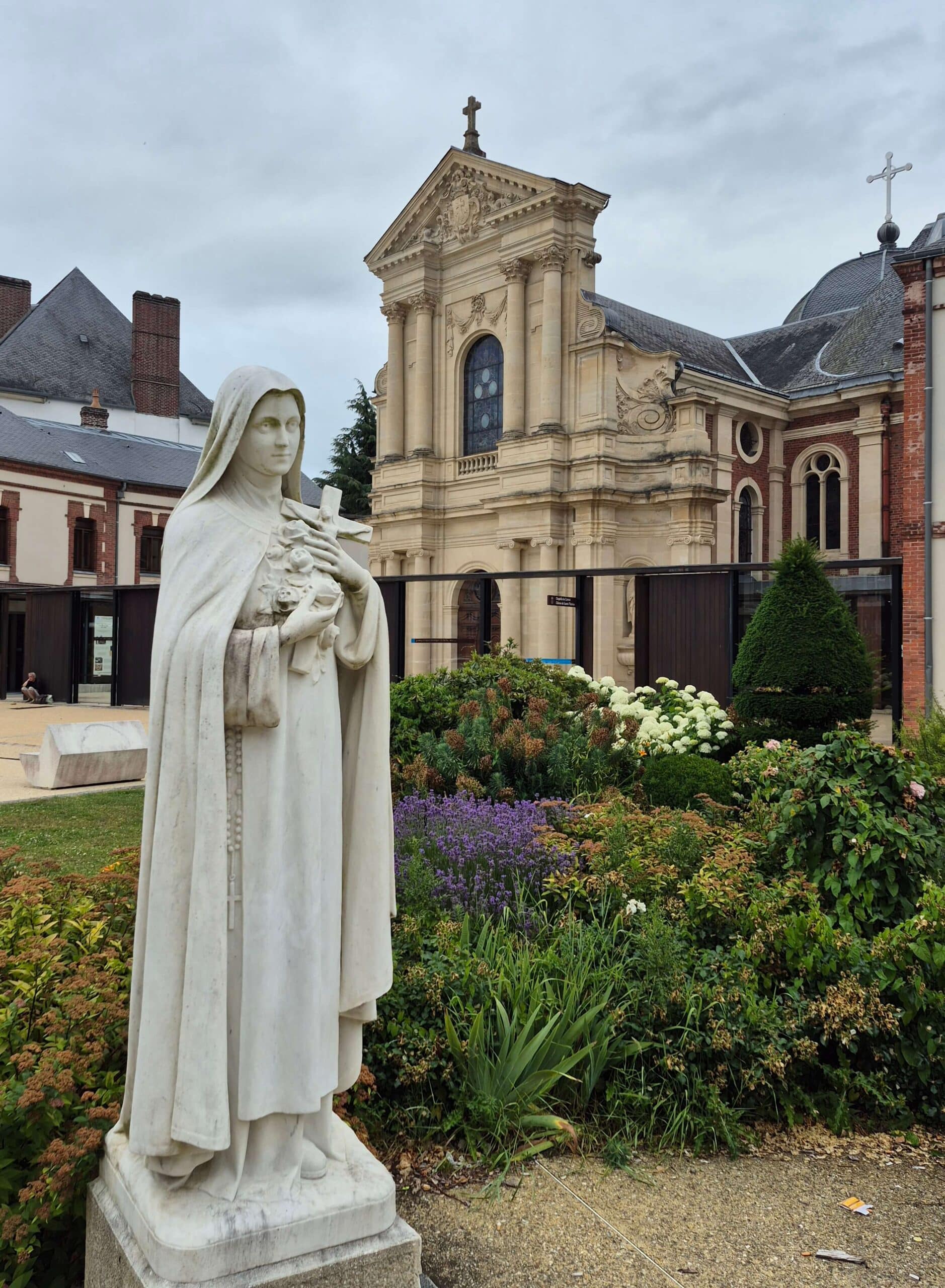
She would pursue the way of perfection with genuine fervor and fidelity as outlined by the Carmelite Foundress, Saint Teresa of Jesus. As a nun, she seemed to do nothing “grand” by the world’s standards—she swept floors, folded laundry, and suffered through illness. Behind these walls, Thérèse spent nine years in total obscurity. Yet her internal life was so vast that it eventually burst through the walls of her convent to reach the ends of the earth. A sickly girl from Normandy became the most famous Frenchwoman in the world. You can read more about her “Morning Offering” and follow her example on this site.
She spent hours in silence, her “Little Way” taking shape in the way she treated a difficult sister with the same kindness she would show a saint. While the architects of Chartres used stone and glass, Thérèse used the minimalness of her daily routine to build an interior cathedral out of her soul to be dedicated to God.
Thérèse famously called her spirituality the ‘Science of Love’—a path that didn’t require great deeds, but rather total abandonment to God’s mercy and love. Visit the page “Ten St. Therese Quotes” for more of her wisdom on loving God and neighbor.
The more Thérèse shrank herself through humility, the more space God had to work. Her internal life became so vast that it could no longer be contained by brick and mortar.
During her final days, she suffered greatly from tuberculosis. While some saints bore the suffering without complaint, the records of her final days give blunt accounts of the struggles, doubts and temptations she faced. You can learn more about her struggle on the page “St. Therese of Lisieux Quotes That Show Her Struggle.”
When she died at twenty-four, her “Story of a Soul,” the autobiography written under obedience, acted like a spiritual transfusion to a forlorn Catholic France.
Inside the Cloister: Birth of a Doctor
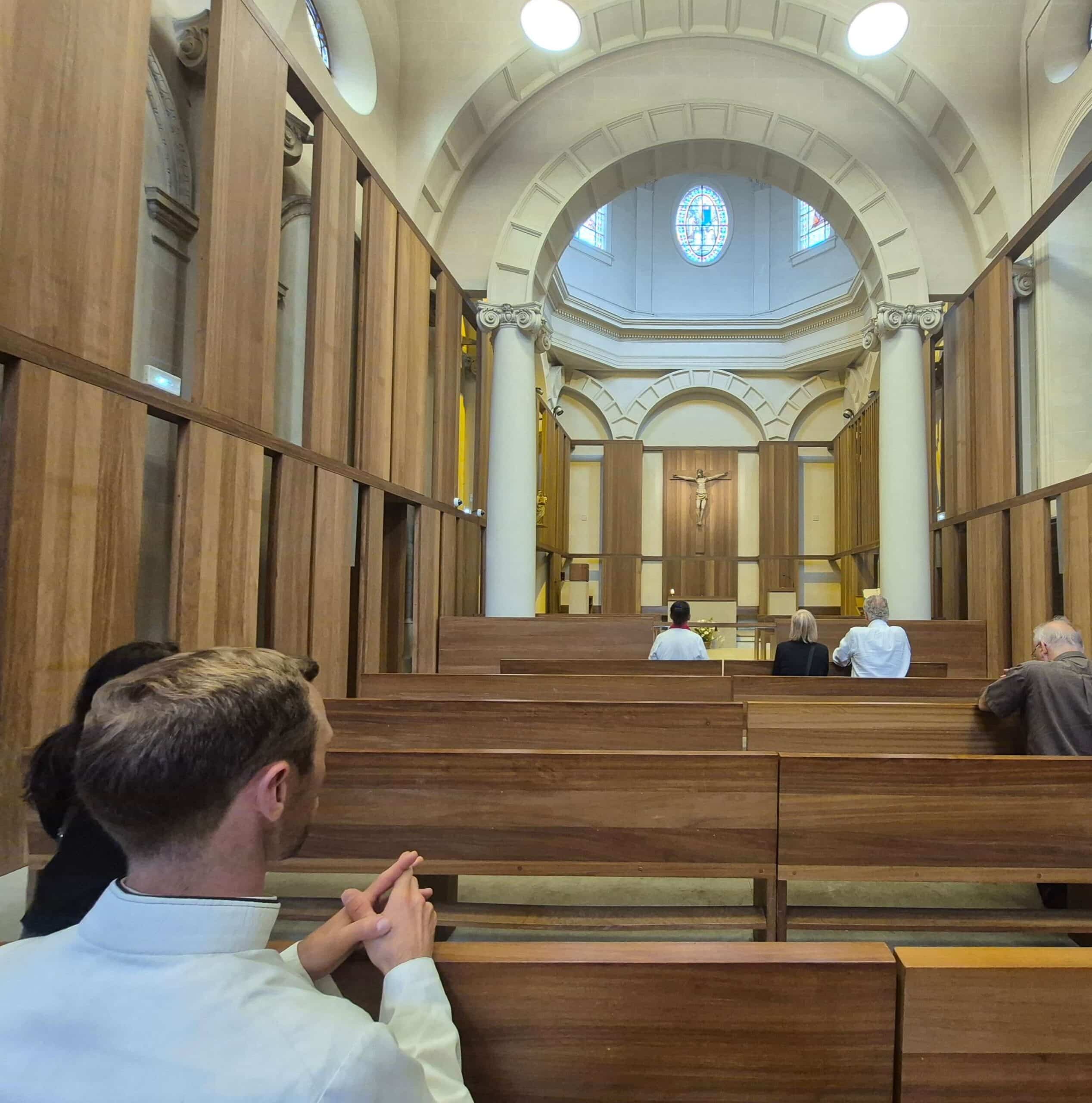
Entering Carmel, one is struck by how unassuming it felt compared to the soaring vaults of Chartres. There are no flying buttresses here with grandiose carvings and intricately stained windows, only symbols of the quiet, simple life of the sisters. Even the “wreckovation” and modernization of the public chapel area (which I would normally abhor) almost seemed suitable in this case to illustrate the simplicity of Therese’s vocation.
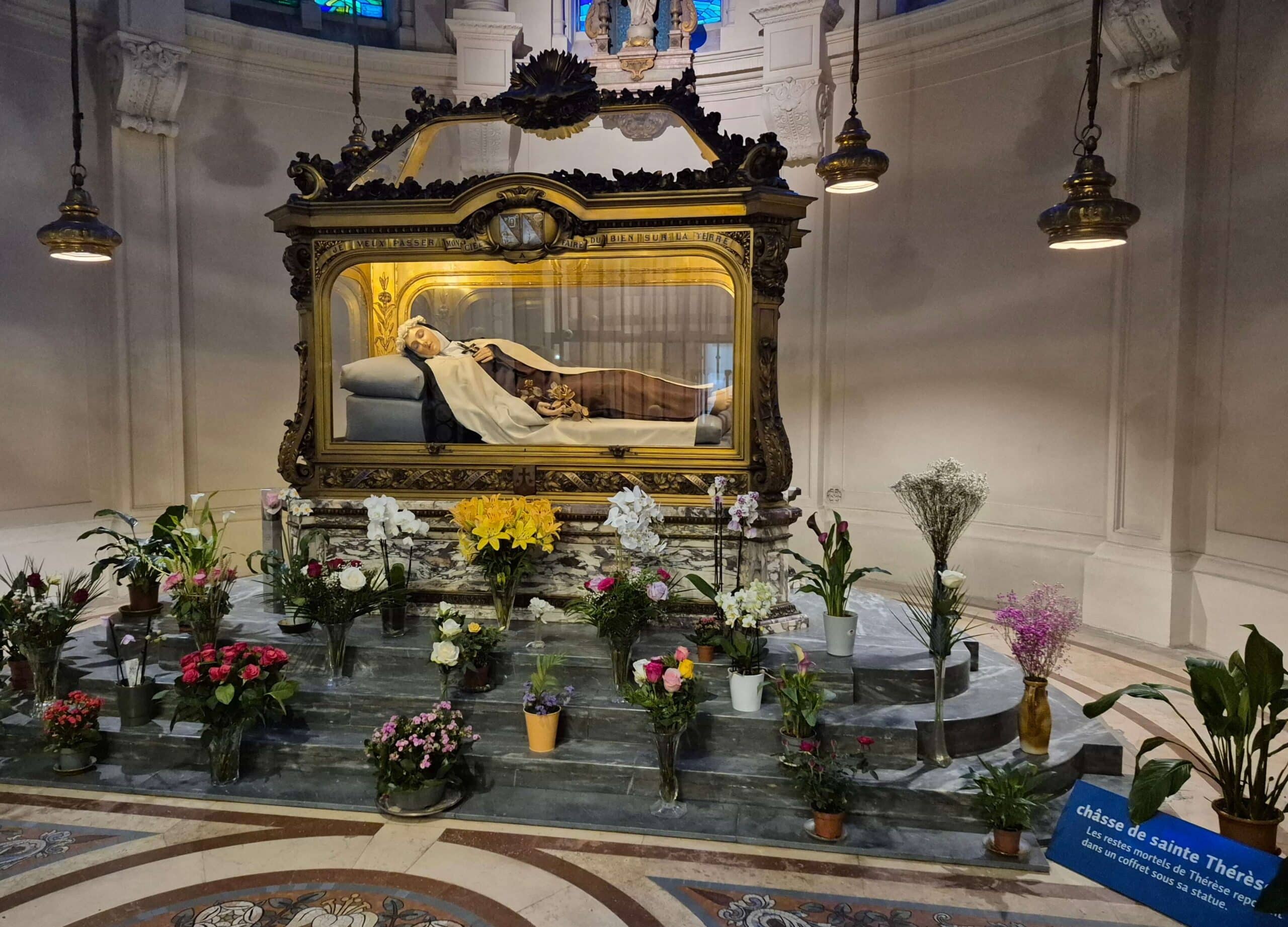
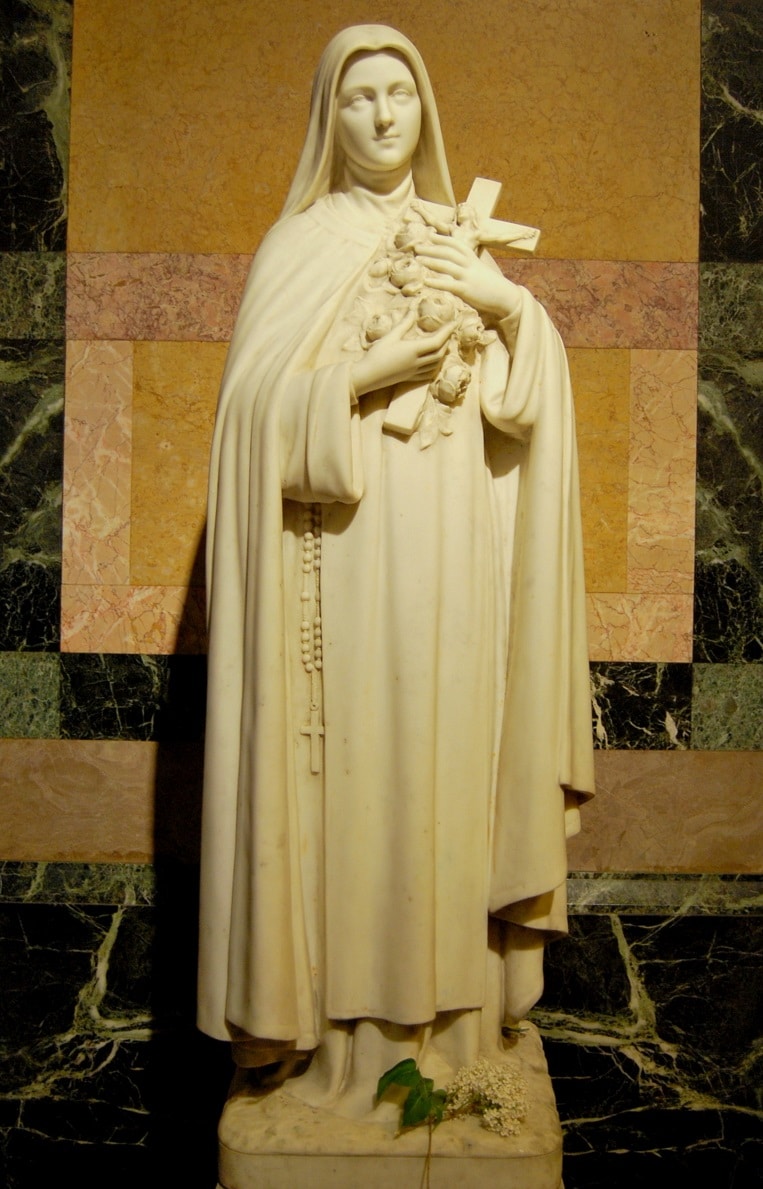
The climax of the visit to the Carmel is the Chapel of the Reliquary, the famous recumbent statue of St. Thérèse. The carved figure depicts Thérèse as she appeared at the moment of her death at age twenty-four. She is dressed in her Carmelite habit, her face serene, with her hands clutching a crucifix and a bouquet of roses. To look at her reclining in the peace of death is to see the victory of the ‘Little Way.’ She proved that the most powerful thing one can do with a life is to give it away, one tiny, unnoticed sacrifice at a time.
The legacy of Therese was a direct challenge to the idea that holiness was reserved for the spiritual elite or those capable of heroic feats. She taught that God is not a distant judge, but a Father who cannot resist the love of a child. Her teaching was centered on spiritual childhood: a total, confident surrender to God’s mercy. She became another patroness of France alongside Joan of Arc. While Joan represented the martial, public defense of the nation, Thérèse represented the internal, spiritual resilience of the French people.
However, her short life of work was not yet done. She had famously promised, “After my death, I will let fall a shower of roses. I will spend my heaven doing good upon earth.” Stories of her miraculous interventions, including “Showers of Roses” as a sign or manifestation of her intervention spread rapidly among the faithful. You can learn more about this at the page “Miraculous Invocation of St. Therese.”
My father once told me he faced an important personal decision (he never told me what is was). He asked for a sign of roses as an affirmative answer from heaven regarding this matter. Soon after, my parents had a visitor unexpectedly drop by–bearing a bouquet of roses! A friend had just attended a funeral nearby and they were passing out the flowers to the visitors. This friend felt compelled to take a vase of roses and give it to my parents.
The Science of Love: A Revolutionary New Doctrine
During the exhumations of her remains in 1910 and again in 1923, witnesses consisting of a mix of skeptical doctors and solemn clergy recorded a phenomenon that defied clinical explanation. As the tomb was opened, the air was not thick with the expected dampness of the earth, but instead filled with a powerful, inexplicable fragrance of roses. In the tradition of the Church, this is known as the ‘Odor of Sanctity.’ It was an inexplicable sign that defied the natural progression of bodily decay—a sensory sign that the saint had remained in communion with the divine even in death. For those present, it was the first earthly proof of the “shower of roses” she had promised to send from heaven.
In 1997, Pope John Paul II declared her a Doctor of the Church. The title was a tectonic shift in ecclesiastical honor, historically reserved for the great minds who codified the faith: the Aquinas’s, the Augustines, and other the heavy-hitting theologians of the Western world.
France, a nation that prides itself on its tradition of dense philosophy and intellectual rigor, was suddenly forced to reconcile its legacy with a new kind of “Doctor.” They had to acknowledge the wisdom of a young girl from a provincial Carmel who claimed to know nothing of complex theology, but everything about the “Science of Love.” She dismantled the intellectual elitism of the faith, proving that the most profound theological truth is often the simplest one: that we are loved, and that we are called to love in return.
As we finally turned our backs on the Carmel, we were, in a sense, saying goodbye to the “Daughter” in her physical state, that girl who struggled with silence and the cold of the cloister. But as we stepped onto the bus, the tone of our pilgrimage shifted. We had spent the morning looking at her path of earthly life to grave; but now we were preparing to look upward at the scale of her eternal glory. We were leaving behind the history of her mortality to enter the vast, golden architecture of her influence.
The Scale of a Soul: The Basilica
By this point in the pilgrimage we had been accustomed to seeing great basilicas and cathedrals dedicated to legendary royal and saintly figures of history but it was a little surreal to see a mammoth basilica dedicated to a comparatively young girl with such a short life. Even more so amazing, that her short life would be worthy of being made a Doctor of the Church!
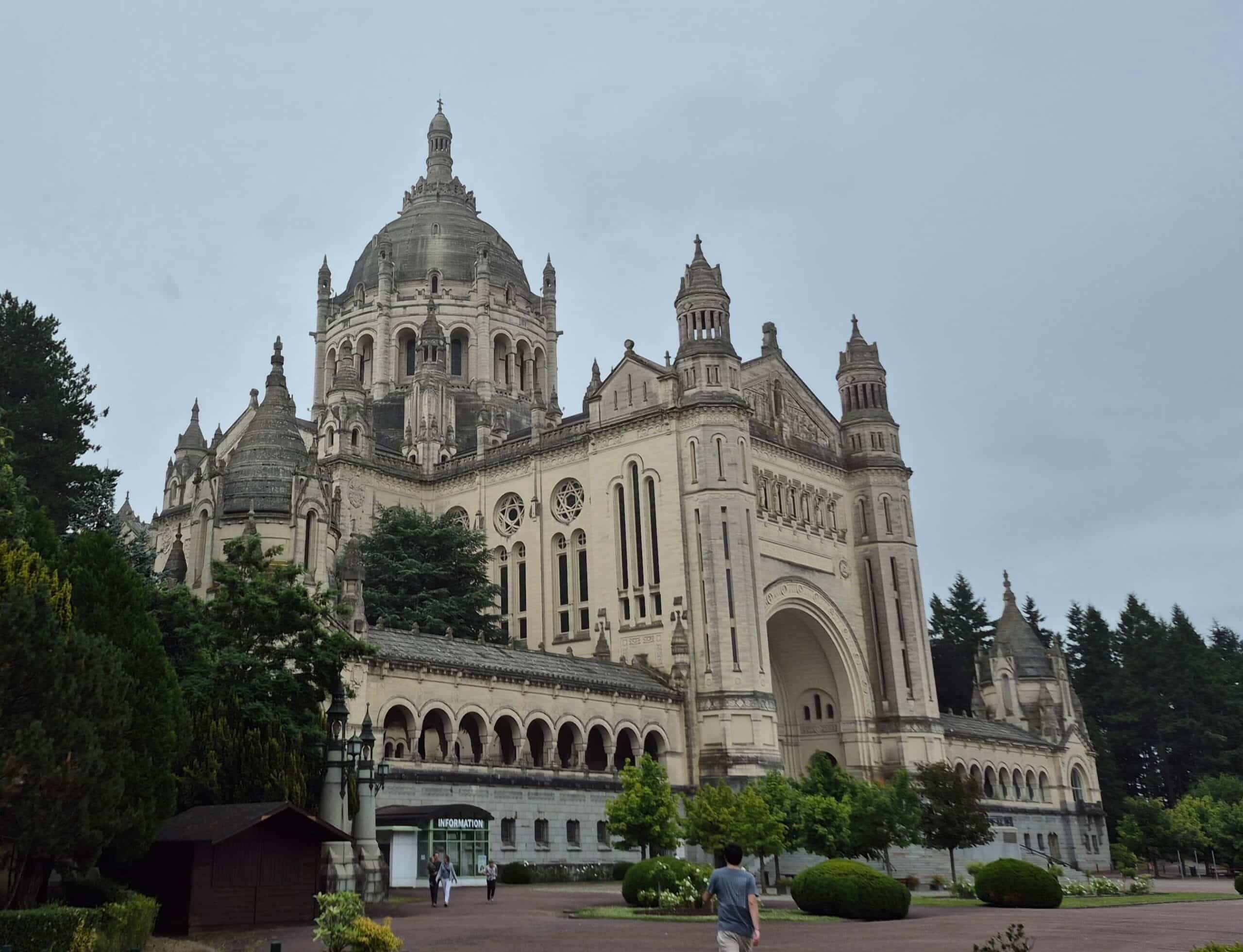
The Basilica of St. Thérèse is not a relic of the Middle Ages; it is a modern miracle of 20th-century devotion. Construction began in 1929, just four years after her canonization, because the crowds of pilgrims descending on Lisieux had become so vast that the local Carmel chapel and the town’s church and cathedral simply could not hold them.
To honor the “Little Flower,” the architects chose a scale that was anything but little. The building was designed in the Neo-Byzantine style inspired by the Sacré-Cœur in Paris to emphasize the universal nature of her message. It is one of the largest churches built in the 20th century, The central dome rises 311 feet into the Normandy sky, capped by a crown that can be seen for miles across the countryside. The upper basilica can accommodate 3,000 people, designed with a completely open floor plan and no pillars to blocking the view. Unlike Chartres, which is famous for its glass, Lisieux is famous for its mosaics. Over 4.5 million tiny tiles of glass and gold leaf cover the interior, creating a shimmering, climate-controlled “tapestry” that never fades.
Nave and Transept: A House Without Walls
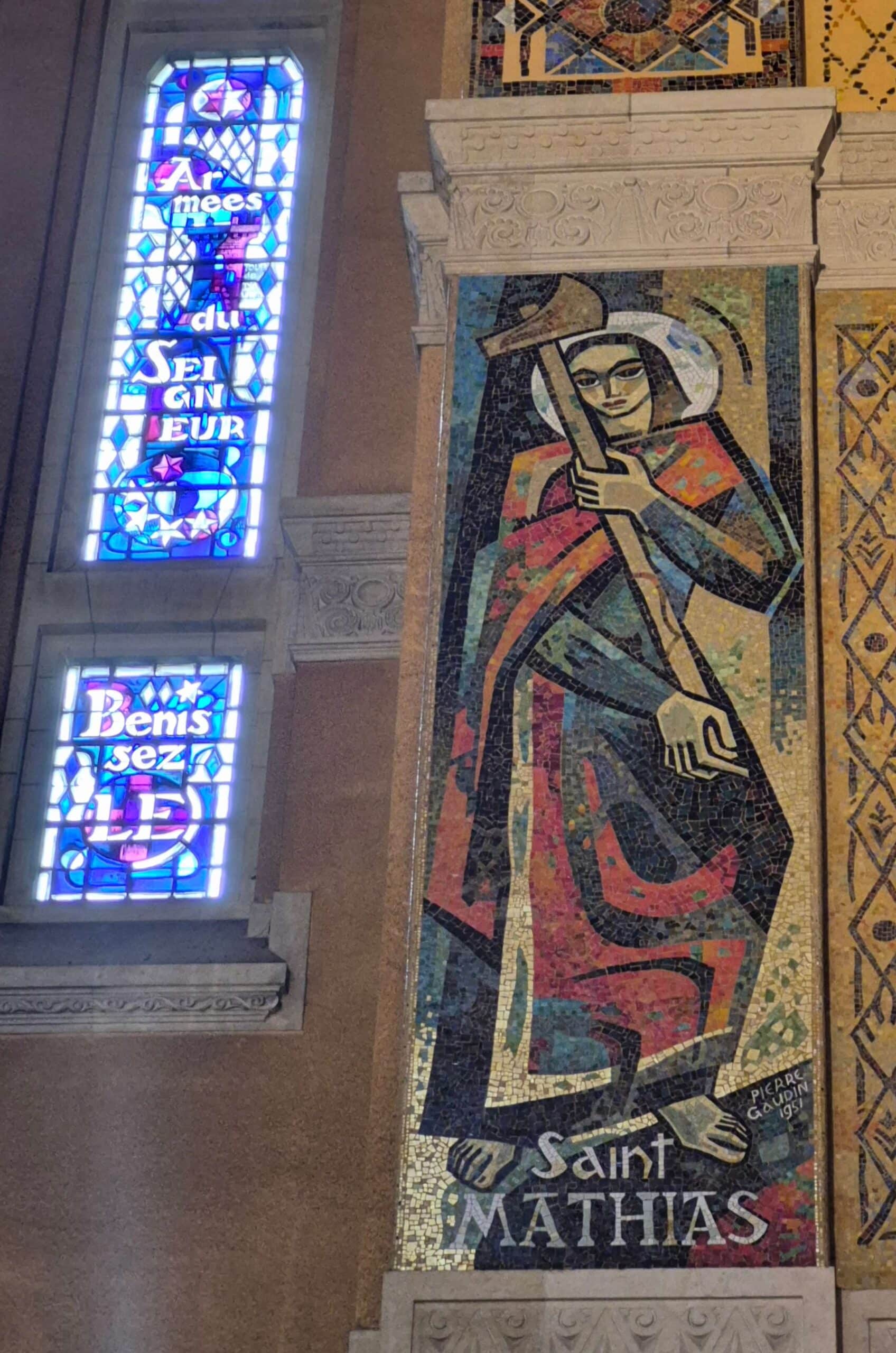
At Chartres, the massive stone pillars were like the trunks of an ancient forest, beautiful but imposing, a reminder of the weight of history and the distance between the human and the divine. But at the Basilica of Lisieux, the architects achieved a 20th-century marvel: a nave with no pillars and therefore no obstructed views. By removing the pillars, the architecture mirrors Thérèse’s own simpler theology of the Little Way—that there need not be anything standing between the soul and God.
In the nave, the mosaics are of greater emphasis than the stained glass windows. Unlike stained glass, which relies on external sunlight to function and introduced colored lights, the mosaics possess an internal and more diffused color source to represent a faith that glows even when the sky outside is grey. A mosaic is, by definition, a collection of thousands of tiny, insignificant fragments that only become a masterpiece when they are fitted together by the hand of the Artist. It is a metaphorical representation of how many, many “Little Ways” can achieve great beauty and greatness.
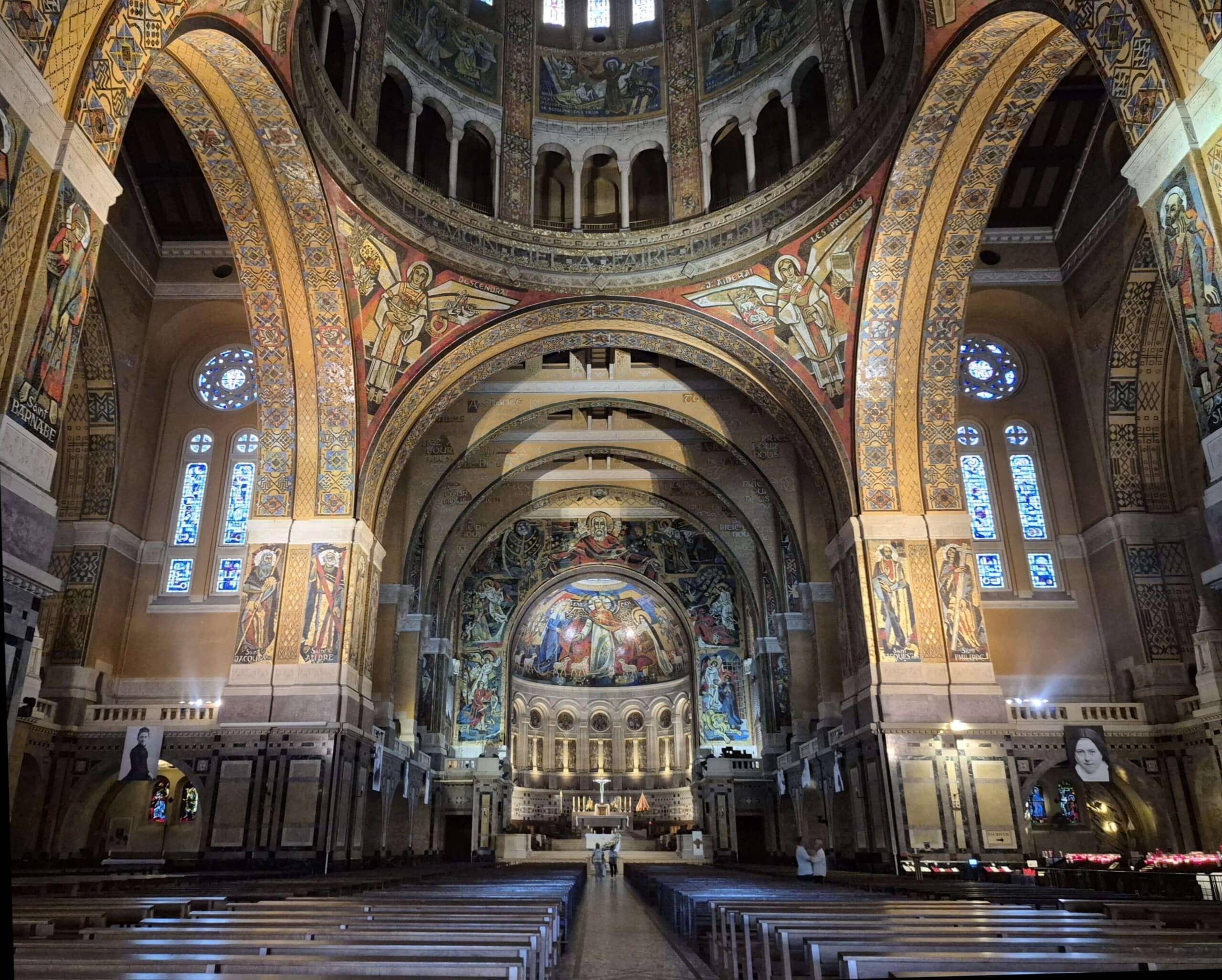
I previously mentioned the tuning of the windows at Chartres. There is a distinctive light tuning scheme of the mosaic as wells. In the traditional method, an artist glues tiles onto a wall one by one. But for a project as massive as the Basilica, that would have taken too long. Instead, the artists used the Reverse Method: Artists in workshops drew the designs onto large sheets of heavy paper as a mirror image (backwards). They glued the colored glass tiles face-down onto the paper. For months, the artists only saw the rough, grey backs of the tiles. They had to trust their skill and the blueprint, never seeing the beautiful colors they were actually creating. The completed paper panels were shipped to Lisieux, pressed into wet mortar on the Basilica walls, and then once the glue dried, the paper was peeled away with water. Only then, for the first time, did the facing of the mosaic see the light. Because the tiles were pressed into the mortar all at once, the surface was perfectly uniform in its reflection of light. This now even more so seems like the perfect metaphor for the hidden beauty of all her little acts! Her ‘Little Way’ is a reminder that we don’t always get to see the masterpiece we are building with our daily choices, but we just have to keep placing the tiles in the hidden mosaic of our soul.
The High Altar: Where Little Becomes Great
If the nave is the body of the church, the altar is the soul, and it is framed by a mosaic canopy that is breathtaking in its symbolism. The high altar is positioned directly under the Great Dome, acting as the focal point of that massive, pillar-less span. Because there is nothing to block the view, the altar well equipped for the celestial drama that unfolds at each Mass.
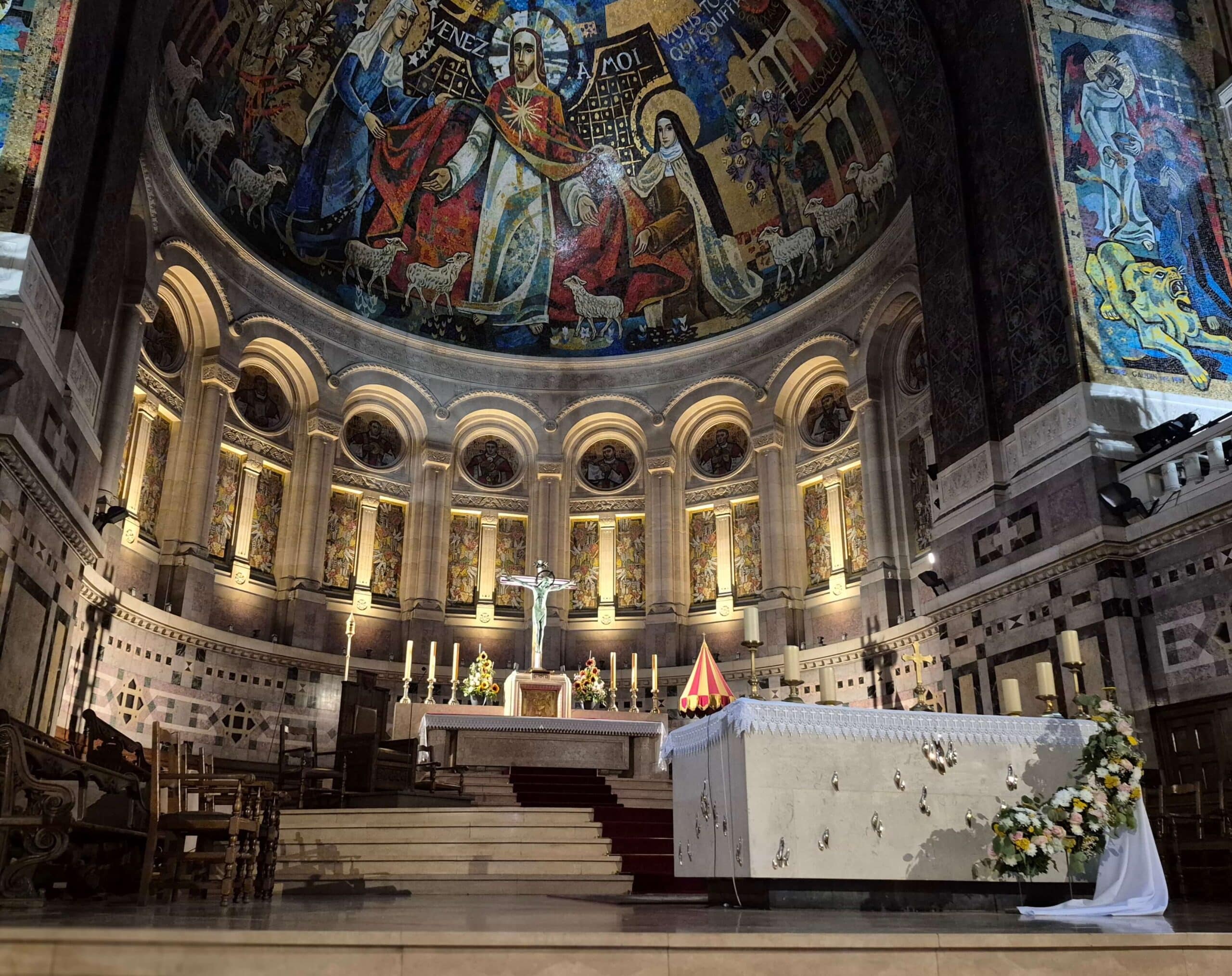
The altar itself is carved from pristine white marble, standing in stark, elegant contrast to the dizzying colors of the mosaics surrounding it. It is simple, solid, and central, as St. Therese would want it. Thérèse had a profound, almost child-like devotion to the Eucharist. She famously wrote, “I cannot find any fear in a God who made Himself so small for me.” The placement of this altar in such a gargantuan space reinforces that paradox: the God who created the universe as represented by the dome is the same God who makes Himself little in the Host.
In the “Shower of Roses” canopy mosaic directly above and behind the altar is a radiant depiction of the Holy Spirit and Christ. Included here is the figure of Thérèse depicted there not as a distant saint, but as an intercessor, literally leaning out from the gold-leaf heavens to drop roses onto the altar. The symbolism is clear: the graces flowing from the Mass is what fuels the ‘Shower of Roses’ she promised the world. The altar isn’t just a place of sacrifice; it’s the source of the Daughter’s miracles reported in the trenches and the sickrooms of France.
The National Ex Voto Altars
Running along the sides of the Nave and the Transepts are these beautiful, semi-circular chapels. Each one was funded and decorated by a different nation (Canada, Brazil, Ireland, Spain, etc.), representing her universality as the Patroness of Missions. Each of these side altars are essentially giant “thank you” notes. Each nation chose to depict Thérèse in a way that resonated with their own culture, often showing her blessing their specific landmarks or people.
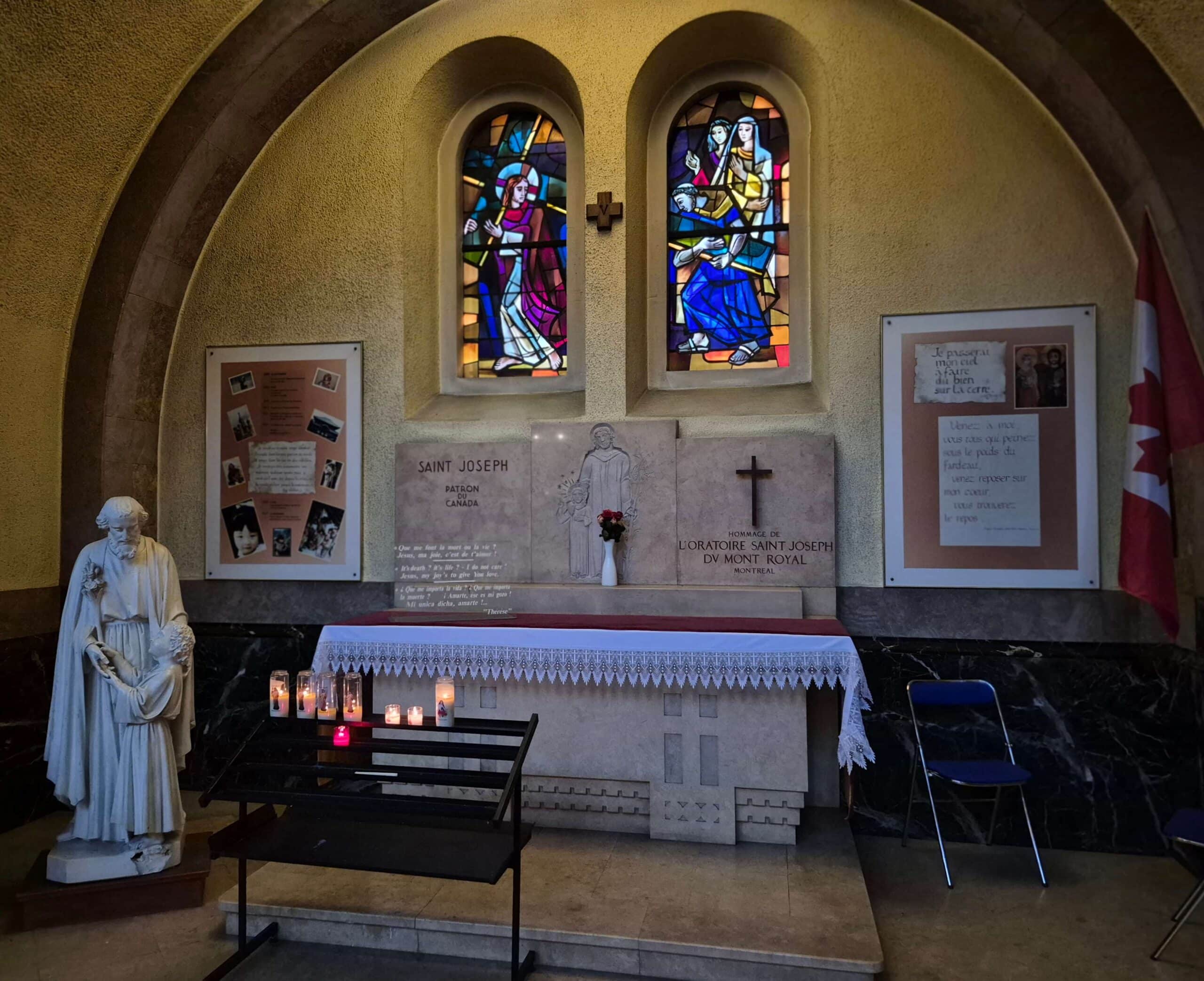
The St. Joseph Altar in the Canadian Chapel is a tribute from the people of Canada to the Saint who protected the Holy Family, reflecting the same quiet, fatherly faith that Louis Martin provided for Thérèse. The statue to the side shows St. Joseph not holding Jesus as often seen but rather guiding him as a boy. It’s a poignant choice for a Basilica built by a daughter who so deeply guided by her own father. It suggests that the ‘Little Way’ wasn’t just about being a child, but about receiving the steady, quiet guidance of a father raising and teaching his child. Canada has a deep devotion to Thérèse because she is the Patroness of the Missions. In the early 20th century, Canadian missionaries carried her “Little Way” into the vast territories of the North.
The Crypt Chapel
While the upper Basilica is all about Thérèse’s Glory, the Crypt is about her Humanity. Architecturally, the Crypt is a complete contrast to the “no-pillar” design upstairs. Here, the weight of the massive structure above is supported by heavy, low-arched columns. It was as if the architects were saying that the grand, pillar-less expanse of her spirit is only possible because it is held up by the columns of her family, her struggles, and her daily small acts of love.
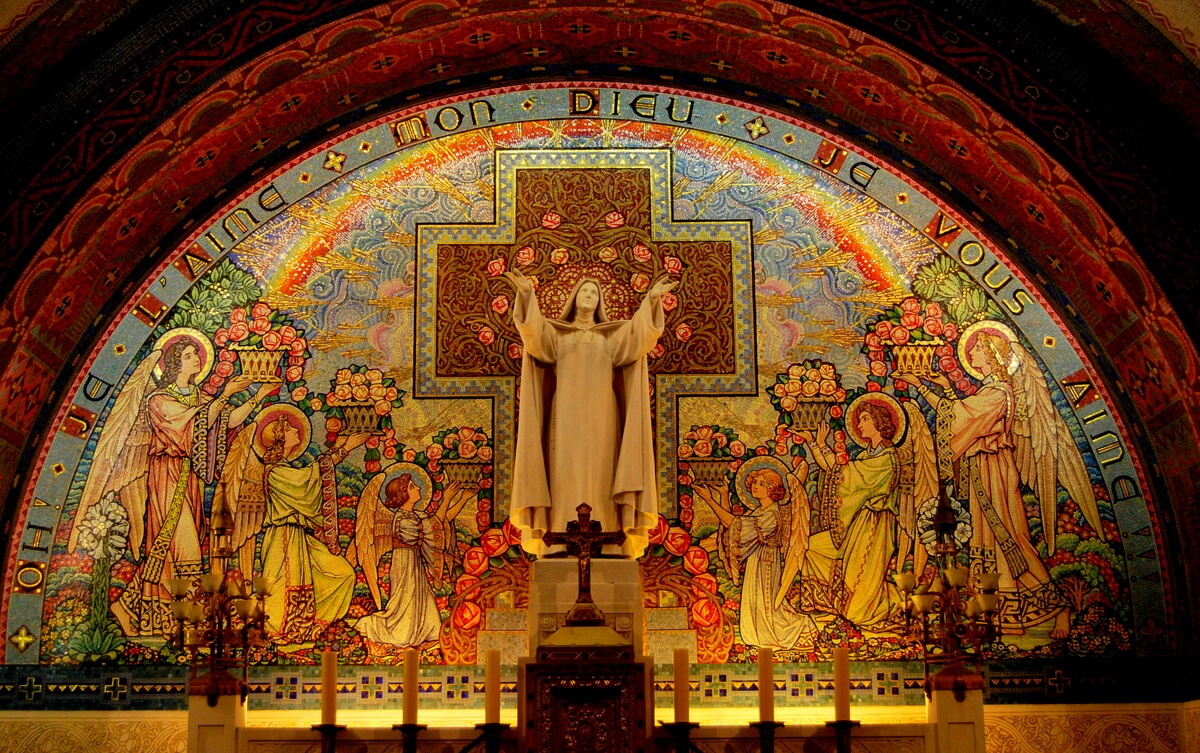
Standing in the quiet of the Crypt Chapel, I couldn’t have known that a ‘full circle’ moment was already in motion. Just months after returning home, I was surprised by a familiar sight on my social media feed: a priest friend was on a pilgrimage with his parish, retracing some of our very steps through Normandy. Seeing him concelebrating Mass in that same Crypt Chapel was more than a moment of nostalgia—it felt like a whisper of Providence.
Our history stretches back years to my time as a catechist at the Shrine of the Little Flower Basilica in Royal Oak, Michigan. Back then, he was an “adopted seminarian” that our class would pray for. He even made the time out of his busy seminary schedule to meet and talk with my class, reinforcing our connection. To see him now, standing as a priest in the heart of the crypt sanctuary, I couldn’t help but wonder if Thérèse had been tending that garden of prayers all along. It felt as though those prayers planted years ago had finally found their full, glorious bloom of roses at her altar in Lisieux.
Of course, one does not need to be a catechist or cloistered nun to pray for priests. This is the beauty of the ‘Little Way.’ Even the smallest, most hidden breath of prayer can help support the priesthood. Whether we are praying for our current pastors or the future vocations planted in the garden soil of the seminary, we are all called to participate in the lineage of our faith. If you feel called to begin your own ‘garden of prayer’ for our clergy, you can find the beautiful and profound St. Thérèse of Lisieux Prayer for Priests here on this site.
Crypt Tomb of Zelie and Louis
Having seen Therese in her “Heavenly” state; we now went into the “Womb” of the church to see where her story began, with the crypt tomb of her parents, Louis and Zélie. Since 2008, they have shared a joint reliquary tomb in the Chapel of the Holy Spouses. For decades, they were interred in a municipal cemetery of Lisieux, but after being canonized in 2015, they were brought here. They became the first married couple in history to be canonized together. This validated her “Little Way,” showing that the simple ordinary lives of a watchmaker (Louis) and a lacemaker (Zélie) could produce a Doctor of the Church.
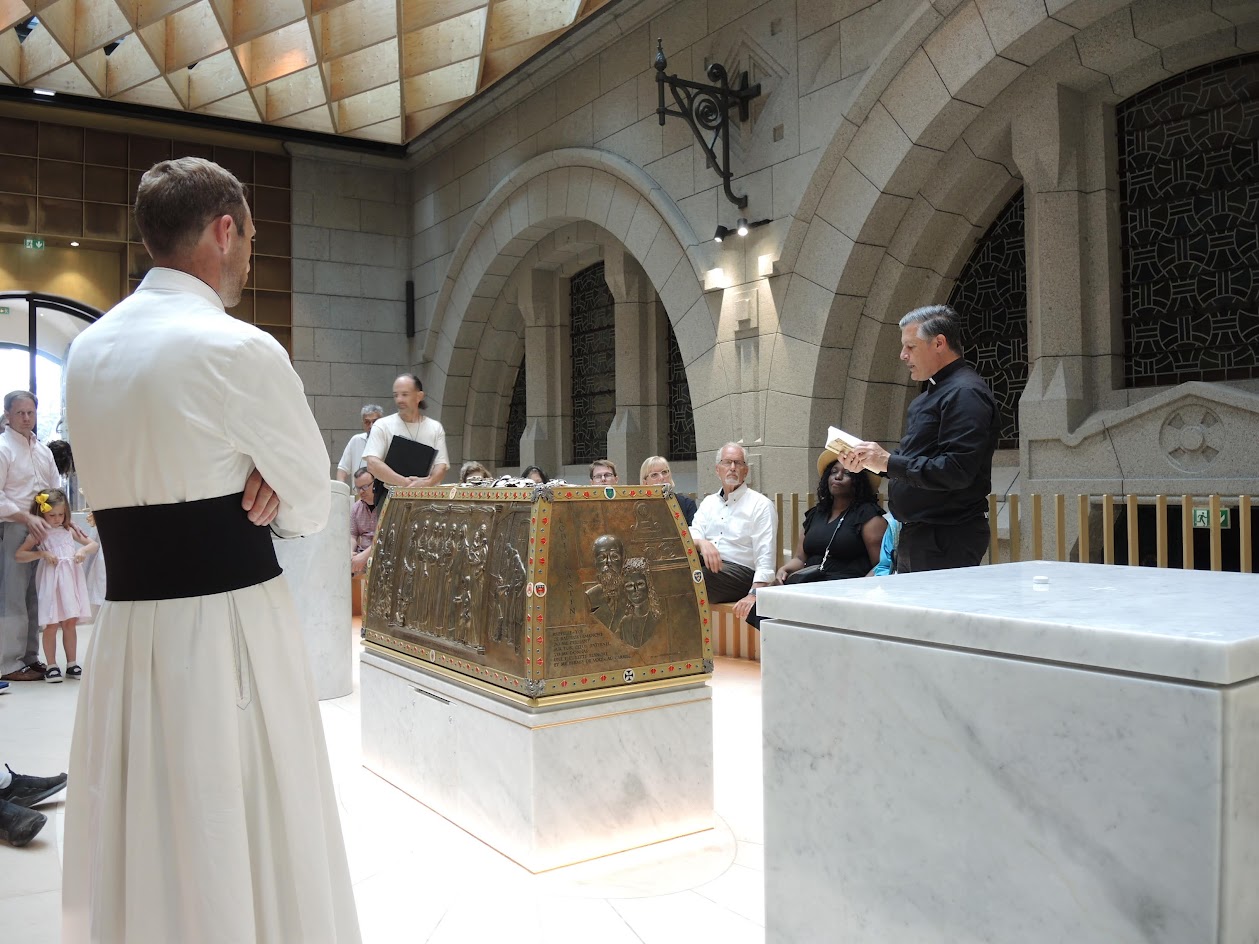
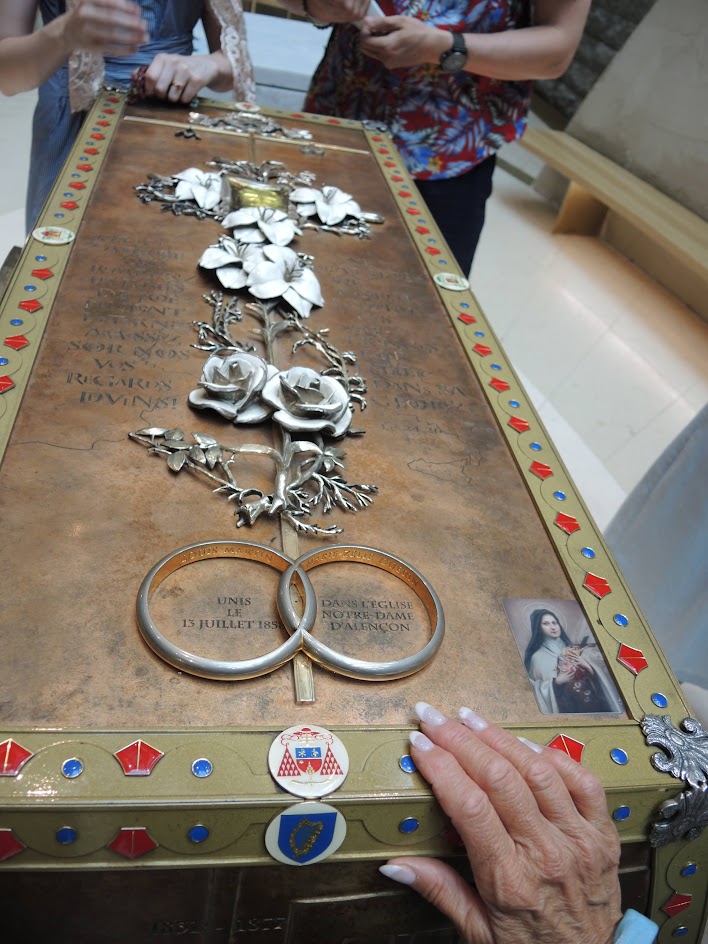
The reliquary is a masterwork of gilded bronze and blue enamel. It doesn’t look like the typical heavy stone sarcophagus we have seen at basilicas but rather, it looks like a treasure chest. Thérèse always said, “The Good God gave me a father and a mother more worthy of Heaven than of earth.” By placing them in the Crypt, the Church literally made them the foundation of this heavenly edifice. The ornamentation of the lid tells the story: it began by a simple “Yes” between a man and a woman in 1858 as represented by the two wedding rings at the base. Rising from the rings are the roses, the bloom of the “Little Flower” that came from that union. It reflects her promise to let fall a shower of roses from heaven. Above the roses are the lilies, the traditional symbol of French saints and purity, representing the ancestry of the French piety that the Martin family was so deeply rooted in. Directly above the lilies, you will see the Chi-Rho, which looks like a “P” with an “X” through it. It is one of the earliest forms of a christogram, representing the name of Christ. Flanking the Chi-Rho are the Greek letters Alpha and Omega symbolizing that God is the Beginning and the End. This signifies that the story doesn’t end with the family; it ends with God, who is found at the end of their journey.
The Campanile: The Voice of the Basilica
As we completed our time and stepped out into the late afternoon waiting for our bus, we had time to observe the distant belltower. The bell tower (the Campanile) is the exclamation point of the Basilica visit. It stands detached from the main building, reaching 150 feet into the Normandy sky, and it houses one of the most impressive carillons in Europe. While the featured interior mosaics are the silent sermon of the Basilica, the bell tower is its voice. It contains 51 bells. The largest of them, the “bourdon,” weighs a staggering 9 tons.
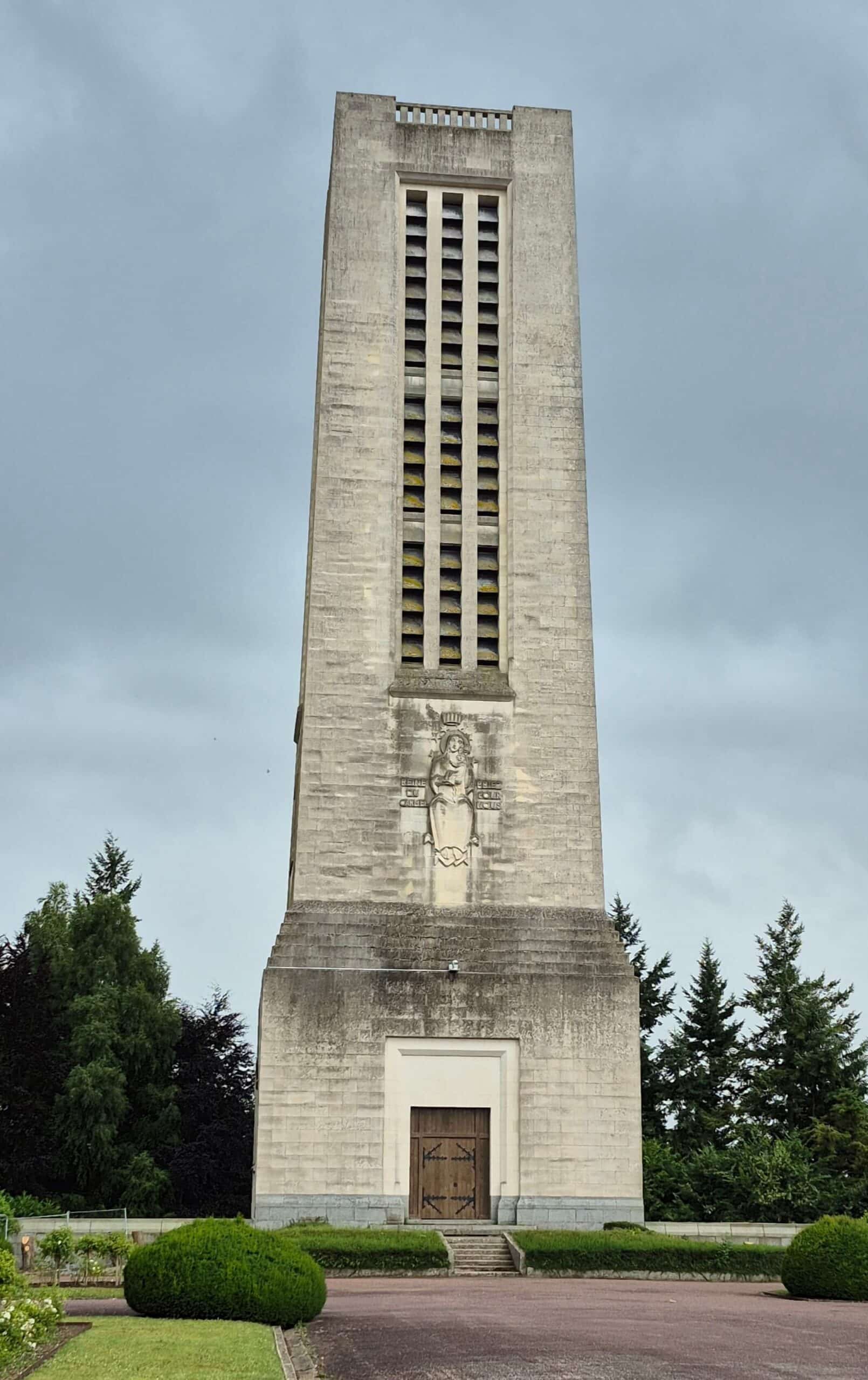
Thérèse once wrote about how much she loved the sound of church bells in Lisieux and how they called the soul to prayer throughout the day. The tower ensures that her “Little Way” isn’t just a quiet, interior path, but one that rings out over the entire valley–quite the contrast to the quiet life of the Carmelites!
The bell tower was built in the 1960s, separate from the main body of the Basilica, and was inaugurated in 1975. The original architectural plan called for it to rise to a greater height and to be topped by a lighthouse structure. However, it was never completed to that original design. It was a conscious decision of charity over architecture. The funds originally earmarked to complete the Basilica’s great tower were instead redirected toward a more practical monument: the Foyer Louis et Zélie Martin. Originally conceived as a sanctuary for the sick and infirm in honor of Thérèse’s parents, this place remains today a place of specialized hospitality, ensuring that those travelling pilgrims seeking the help of Therese in their healing are given special accommodations for their stay. It is a profound realization that the most ‘finished’ work of a Christian life is rarely something tangible, but the sacrifice made for others. Indeed, beauty is often unfinished: Much like the church’s own truncated tower, Thérèse’s life was cut short at twenty-four, yet both reached a height that complete structures rarely attain, a reminder that not every great work is completed in the way we expect.
An Unexpected Additional Stop
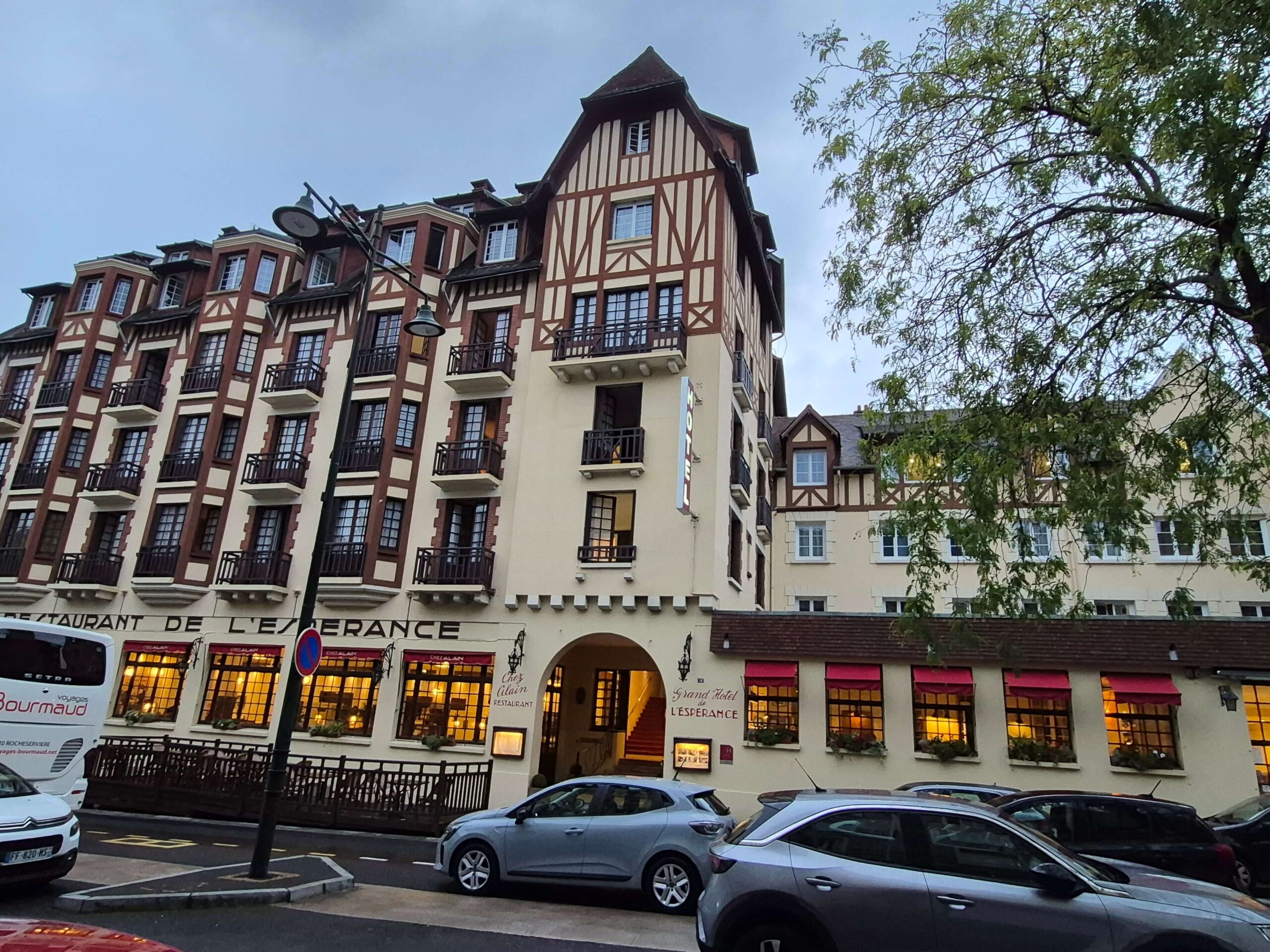
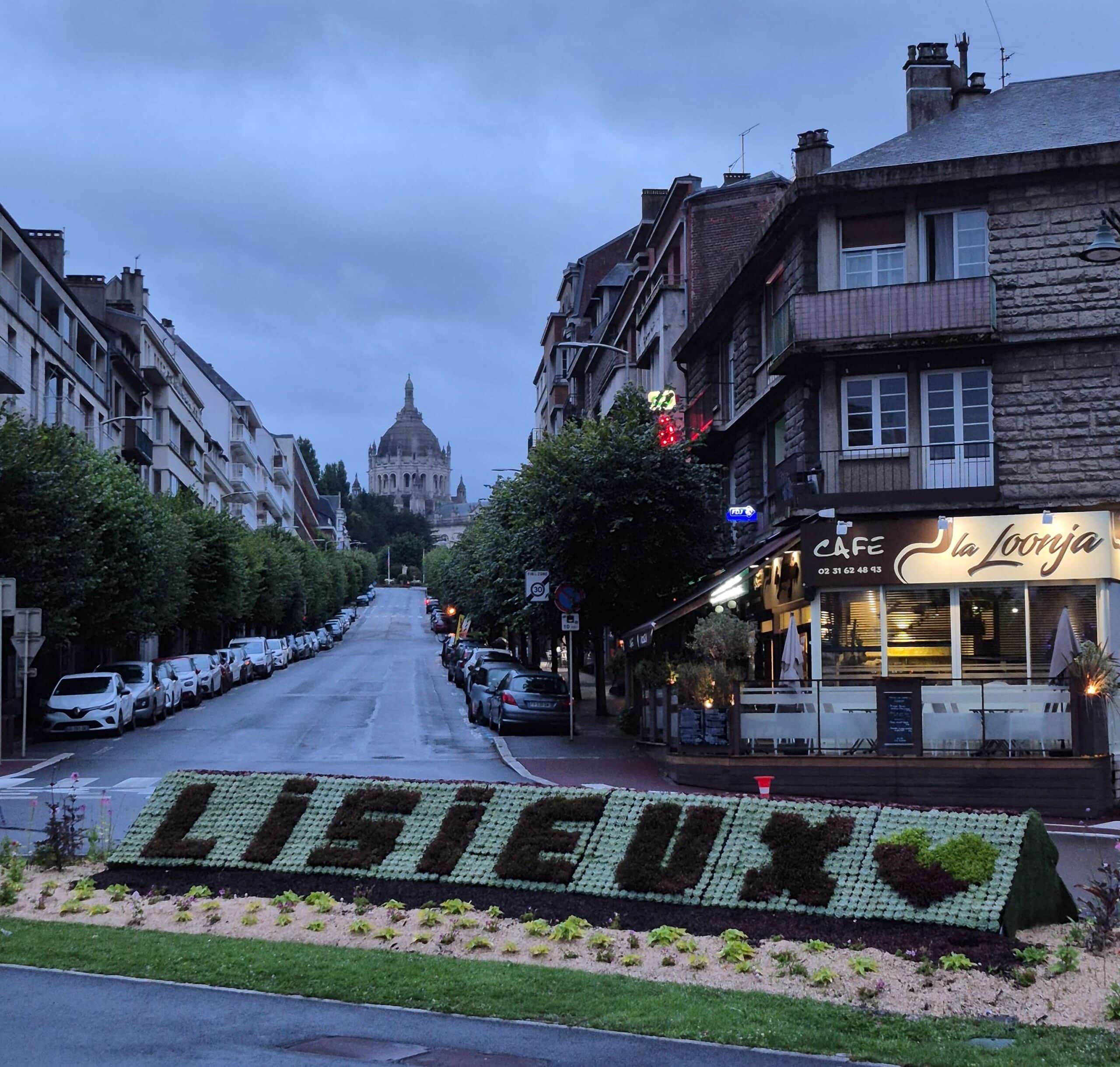
After an afternoon exploring the life of St. Therese culminating with the Basilica, I thought Lisieux had revealed all its secrets. After we had a dinner at our Normanesque hotel, the Grand de L’esperance, I had some time after to wander the quiet streets after dinner. I was just hoping to spend some time to explore and feel the French cultural vibe of a downtown area since so had seen so much of the sacred, and so little of the “profane” (as it were).
A Mystery Unfolds in the Twilight of Lisieux
Before it got dark, I stumbled across this magnificent old church. Unlike the Basilica, which stands on a hill and demands to be seen, this church felt like a secret the town was keeping. It was a majestic stone edifice similar to many of the other great medieval churches we had stopped at, yet as I walked around its perimeter, I was struck by the silence. Strangely, there was no signage, no sign of use. It stood there in the twilight, beholding a building that seemed to be holding its breath.
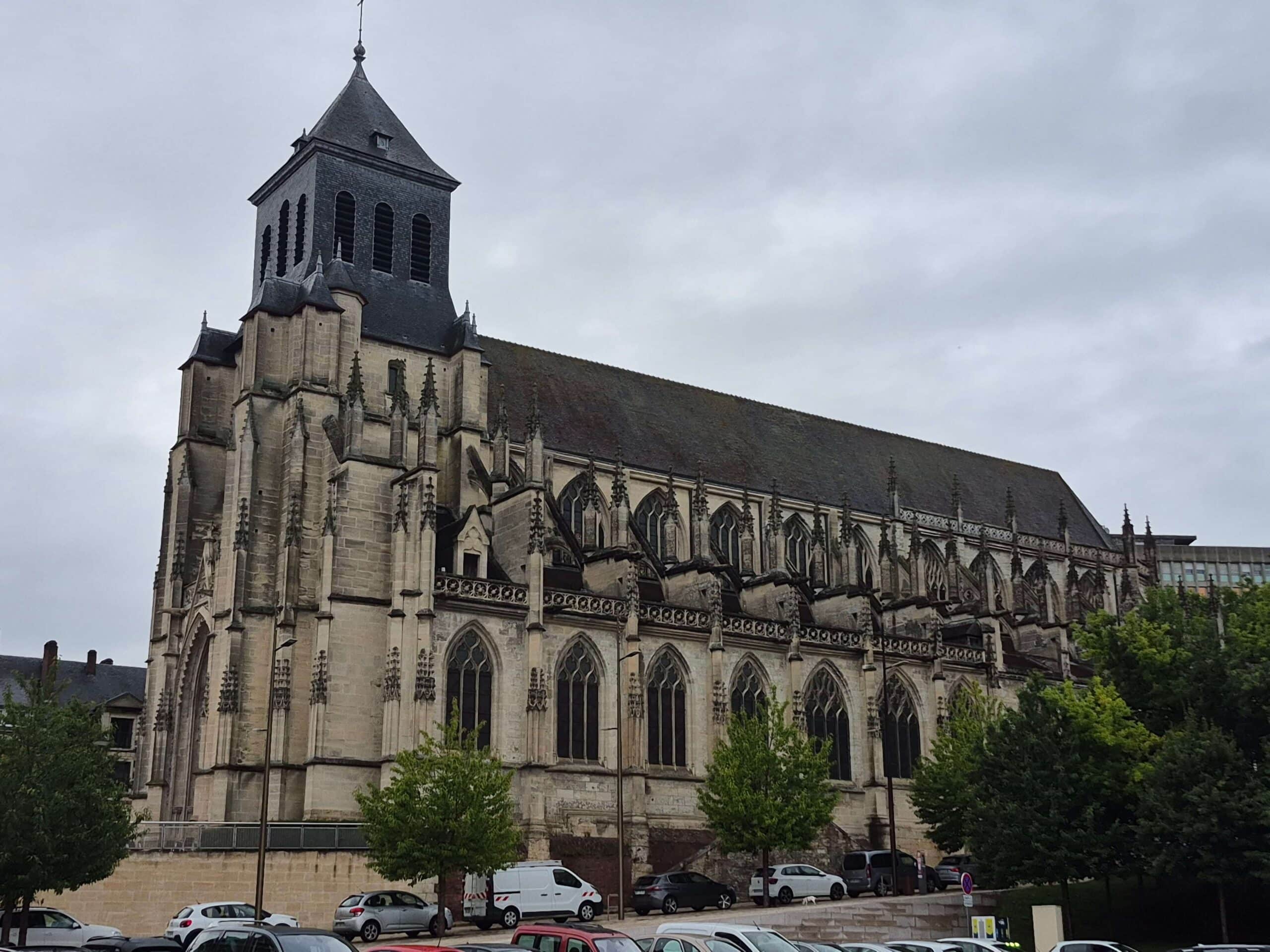
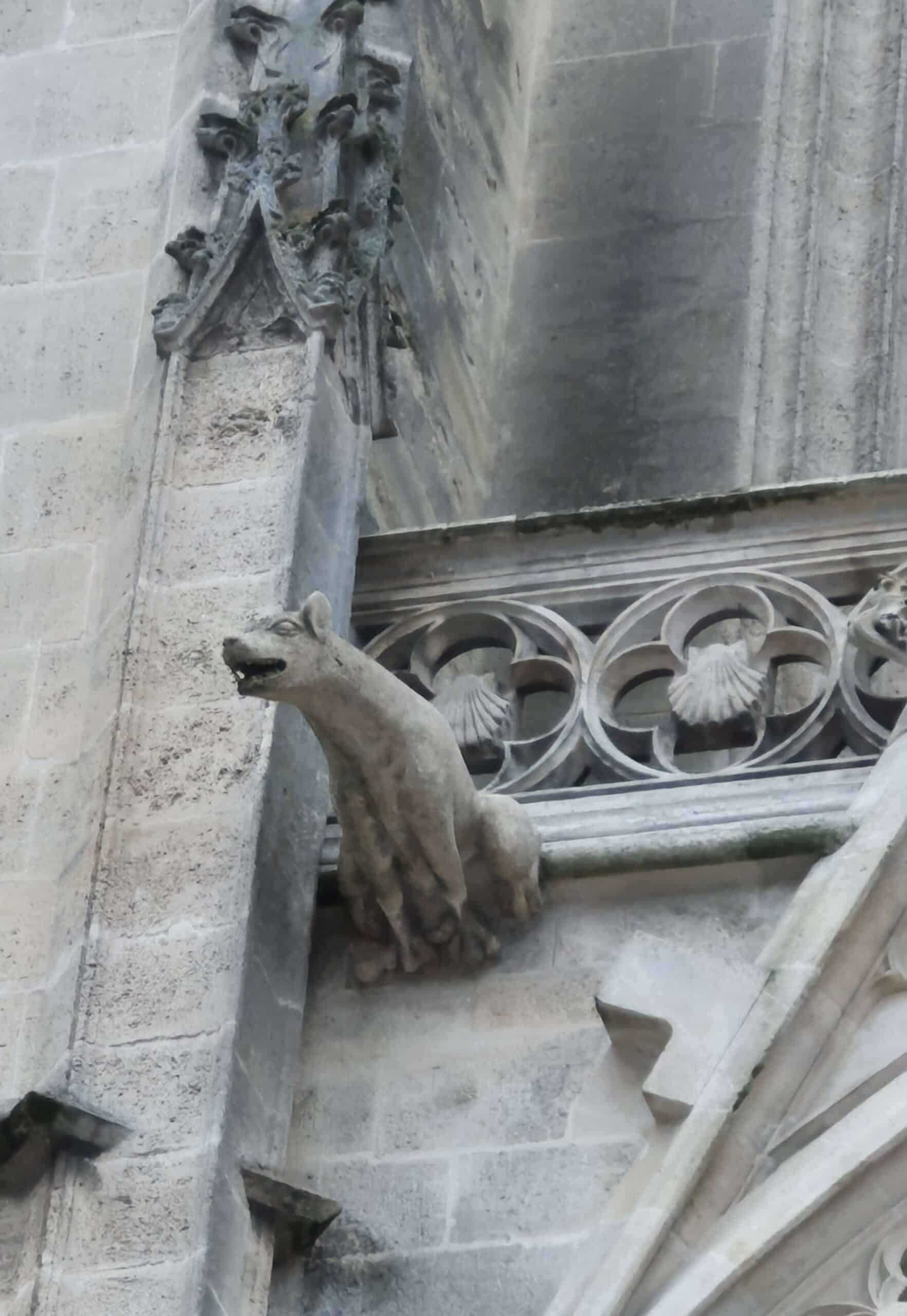
As it happened, I wasn’t the only one drawn to explore the emerging shadows of Lisieux. I was joined by a like-minded pilgrim also out for a stroll, and together we stood like two detectives at a crime scene of history, standing in awe of the flying buttresses—those skeletal stone arms that seemed to be straining to hold the roof against the weight of many centuries. As Gothic as any church we had seen, the great Gargoyles leaned out from the building, frozen in mid-snarl, their weathered faces as expressive than any mosaic we had seen earlier. We returned to our respective hotel rooms, still wondering how it was possible that such an impressive building was seemingly abandoned!
Unravelling the Mystery of a Forgotten Church
I had to know more about the story of this mysterious building. Back in my room, I fired up my laptop and was able to quickly learn its name and happily discover its important role in the story of Therese. This church was the former Église Saint-Jacques, the backdrop of her daily life as a place the Martin family frequently went for daily mass.
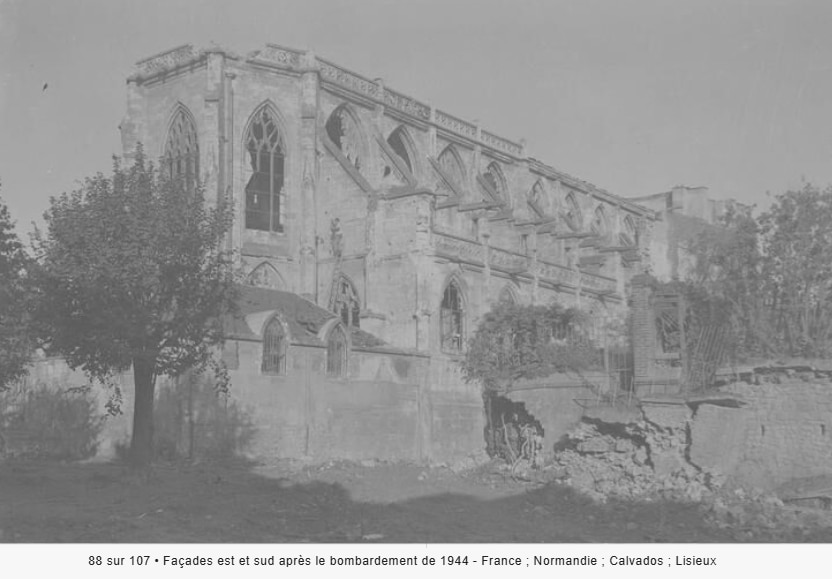
Saint-Jacques was the site of a life-changing moment for her sister, Pauline (who became Thérèse’s “second mother” after Zélie died). On February 16, 1882, while Pauline was praying before the statue of Our Lady of Mount Carmel in a side chapel at Saint-Jacques, she received a sudden, clear inspiration to become a Carmelite. This moment set the “domino effect” in motion for the Martin family; Pauline’s entrance to the cloister eventually paved the way for Thérèse and three other sisters to follow. During the heavy Allied bombings of 1944, Saint-Jacques was heavily damage by fire. However, the statue of Our Lady of Mount Carmel that Pauline prayed before was miraculously recovered from the ruins, a singular witness to the family’s faith that survived the devastation of the parish.
When fifteen-year-old Thérèse decided she was ready to enter the Carmel, her greatest obstacle wasn’t just her age—it was a priest. Father Delatroette, the pastor of Saint-Jacques, was also the ecclesiastical superior of the Carmel. He was a formidable, stubborn man who flatly refused to let her enter so young, famously saying, “I am the delegate of the Bishop; as far as I am concerned, I will not hear of your entering the Carmel until you are twenty-one!” Thérèse in her audacity would famously go over his head to the Bishop and to the Pope to override this objection.
At St. Pierre, she learned the majesty of the Liturgy; at St. Jacques, she faced the human obstacles to her vocation. One was her home of worship, the other was her field of spiritual battle. Saint-Jacques is like that forgotten Great Uncle who stayed in the village—the one who saw Thérèse grow up and remembers the town before the gold-tiled Basilica arrived on the hill.
While the Basilica was being completed in the 1950s to celebrate a modern saint, Saint-Jacques was entering its long silence. The church was officially desacralized (deconsecrated) in 1965. It ceased to function as a place of worship following the administrative merger of the communes of Lisieux and Saint-Jacques. Unlike many surrounding buildings, this historical structure had survived. While it was faithfully restored after the war, the restoration was largely focused on preserving its architectural heritage rather than its parish life. As the massive Basilica of Sainte-Thérèse was completed (consecrated in 1954), it became the new spiritual center of the city. The town’s religious activity shifted toward the hill and the nearby 12th-century Saint-Pierre Cathedral, where the Martin family attended Sunday Mass, leaving the aging, war-weary Saint-Jacques without a large enough congregation to sustain it.
After its closure in 1965, the building was used for decades as a storage facility for the municipal museum. Eventually, the city realized its value as a living monument. Today, it is known as the Halle Saint-Jacques, having been converted into a cultural space for art exhibitions, concerts, and community events. Whether out of embarrassment or for aesthetics, this purpose remains hidden to the casual observers like us.
Whispers of Stone: Great Ways and Little Ways
As the bus pulled away from our hotel the next morning, I found myself thinking about the two versions of Lisieux I had just encountered. On the hill, there was the Gold: the five million tiles, the global chapels, and the “High Glory” of a Saint who promised a shower of roses. In the downtown, there was the Grey: the weathered stone featuring the gargoyles of St. Jacques, the empty nave, and the weight of five hundred years of history.
Scrolling through my photos as the bus hummed toward our next destination, I realized that these stones were telling an interwoven generational story. The ‘Little Way’ of the Daughter was only possible because it was built on the older foundation of the Grandmother at Sainte-Anne-d’Auray, and nurtured by the Mother at Chartres, whose soaring ‘Grand Way’ provided the enduring spiritual architecture of the faith. Only then could the ‘Little Way’ of Thérèse truly bloom.
With the pilgrimage unfolding wonderfully, I felt a shower of roses falling upon us, even as the next stop called to us from the road ahead…
⚜ ⚜ ⚜ ⚜ ⚜ ⚜ ⚜ ⚜
Did you miss Parts I and II of this pilgrimage series?
Sacré-Cœur: From the Roman Shadow Blooms the Fleur-de-Lis-Part I
Salt and Silk: A Tale of Two Abbeys-Part II
References and Further Reading
The Apparitions & Ancestry of St. Anne
- Patrick Huchet, Sainte-Anne-d’Auray: Histoire d’un Sanctuaire en Bretagne. The definitive history of the 1625 apparitions to the peasant Yves Nicolazic and the subsequent building of the sanctuary.
- The Official Sanctuary of Sainte-Anne-d’Auray Archive. Documentation on the discovery of the ancient wooden statue and the history of the Pardons (the traditional Breton pilgrimages).
- Anatole Le Braz, The Land of Pardons. A classic 19th-century exploration of Breton spirituality, capturing the rugged, ancient atmosphere of the Normandy area before the modern era.
- Tradition of the Church, The Protoevangelium of James. The 2nd-century apocryphal text that provides the primary narrative of Anne and Joachim, establishing the “Grandmother” role in the Christian imagination.
- Desiré De Haerne, The Basilica of Sainte-Anne-d’Auray. An architectural breakdown of the 19th-century Basilica, its Renaissance influences, and the symbolism of the Scala Sancta (the Sacred Stairs).
The Architecture and Story of Chartres
- Jean Villette, The Story of Chartres Cathedral. A comprehensive guide to the transition from Romanesque to Gothic and the “miraculous” rebuilding of the cathedral after the fire of 1194.
- Otto von Simson, The Gothic Cathedral: Origins of Gothic Architecture and the Medieval Concept of Order. A foundational study on how medieval builders used Sacred Geometry and the Theology of Light to manifest the “Heavenly Jerusalem” on earth.
- Malcolm Miller, Chartres Cathedral. Written by the cathedral’s most famous guide, this book offers a masterclass in reading the stone portals and the vertical ascent of the nave.
- Colette Deremble, The Stained Glass of Chartres: Reading a Medieval Masterpiece. An exploration of the narrative windows, specifically the “Blue Virgin” (Notre-Dame de la Belle Verrière).
- Louis Grodecki, The Stained Glass of Chartres. A technical and artistic study of the 13th-century glass that survived centuries of war to remain the most complete collection in the world.
- E. Jane Burns, The Sanctity of the Veil: The Sancta Camisia at Chartres. A history of the cathedral’s most precious relic, the tunic worn by Mary at the birth of Christ, and its impact on the church and France.
- The Cathedral of Notre-Dame de Chartres (Official Site). Detailed theological reflections on the Labyrinth, the Crypt of Saint-Lubin, and the devotion to Mary as the Seat of Wisdom (Sedes Sapientiae).
- Émile Mâle, The Gothic Image: Religious Art in France of the Thirteenth Century. This is the “Bible” of medieval iconography. It explains how the Mother Church used statues and glass to teach the Bible to a world that couldn’t read.
The Life and Writings of St. Thérèse
- Thérèse of Lisieux, Story of a Soul: The Autobiography of St. Thérèse of Lisieux. The definitive primary source for the “Little Way,” written within the walls of the Carmel.
- The Archives of Carmel of Lisieux (Online Edition). A massive digital repository of her letters, poems, and photos, providing the intimate “daughter” details of her life.
- Robert Ellsberg, The Saints’ Guide to Happiness. Includes chapters on Thérèse and the “Little Way” as a modern evolution of the ancient faith found in places like Chartres.
Saints Louis and Zélie Martin
- Fr. Stéphane-Joseph Piat, The Martin Family: The Family of St. Thérèse of Lisieux, 2016. This is the definitive biography of the Martin family. As a foundational text in Catholic spirituality, it was reprinted a few times.
- Louis and Zélie Martin, A Call to a Deeper Love: The Family Letters of the Parents of St. Thérèse, 2011. This remains the standard collection of Martin family correspondence and is still the primary edition used by researchers and pilgrims.
The Basilica of Therese
- Sanctuaire de Lisieux (Official Site). Detailed guides on the symbolism of the Nave mosaics, the Reliquary of the Saints, and the bell tower.
- Fabrice Maze, The Basilica of Saint Thérèse of Lisieux. A look at the 20th-century construction by the Cordonnier family and the specialized “Reverse Method” used for the five million mosaic tiles.
The Hidden History of Saint-Jacques
- The City of Lisieux Cultural Heritage Registry. Information on the Halle Saint-Jacques, its 15th-century Flamboyant Gothic architecture, and its transition from a parish church to a cultural space in 1965.
Editorial Note: This article is a synthesis of tour guide insights, historical records, and personal observations gathered during a pilgrimage with the Institute of Christ the King Sovereign Priest. The historical context was compiled with the assistance of Gemini and the official archives listed above.